Monolith to Microservices: The migration strategy that unlocks cloud-native agility
Microservices architecture decomposes applications into small, loosely coupled services aligned with specific business capabilities. Each service operates independently, with its own codebase, database (where appropriate), and deployment pipeline.

Introduction
In an era where digital agility defines competitive advantage, many enterprises find themselves constrained by legacy monolithic applications. These systems, once efficient for rapid initial development, now impede scalability, slow innovation, and increase operational costs. The transition from monolith to microservices has become a cornerstone of cloud-native transformation, enabling organizations to achieve greater flexibility, resilience, and speed to market.
This in-depth guide serves as a practical roadmap for decomposing monolithic applications. It delves into proven patterns like the Strangler Fig approach and domain-driven design (DDD), details implementation steps on AWS, addresses common pitfalls, and highlights how Applify’s expertise in cloud migration and cloud modernization can support your journey. With real-world patterns, AWS service integrations, and industry-specific considerations, this article equips technical leaders, architects, and decision-makers with actionable insights.
By the end, you will have a comprehensive understanding of not just the technical “how,” but also the strategic “why” and the partnership model that minimizes risk while maximizing ROI. Whether you’re in healthcare navigating compliance demands or financial services optimizing for performance, this monolith to microservices migration framework is designed for your context.
Understanding monolithic applications and their limitations
Monolithic applications consolidate all business logic, data access, and user interface components into a single, unified codebase and deployment unit. This architecture simplifies early-stage development, testing, and deployment but creates compounding problems as the application grows in complexity and user base.
Core limitations include
- Development velocity bottlenecks: Any code change, no matter how small, requires rebuilding, testing, and redeploying the entire application. This leads to lengthy release cycles and coordination overhead across large teams.
- Scalability inefficiencies: Horizontal scaling requires replicating the full monolith, even if only one module experiences high load, resulting in wasted resources and higher cloud costs.
- Technology rigidity: Introducing new languages, frameworks, or libraries becomes prohibitively expensive due to tight coupling.
- Single point of failure: Bugs or performance issues in one component can cascade and bring down the entire system.
- High maintenance and onboarding costs: Accumulated technical debt makes the codebase difficult to understand, increasing the ramp-up time for new developers and raising long-term ownership expenses.
- Limited innovation potential: Teams cannot easily experiment with modern cloud-native features such as serverless computing or event-driven architectures.
Many organizations begin with a “lift and shift” cloud migration strategy, moving monoliths to AWS without refactoring. While this provides immediate infrastructure benefits, it rarely addresses underlying architectural debt. True value emerges only through deeper modernization.
The advantages of microservices architecture
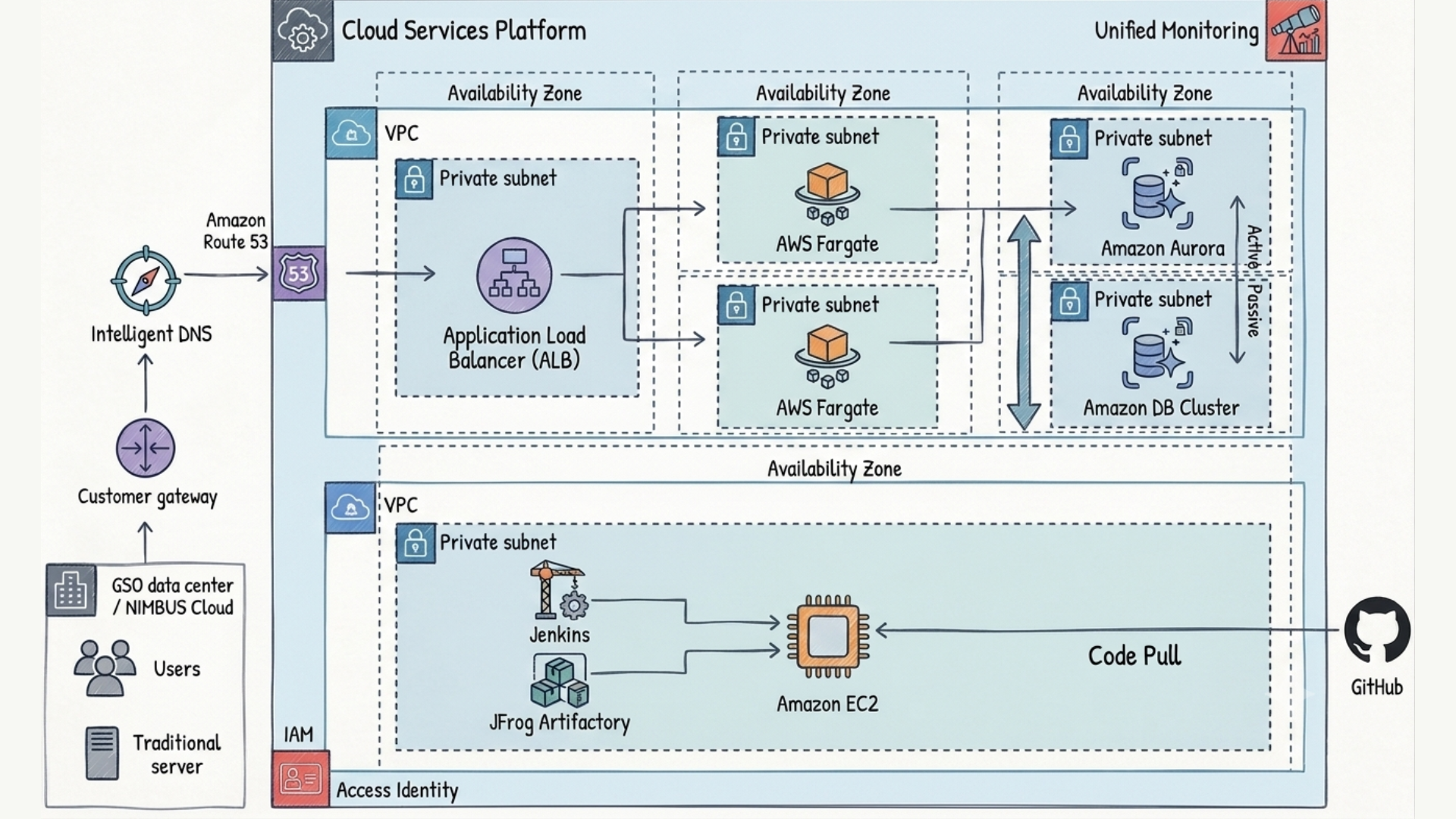
Microservices architecture decomposes applications into small, loosely coupled services aligned with specific business capabilities. Each service operates independently, with its own codebase, database (where appropriate), and deployment pipeline.
Key benefits that drive adoption
- Independent scalability and deployment: Scale individual services based on demand and deploy updates without affecting the rest of the system.
- Accelerated development and innovation: Autonomous teams work in parallel, reducing time-to-market for new features.
- Improved fault isolation and resilience: Failures in one service have minimal impact on others when proper patterns like circuit breakers are implemented.
- Technology heterogeneity: Select the optimal stack for each service, Node.js for real-time features, Python for data processing, or Java for enterprise logic.
- Enhanced developer experience: Smaller codebases improve productivity, testing, and maintainability.
- Alignment with cloud-native paradigms: Seamless integration with containers (Amazon ECS/EKS), serverless (AWS Lambda), and managed services for superior agility and cost efficiency.
For enterprises pursuing digital transformation, monolith to microservices migration unlocks these advantages while supporting long-term goals like SaaS productization and operational excellence.
Key challenges in monolith to microservices migration
Despite the benefits, the path is fraught with complexities. Organizations frequently underestimate the effort involved.
Major technical and organizational challenges
- Service boundary identification: Incorrectly defined domains result in “distributed monoliths” with excessive inter-service communication.
- Data management and consistency: Splitting monolithic databases while ensuring transactional integrity and data synchronization is complex. Strategies like database-per-service or saga patterns become essential.
- Inter-service communication: Handling synchronous vs. asynchronous calls, latency, versioning, and failure scenarios requires robust patterns (API gateways, event buses).
- Legacy code and dependencies: Extracting functionality without breaking existing operations demands careful planning.
- Observability and monitoring: Distributed tracing, logging, and metrics across services add overhead.
- Organizational and cultural shifts: Transitioning to DevOps, cross-functional teams, and ownership models often requires significant change management.
- Cost and risk management: Initial refactoring investments can be high, and a failed big-bang approach risks business disruption.
Successful migrations prioritize incremental progress over wholesale replacement.
Proven migration patterns: Strangler Fig and domain-driven design
Effective decomposition relies on established patterns.
The Strangler Fig pattern
Martin Fowler’s Strangler Fig pattern draws an analogy from nature: a strangler fig vine grows around a host tree, eventually replacing it entirely. In software, new microservices are built incrementally around the monolith, with traffic gradually rerouted until the legacy system can be decommissioned.
Implementation steps on AWS
- Introduce a facade layer (e.g., Amazon API Gateway) in front of the monolith.
- Identify extractable features and build corresponding microservices.
- Route specific requests to new services while the monolith handles others.
- Expand coverage iteratively.
- Retire monolith components as they become obsolete.
AWS Migration Hub Refactor Spaces is specifically designed to support this pattern, simplifying environment setup, routing, and incremental refactoring.
Domain-driven design (DDD) for effective decomposition
DDD focuses on modeling the business domain to identify bounded contexts, natural seams for microservices. Event storming workshops help visualize processes, aggregates, entities, and value objects.
Practical DDD application
- Collaborate with domain experts in workshops.
- Map bounded contexts and define service responsibilities.
- Implement anti-corruption layers to protect new services from legacy complexities.
- Ensure services remain focused on single business capabilities.
Combining DDD with Strangler Fig delivers technically sound and business-aligned services.
Step-by-step guide to monolith to microservices migration
A disciplined, phased approach minimizes risk:
- Comprehensive assessment: Inventory code, dependencies, performance bottlenecks, and business priorities. Use tools for static and dynamic analysis.
- Domain modeling and prioritization: Apply DDD and event storming to identify high-value candidates for extraction (e.g., frequently changing or high-load modules).
- Establish the strangler facade: Deploy Amazon API Gateway or AWS App Mesh for intelligent routing.
- Incremental extraction and refactoring: Containerize components or rewrite as microservices using Amazon ECS, EKS, or Lambda. Leverage AWS App2Container for legacy code.
- Data modernization: Design schemas for new services, implement change data capture (CDC) with AWS DMS, and manage consistency with sagas or eventual consistency.
- Communication and integration: Adopt Amazon EventBridge, SNS, SQS for events, and service meshes for traffic management.
- Implement observability: Integrate Amazon CloudWatch, X-Ray, and third-party tools for end-to-end visibility.
- Automated testing and CI/CD: Use contract testing, canary/blue-green deployments, and pipelines with AWS CodePipeline.
- Performance tuning, monitoring, and decommissioning: Measure KPIs, optimize, and retire legacy code.
Iterate frequently, delivering business value at each step.
Leveraging AWS for monolith to microservices transformation
AWS offers a mature ecosystem tailored for modernization:
- Compute and orchestration: Amazon ECS with Fargate, Amazon EKS, and AWS Lambda for flexible execution models.
- Networking and service discovery: Amazon API Gateway, AWS App Mesh, and VPC Lattice.
- Data and storage: Amazon RDS, Aurora, DynamoDB, and migration tools like AWS DMS.
- Modernization accelerators: Migration Hub Refactor Spaces, the AWS Well-Architected Framework, and automation services.
- Security and compliance: IAM, AWS WAF, and services supporting HIPAA, PCI DSS, etc.
These capabilities enable hybrid operations during transition and support industry-specific needs in healthcare and finance.
How Applify supports your monolith to microservices journey
We specialize in end-to-end cloud migration and modernization. Our experienced teams guide enterprises through assessment, pattern application, AWS implementation, and post-migration optimization.
Our case study on successful migration from on-prem to cloud demonstrates tangible results in agility, cost savings, and compliance.
Best practices and considerations for success
- Begin with low-risk, high-value features.
- Prioritize automated testing, observability, and security from day one.
- Foster cross-functional collaboration and cultural alignment.
- Continuously monitor costs, performance, and technical debt.
- Address data consistency thoughtfully and plan for rollback scenarios.
- Tailor strategies for regulated sectors, review cloud security in healthcare and financial services.
Embrace cloud-native agility with Applify
The journey from monolith to microservices is challenging yet highly rewarding. By leveraging the Strangler Fig pattern, domain-driven design, and AWS’s powerful services, organizations can transform legacy constraints into competitive strengths.
Our team brings decades of experience to make this transformation predictable and successful. Contact us today via our cloud migration ebook or schedule an expert consultation.
You may also like