.png)


Introduction
If AWS Partner Revenue Measurement has come up on more than one partner call recently, that is not a coincidence. AWS is closing the gap between partners who influence customer spend and partners who can actually prove it, and July 31, 2026 is the date most of the partner ecosystem has converged on as the operational cutoff.
What you will learn
- What AWS Partner Revenue Measurement actually measures and how the tagging mechanism works
- How PRM connects to ACE, Partner Central, and AWS Marketplace
- The three implementation methods and which one fits which kind of infrastructure
- The prerequisite chain that quietly blocks most partners before they even start tagging
- A short checklist for what to verify this week
What AWS Partner Revenue Measurement actually does
AWS Partner Revenue Measurement is AWS reading a specific tag on customer resources and using it to decide which partner gets credit for the resulting spend. The tag key is aws-apn-id, and its value follows the format pc:<marketplace-product-code>, where the product code comes from the partner's AWS Marketplace listing. Tagged spend counts toward a partner's attribution. Untagged spend does not, regardless of how real the engagement behind it was.
PRM now sits underneath a newer capability called revenue attribution, which associates a partner's AWS Marketplace offers and ACE opportunities to a specific Marketplace product listing so AWS can determine the revenue those offers and opportunities generated. PRM is the foundation that captures total attributed revenue across a partner's products or service delivery engagements, and revenue attribution is the deal-level layer sitting on top of it, mapping revenue to specific offers and opportunities rather than just aggregate consumption.
That distinction matters. A partner can be fully PRM compliant at the infrastructure level and still be leaving deal-level detail on the table if revenue attribution has not been layered in on top.
How PRM connects to ACE, Partner Central, and Marketplace
AWS Partner Revenue Measurement does not live in isolation. It is one piece of a wider measurement stack that AWS has been building out across its partner programs, and understanding those connections is what makes the deadline feel less like an isolated compliance task.
ACE is the AWS Customer Engagements program, AWS's co-sell pipeline platform inside Partner Central, and partners use it to share opportunities with AWS, receive AWS-originated leads, and track deal progress. In 2026, ACE activity became mandatory for AWS Specialization renewals, which means a partner's PRM and ACE data are now both feeding directly into whether that partner keeps the specializations it already earned.
Partner Central is where all of this surfaces for the partner. AWS launched an Attributed Revenue dashboard inside Partner Central that gives partners self-service visibility into the revenue impact of their solutions as measured by PRM, displaying aggregated monthly attributed revenue by partner product, AWS service, and billing period, and consolidating insight from all three PRM capabilities, Resource Tagging, User Agent String, and Marketplace Metering, in a single view. If your Partner Central account is not correctly linked and migrated, none of this data will surface correctly even if your tagging is technically sound.
Cloud teams already deep in AWS partnership work tend to find this stack easier to navigate, since the underlying account linkage and Marketplace listing work overlaps heavily with what is already required for co-sell eligibility.
AWS Marketplace is where the product code that makes tagging possible actually comes from, and it is also where one of the three attribution methods, Metering, operates automatically once a listing is live.
Key dates partners need to know
July 31, 2026 is the date the broader partner ecosystem, consultancies, advisors, and partner program guidance, has converged on as the operational deadline. Partners holding the AWS AI Competency are being asked to have at least one AI service tagged under PRM by May 31, 2026.
The 3 AWS Partner Revenue Measurement attribution methods
PRM supports three implementation methods, and a partner can run more than one at the same time depending on the resource type.
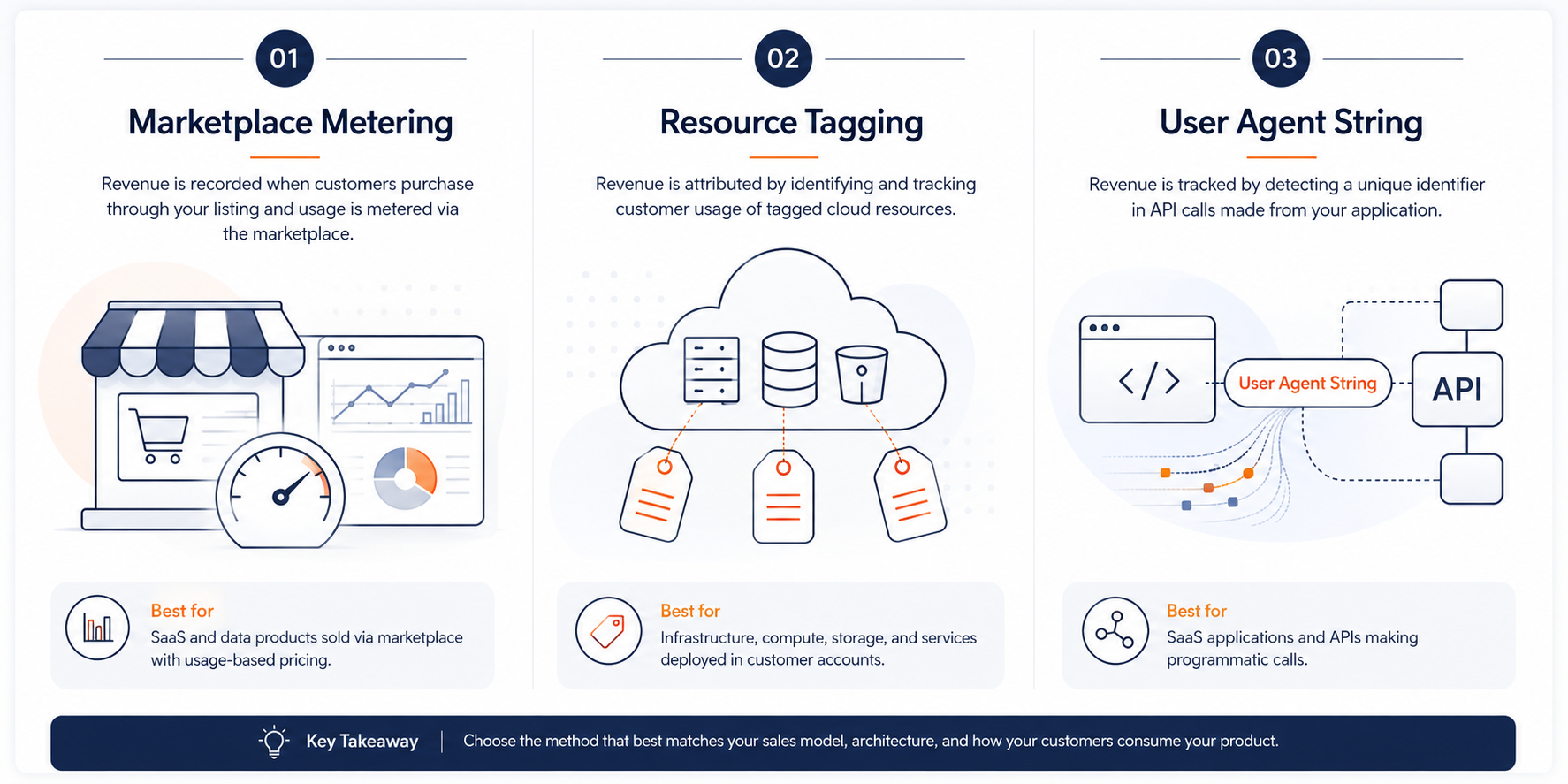
Table comparing the three AWS Partner Revenue Measurement attribution methods, Marketplace Metering, Resource Tagging, and User Agent String
A short note before the table, since each method fits a different part of a typical delivery stack.
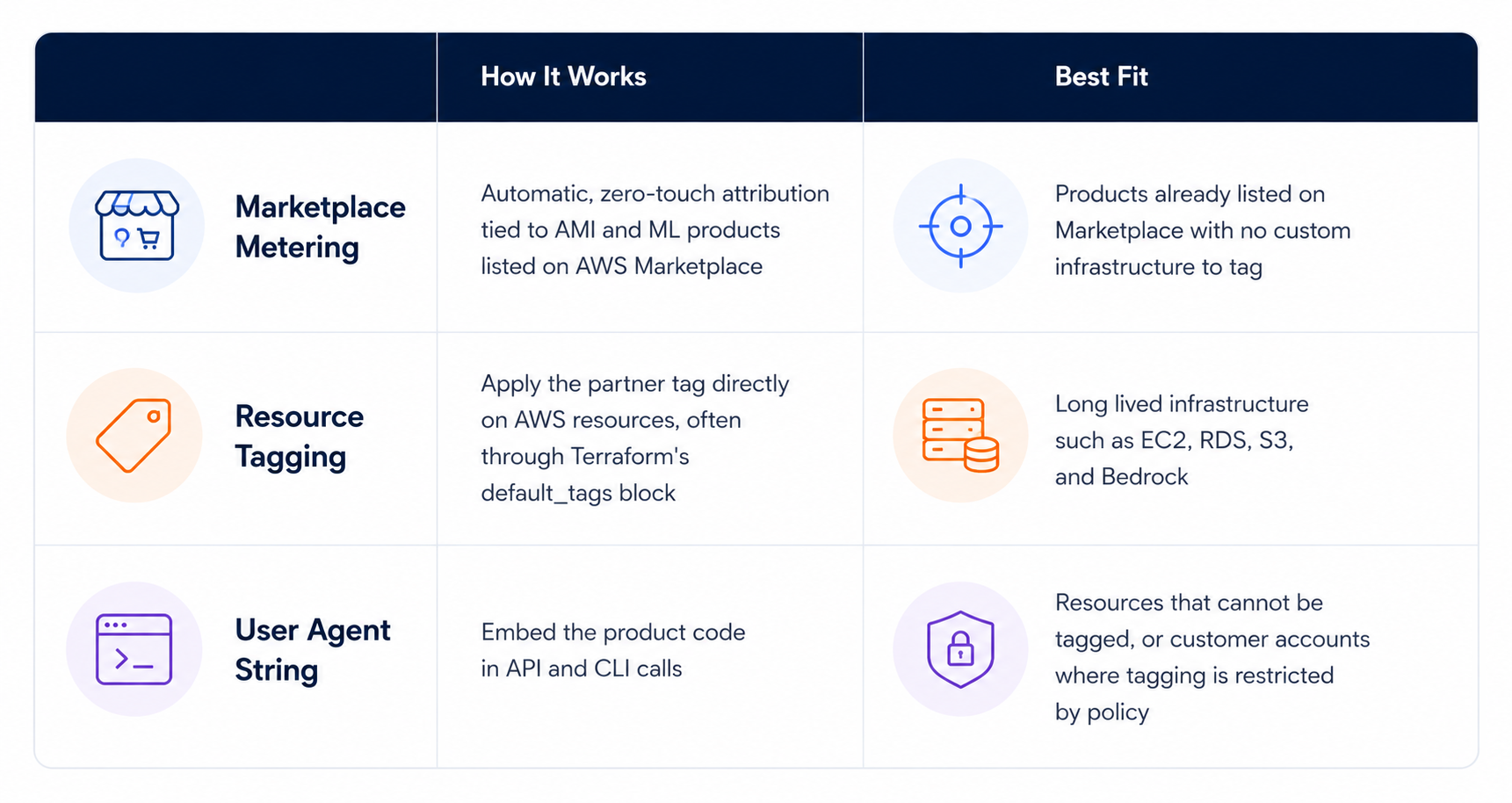
Diagram showing where each PRM attribution method fits across a typical partner delivery stack
Marketplace Metering now covers Amazon EC2 and Amazon SageMaker AI specifically, after AWS expanded the capability in April 2026 to automatically measure consumption when customers purchase and use AMI and ML products through Marketplace, without requiring any additional partner-side implementation.
User Agent String has a catch worth flagging clearly. Attribution under this method only continues if there is at least one qualifying API call per resource every month, which makes it a poor fit for quiet, steady state infrastructure that does not generate frequent API traffic.
How much retrofitting a given environment needs often comes down to how it was built in the first place. A workload that arrived through a straightforward lift and shift vs replatform vs refactor migration path carries very different tagging debt depending on which of those three approaches was used, and it is worth checking that history before assuming Resource Tagging will be a clean, one-time pass.
The prerequisite chain nobody budgets time for
Tagging looks like a 5-minute task until it becomes clear it sits at the end of a dependency chain. Four things need to be true before a single resource can carry the tag correctly.
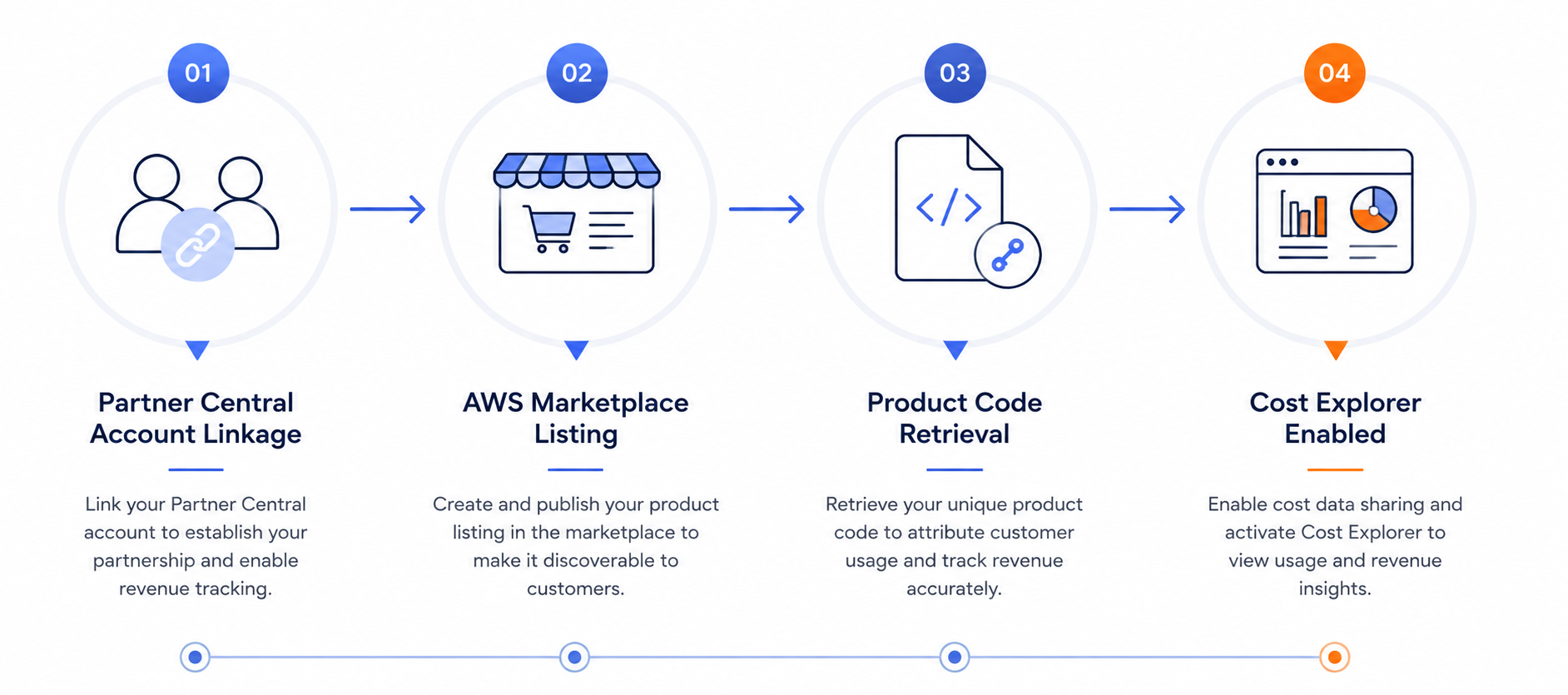
Flowchart of the four prerequisites required before AWS Partner Revenue Measurement tagging can begin
- Partner Central account linkage. The linked account is used for APN funding eligibility and the migration to the new Partner Central experience, and it is also billed for the annual APN membership fee, so this step is rarely owned by the same team that eventually does the tagging.
- An active AWS Marketplace listing. A listing is required to obtain the product code used in attribution, and listing approval has its own review cycle that is not fully in a partner's control on timing.
- Retrieval of the actual product code. This is the value half of the tag, and partners should be careful here, since the product code is a long alphanumeric string and is not the same as the Product ID or the UUID-formatted product ID shown elsewhere in the Marketplace listing.
- Cost Explorer is enabled on the linked account. This requires a manual opt-in and is not on by default, and in an AWS Organizations setup, member accounts can only access Cost Explorer if the management account has already enabled it, with the management account also able to selectively deny access to specific member accounts.
Partners who check these four items this week still have runway before July 31. Partners who wait for the tagging conversation to force the issue are going to be completing all four steps under real deadline pressure.
What happens if a partner misses the deadline
None of the consequences here are about whether the underlying work was real. They are about whether AWS's systems can see it. Partner channel guidance points to reduced co-sell visibility, lower prioritization in AWS seller conversations, impact on partner funding eligibility, and added friction in ACE opportunity motions.
The funding piece is concrete and worth naming directly. ACE unlocks access to partner benefits as partners engage deeper with AWS, including discounts for originating new customer opportunities and access to Marketing Development Funds (MDF) and other partner funding programs, and eligibility for some of these benefits already carries minimum activity thresholds, including a minimum of five launched opportunities transacted within the past 12 months and 15 qualified opportunities in ACE within the same window. This kind of activity gating is not unique to PRM either; it echoes how the AWS Migration Acceleration Program ties funding access to demonstrated migration activity rather than intent alone. PRM attribution feeds directly into how consistently a partner clears bars like these going forward.
There is a longer-tail consequence too. As PRM data matures, it becomes a real input into how AWS segments and prioritizes its partner ecosystem, including specialization renewals and future program eligibility that has not been announced yet. Partners with clean attribution histories start those conversations ahead. Partners with thin data start behind, even with strong delivery work behind them.
The mistake that quietly costs partners the most
Tagging is not a one-time task; it is a state that has to be maintained, and this is where most partners underestimate the work. A team does a clean first pass, tags everything correctly, and ships it. Weeks later, a developer redeploys a resource from an older module that does not carry the tag block, or rebuilds something manually outside the original pipeline. Nothing visibly breaks. The resource keeps running, the customer keeps paying, and the only casualty is the attribution claim on that spend.
This shows up most often on AI and machine learning workloads specifically, since that is where consumption is growing fastest and where tagging discipline tends to be weakest across the industry. For AI Competency holders working to the earlier internal deadline, a tag that silently falls off a Bedrock or SageMaker workload turns into a competency compliance gap, not just a missed attribution window.
Teams already running structured cloud migration or cloud modernization engagements are in a good position to catch this early, since tag hygiene checks can be folded directly into the same infrastructure as code review process already covering security and cost controls.
A typical rollout pattern
Most partners who get ahead of this deadline follow a similar sequence. They start by auditing existing infrastructure as code modules for missing tag blocks, then add the partner tag to their standard provisioning templates so every new deployment is compliant by default. From there, they retrofit tags onto existing long-lived resources in priority order, starting with the highest volume customer accounts, and finally set up a recurring drift check so tags that fall off during future redeployments get caught within days instead of months. Firms already doing this kind of work inside broader AI and data engagements tend to fold PRM tagging into that same governance layer rather than treating it as a separate project.
What to verify this week
Two checks matter more than anything else in this article.
- Confirm Partner Central 3.0 migration status and account linkage.
- Confirm an active Marketplace listing exists and the product code has been retrieved.
Those two answers reveal more about where a partner actually stands than another hour of documentation reading. If both are already in place, the next move is tagging the highest volume customer accounts first, since that is where attribution gaps cost the most, then working outward toward smaller and legacy infrastructure.
If your team needs a second set of eyes on where these prerequisites currently stand, Applify's team can help build tagging directly into your provisioning pipeline so it survives redeployments instead of quietly disappearing.
What AWS partners actually want to know
What is AWS Partner Revenue Measurement? AWS Partner Revenue Measurement (PRM) is the mechanism AWS uses to attribute customer AWS spend to the partner who influenced it, based on a resource tag or API call pattern tied to a Marketplace product code, rather than partner-reported estimates.
When is the AWS PRM deadline? The broader partner ecosystem is treating July 31, 2026 as the operational deadline. Partners holding the AI Competency are being asked to have at least one AI service tagged by May 31, 2026.
What is the AWS PRM tag key and value? The tag key is aws-apn-id, and the value follows the format pc:<marketplace-product-code>, where the product code identifies the partner's AWS Marketplace listing.
What happens if a partner misses the PRM deadline? Consequences cited across partner channels include reduced co-sell visibility, lower field seller prioritization, funding program impact, and added friction in ACE opportunity motions.
What are the three PRM attribution methods? Marketplace Metering, Resource Tagging, and User Agent String. They can be used together across different parts of the same deployment.
Does AWS Partner Revenue Measurement work with Terraform? Yes. The tag is commonly applied through the AWS provider's default_tags block, which applies it automatically across every resource that provider manages and merges cleanly with existing resource-level tags.
What prerequisites are required before PRM tagging can begin? Partner Central 3.0 migration and account linkage, an active AWS Marketplace listing, retrieval of the Marketplace product code, and Cost Explorer enabled on the linked account.
How is PRM different from ACE? PRM measures and attributes actual AWS consumption. ACE is the co-sell pipeline where partners share and track sales opportunities with AWS. In 2026, ACE activity became mandatory for Specialization renewals, connecting the two more tightly than before.
Why does tagging fail after it was set up correctly the first time? The most common cause is a redeployment from an older infrastructure module that does not include the tag block, which silently removes attribution without any visible error or alert.
Does AWS Partner Revenue Measurement apply to professional services engagements, not just software products? Resource Tagging applies broadly, including to infrastructure deployed via Terraform or CloudFormation as part of a professional services engagement, not only packaged software products.
What is the difference between Resource Tagging and User Agent String for ongoing attribution? Resource Tagging attributes revenue continuously as long as the tag remains on the resource. User Agent String requires at least one qualifying API call per resource every month to keep attribution active.
Can more than one partner be attributed on the same resource? No, only one partner tag is allowed per resource, since an AWS resource can only carry one tag with that key. Multi-partner scenarios are better handled through the User Agent String method instead.
Conclusion
AWS Partner Revenue Measurement is not technically difficult, but it is dependency-heavy and easy to underestimate right up until the deadline is a week away. The partners who come out ahead are treating tag coverage as an ongoing operational discipline, not a box to check once. With July 31 closing in, the smartest move this week is confirming where the prerequisites stand, not waiting for another reminder.