What Is Model Context Protocol (MCP), and Why Does Agentic AI Need It?
Connecting AI agents to business systems raises questions about access, security, and control. Explore how Model Context Protocol (MCP) makes integrations reusable and what it takes to govern the actions your agents can perform.


- MCP standardizes connections between AI applications and external tools, data, and business systems.
- Reusable integrations reduce duplication when multiple agents need the same capabilities.
- MCP works alongside existing APIs, RAG, function calling, and agent frameworks.
- Access control remains your responsibility, including permissions, tool visibility, and approval steps.
- Production agents need logging and evaluation to trace actions and test tool selection, inputs, and failure handling.
- Adopt MCP where reuse justifies it. A direct integration may be simpler for a single, stable workflow.
An AI assistant can read an incident runbook and explain why an application might be failing. A more capable system goes further. It inspects logs, checks a deployment, creates an incident, and notifies your engineering team.
That gap is the whole problem.
An account-research agent needs to pull customer records from your CRM, check open tickets, and read notes from a shared drive. Three systems, three different APIs, three different auth models, three different ways of failing when something goes wrong. Build that by hand and you've written custom integration code for one agent, for one CRM, for one moment in time. Add a second agent that needs the same CRM and you're maintaining two versions of the same wiring.
Model Context Protocol, or MCP, exists to stop that duplication. It gives AI applications one standard way to connect with external tools and data, so your CRM doesn't need a custom integration for every agent that wants to touch it.
Anthropic introduced MCP as an open standard in November 2024, built to connect AI systems with the systems where data and tools already live. The protocol has since grown past its original scope. AI platforms, development environments, infrastructure providers, and agent frameworks all support it now.
What MCP does not do matters just as much as what it does. It will not tell you which agent should have CRM access, or which identity gets to authorize a refund, or whether a risky operation needs a human to sign off first. Those calls stay yours.
What is MCP in AI?
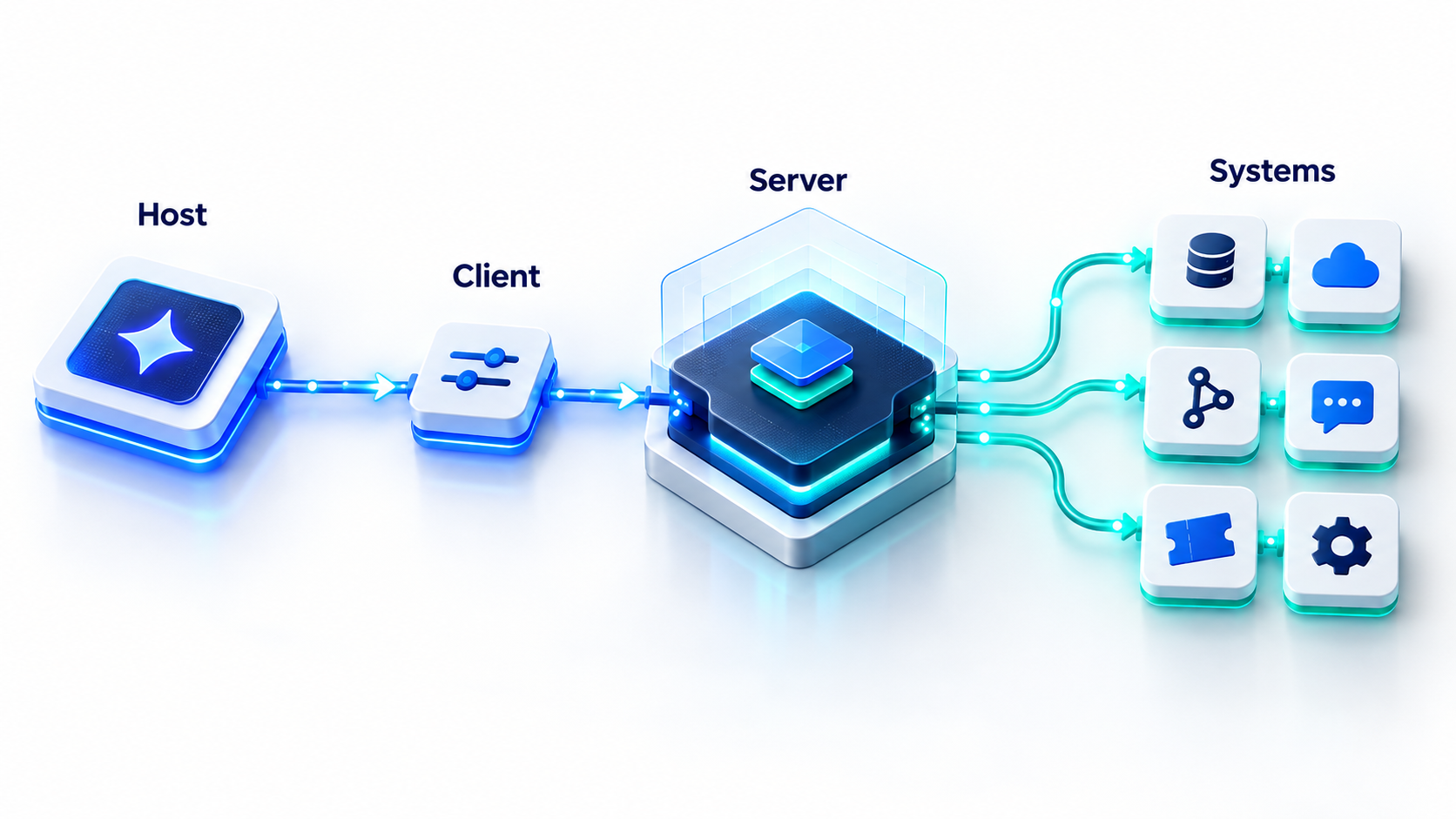
MCP is an open protocol that lets compatible AI applications talk to servers exposing tools, resources, prompts, and other capabilities.
A simplified path looks like this:
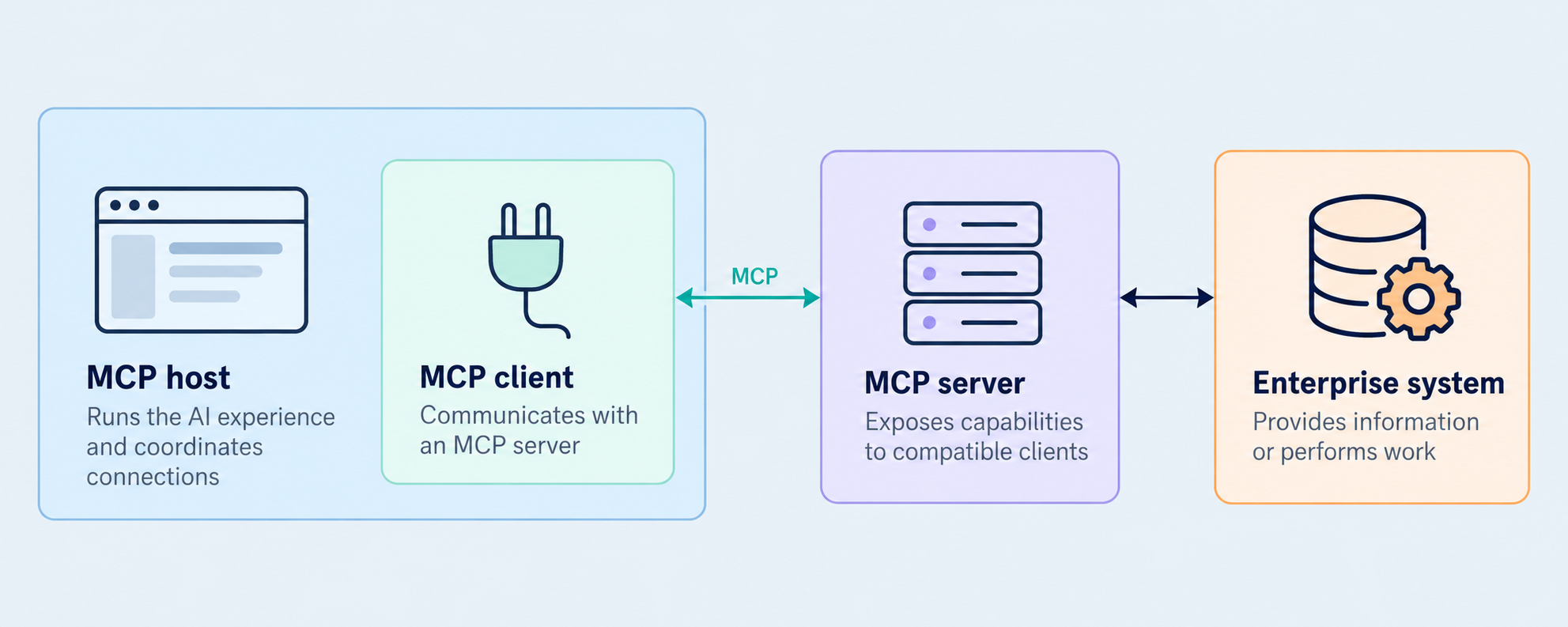
MCP host containing a client that connects to an MCP server, which accesses an enterprise system.
Take the account-research workflow from earlier. The AI application is the host. It creates an MCP client connection to an MCP server that sits in front of your CRM. The agent reasoning runs inside the application, while the MCP client manages the connection to the server. The CRM does not need native MCP support because the server can continue calling the CRM through its existing API or integration layer.
That's the real trick here. MCP creates one shared language at the AI-facing edge, while every system underneath keeps its existing interface untouched. You are not replacing your API estate. You're putting one consistent door in front of it.
The enterprise problem MCP addresses is integration multiplication
One agent talking to one stable internal API rarely needs a new protocol. The math changes once several agents need the same capabilities.
Three agents inside the same company make this concrete: a support agent that needs customer data and ticketing, a sales agent that needs customer data and CRM operations, and an operations agent that needs ticketing and infrastructure data. Look closely and two of them overlap on customer data, and two overlap on ticketing. Build each one by hand and you're solving the same integration problem three separate times, with three separate maintenance paths, three separate places for authentication logic to drift out of sync.
MCP flips this. Expose customer data once, through one reusable server, and every compatible agent that needs it connects through the same protocol. Your integration count stops scaling with your agent count.
MCP separates agent logic from capability integration
Three different pieces of the account-research agent do three different jobs, and none of them should live in the same layer.
The model decides how to reason about the task, the MCP connection decides how the application talks to the CRM, and the CRM itself performs the actual database read.
Separating these gives you real flexibility. Swap the underlying model, and you don't touch the CRM connection. Change how the CRM stores its data internally, and the agent never notices, because the MCP-facing interface holds steady.
That flexibility has a limit, though. It depends entirely on how consistently the client and server both implement the protocol. Treat MCP as an interoperability layer worth building toward, not a guarantee that any client drops into place for any other without engineering work.
Tools, resources, and prompts define what an MCP server exposes
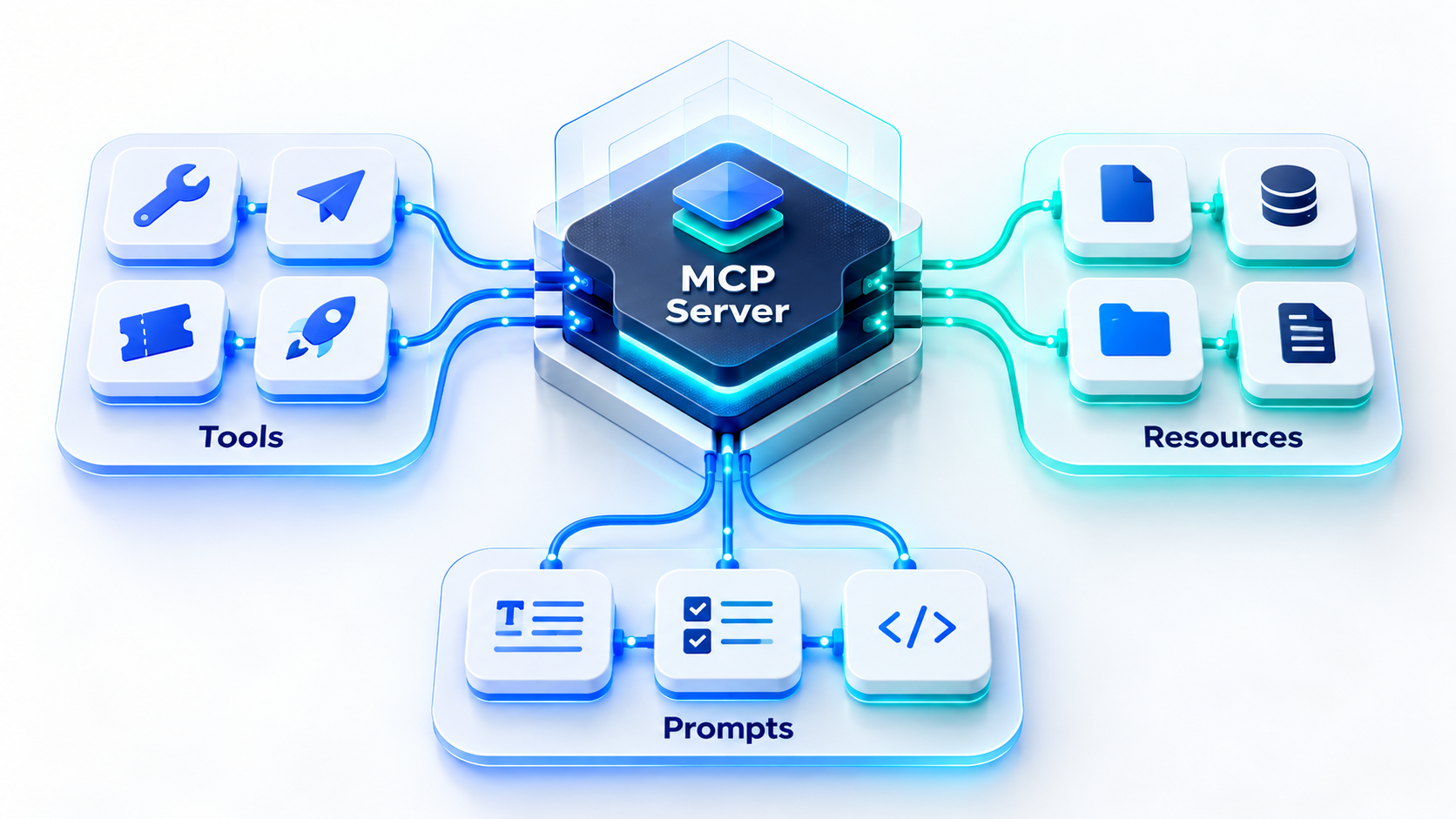
MCP servers publish three kinds of capabilities.
Tools let an application request an action. Create a ticket. Query a database. Send a message.
Resources expose information a client can read. A file, a record, a piece of documentation.
Prompts are reusable templates a client can pull into a workflow.
Take the CRM server behind your account-research agent. It might expose account records as a resource, since the agent only reads them, and expose note-creation as a tool, since that's an actual write. Splitting these matters, because reading a record and writing to one carry very different risks, and you'll want different policies attached to each.
The protocol keeps moving too. The July 28, 2026 spec added a stateless protocol core, authorization changes, cacheable list results, header-based routing, and a formal extensions framework.
MCP does not replace APIs
Here's a common misreading worth killing early: MCP is not an API replacement.
Your CRM keeps its REST API. Your ticketing system keeps its own interface. An MCP server sits in front of those systems and exposes a slice built specifically for AI applications.
That CRM behind your account-research agent might support hundreds of operations. The agent needs maybe four: retrieve account information, retrieve opportunity information, search notes, and add an approved note. The MCP server exposes exactly those four. Nothing more.
That's the design principle worth remembering. Expose what the agent needs, not the entire underlying interface. A narrower boundary is easier to secure, easier to evaluate, and easier to reason about when something goes wrong.
MCP, function calling, RAG, and agent frameworks solve different problems
Several pieces of an AI architecture look like they overlap with MCP. They don't, not really.
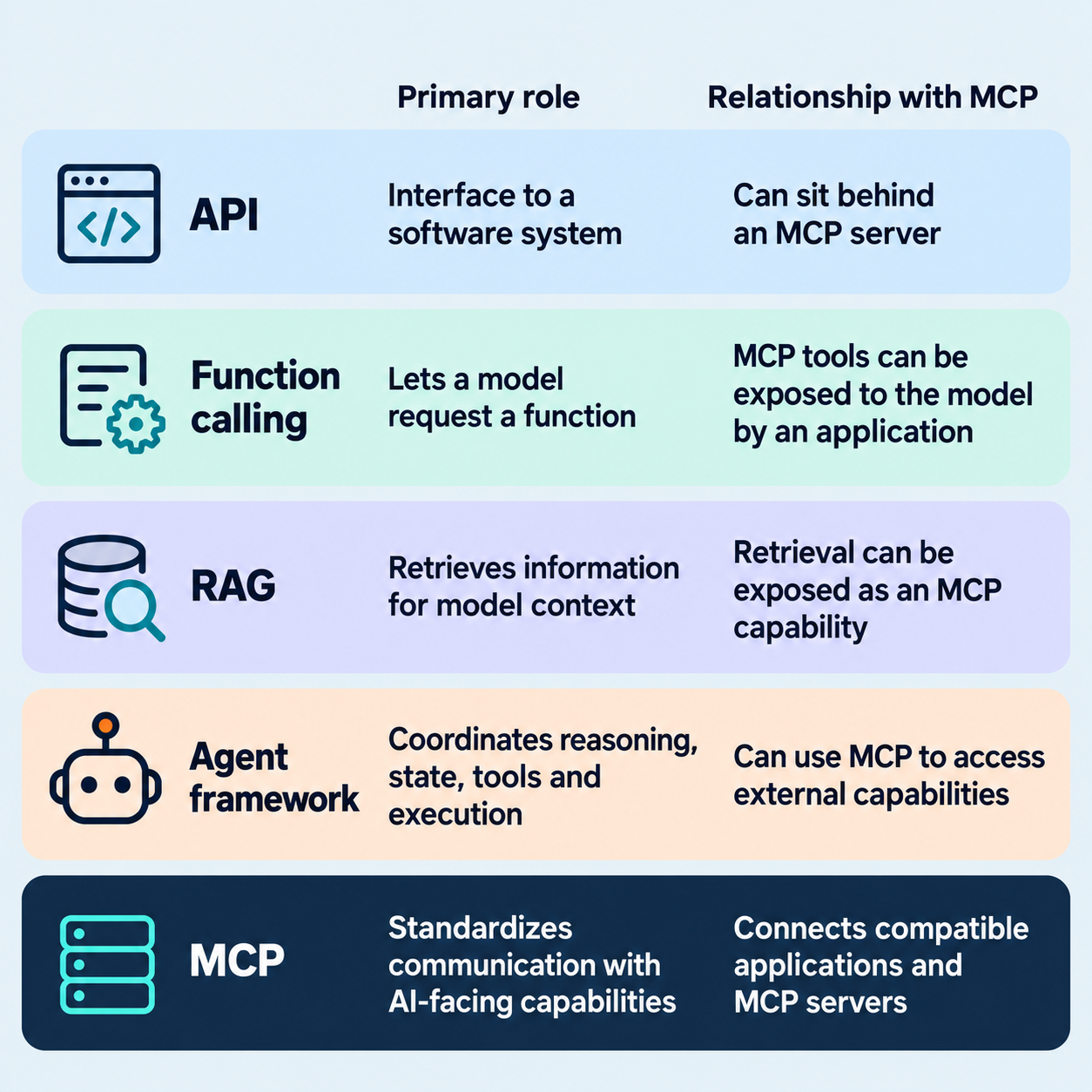
A production build can run all five at once. The agent framework coordinates the workflow. RAG pulls in knowledge. Function calling lets the model request an operation. MCP standardizes how that operation reaches the CRM. The CRM's existing API does the actual work. Each layer stays in its lane, and that's exactly why the architecture holds together instead of turning into one tangled system.
MCP becomes more useful when integrations need to be reused
Don't adopt MCP because it's trending. Adopt it because you have a reuse problem.
One assistant calling one stable internal function gains almost nothing from an extra protocol layer. The case gets stronger fast once more consumers show up.
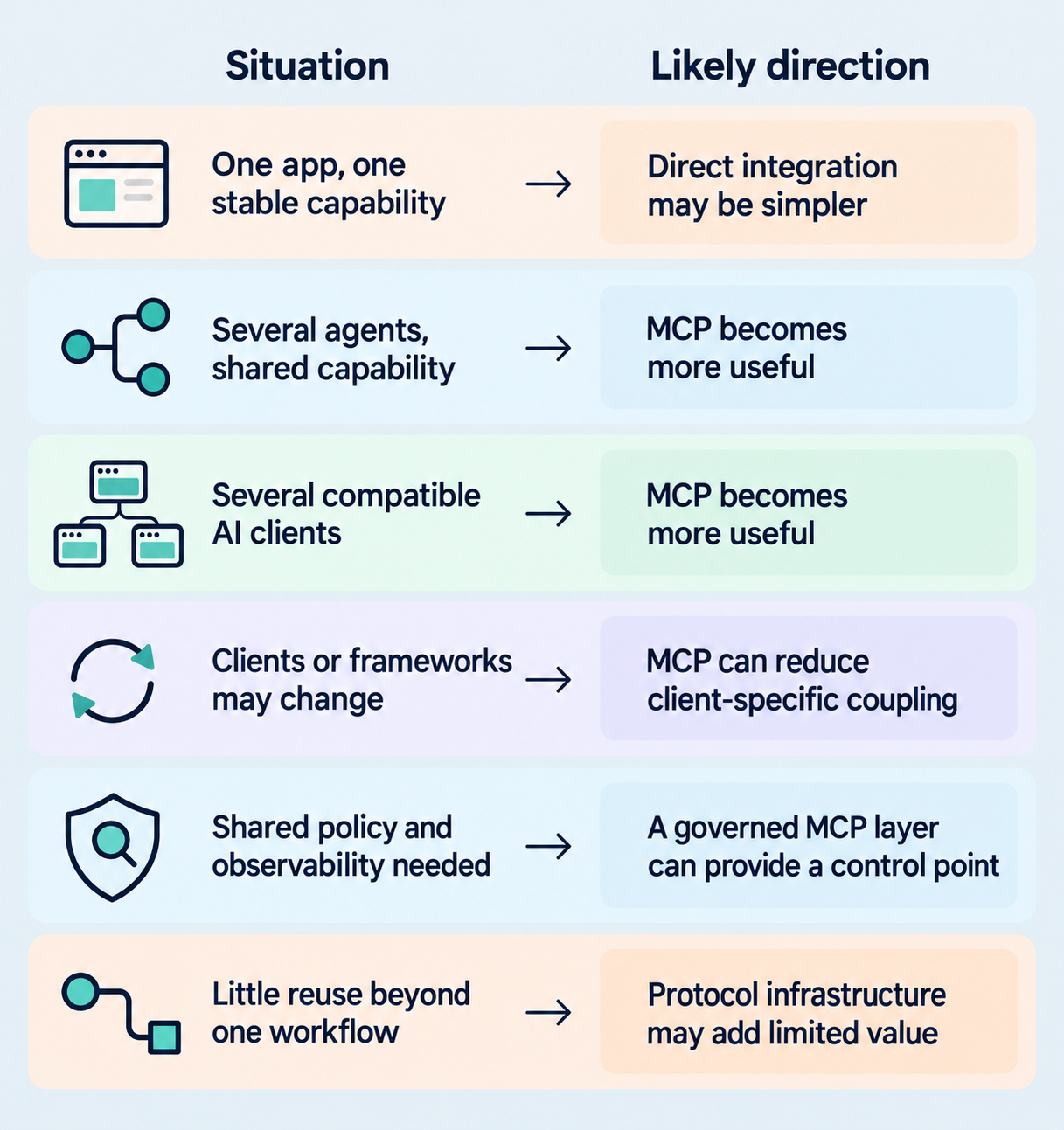
Ask yourself three things before you build. How many consumers actually need this capability? How likely is your AI layer to change under you? And how much control does this operation need around it? If the honest answer to all three is "not much," skip the extra layer.
Tool discovery creates a second problem after connectivity
Getting an agent connected to tools is only half the job. The harder question is which tools it should actually see.
A large MCP estate can expose dozens of capabilities. Hand an agent access to all of them, and you've eaten its context budget, created overlapping choices it has to reason through, and made authorization harder to audit. Connectivity was never the bottleneck. Discovery is.
Teams solving this well end up building capability filtering, role-based tool catalogs, semantic tool search, workload-specific servers, and policy-based discovery. The question worth asking for every tool isn't just "can the agent connect to this?" It's "should this agent even know it exists?"
Connect AI agents to your business systems with control
Model Context Protocol security starts with identity
An MCP server that only exposes documentation carries a very different risk than one that can push changes to production infrastructure. Treat them the same, and you'll either lock down the harmless one for no reason or leave the dangerous one exposed.
Authentication answers who's asking. Authorization answers what they're allowed to do once they're in. Past that, you still need answers to a handful of harder questions. What data can this operation actually reach? How are credentials protected? Are inputs validated before they run? What gets logged, and how do you revoke access fast if something breaks?
Microsoft’s guidance for securing MCP servers with Entra ID treats an MCP server exactly like an API: require OAuth access tokens, and validate them before any tool executes.
Giving an agent access to a server should never mean giving it unrestricted access to whatever sits behind that server.
The server can become a capability boundary
A well-built MCP server exposes less than the full application underneath it, and that's precisely what makes it useful.
Take an internal HR platform instead of the CRM example. An employee assistant only needs that one employee's own benefits information. A manager-facing tool needs limited team data. A payroll administrator needs something else entirely. Publish one unrestricted HR toolset to all three, and you've built a security problem nobody asked for.
Separate MCP capabilities, one built for each use case, with your identity and authorization architecture deciding what each one can actually touch. This pays off in testing too. Ten narrow tools with explicit permissions are far easier to evaluate than one agent holding broad administrative access to an entire application.
Observability needs to connect reasoning with execution
Model monitoring tells you what happened during inference. It stops there. Agentic systems need more, because a model's decision can trigger something in a completely different system.
You need to be able to reconstruct who started the workflow, which agent processed it, which tool it selected, which MCP server received the call, which identity authorized the operation, what parameters went in, what came back, and what actually changed in production.
AWS built this into its own MCP Server, generally available since May 6, 2026. Worth noting: AWS took a different approach to scoping than the CRM example above. Its server exposes one broad tool, call_aws, that reaches thousands of AWS API operations, and narrows access through IAM permissions instead of through the MCP layer itself. That's authorization-based scoping, not capability-based scoping. Both are valid. The choice depends on whether your existing identity system is strong enough to carry that weight on its own.
Where AWS's design does set the standard is observability. The managed service integrates IAM-based guardrails, Amazon CloudWatch metrics, and AWS CloudTrail logging directly. That's the piece worth matching regardless of which scoping pattern you choose. A prompt transcript alone will never tell you why a production record changed.
MCP is gaining value as an interoperability standard
A protocol only one vendor supports gives you limited interoperability, no matter how well designed it is. MCP's value grows with every platform that adopts it.
OpenAI supports remote and local MCP servers now, with developer controls that require explicit approval before a tool runs. Microsoft, AWS, and Anthropic all offer their own implementations or tooling.
That cross-vendor spread matters directly to you. It cuts your incentive to lock every integration into one AI client's proprietary format. Still, verify interoperability rather than assume it. Different platforms expose different approval flows and different feature sets, even when they both speak MCP.
MCP does not solve agent reliability
Standardizing the connection layer does nothing for whether the agent behind it makes good decisions.
An agent can connect flawlessly to the wrong tool. It can send the wrong parameters. It can misread an instruction entirely, or take untrusted content from a tool response and act on it without question. None of that is an MCP problem. All of it is an evaluation problem.
Your testing needs to cover tool selection, parameter accuracy, failure handling, authorization, and what happens when the agent gets something wrong. Treat every external tool response as untrusted input, especially anywhere an agent might let retrieved content steer its next move. This is where prompt injection and tool poisoning live: a malicious instruction hidden inside a document, a webpage, or a tool's own response, written to redirect the agent instead of informing it.
MCP standardizes how a capability gets reached. It says nothing about whether reaching for it was the right call.
A useful MCP architecture separates connection, control, and execution
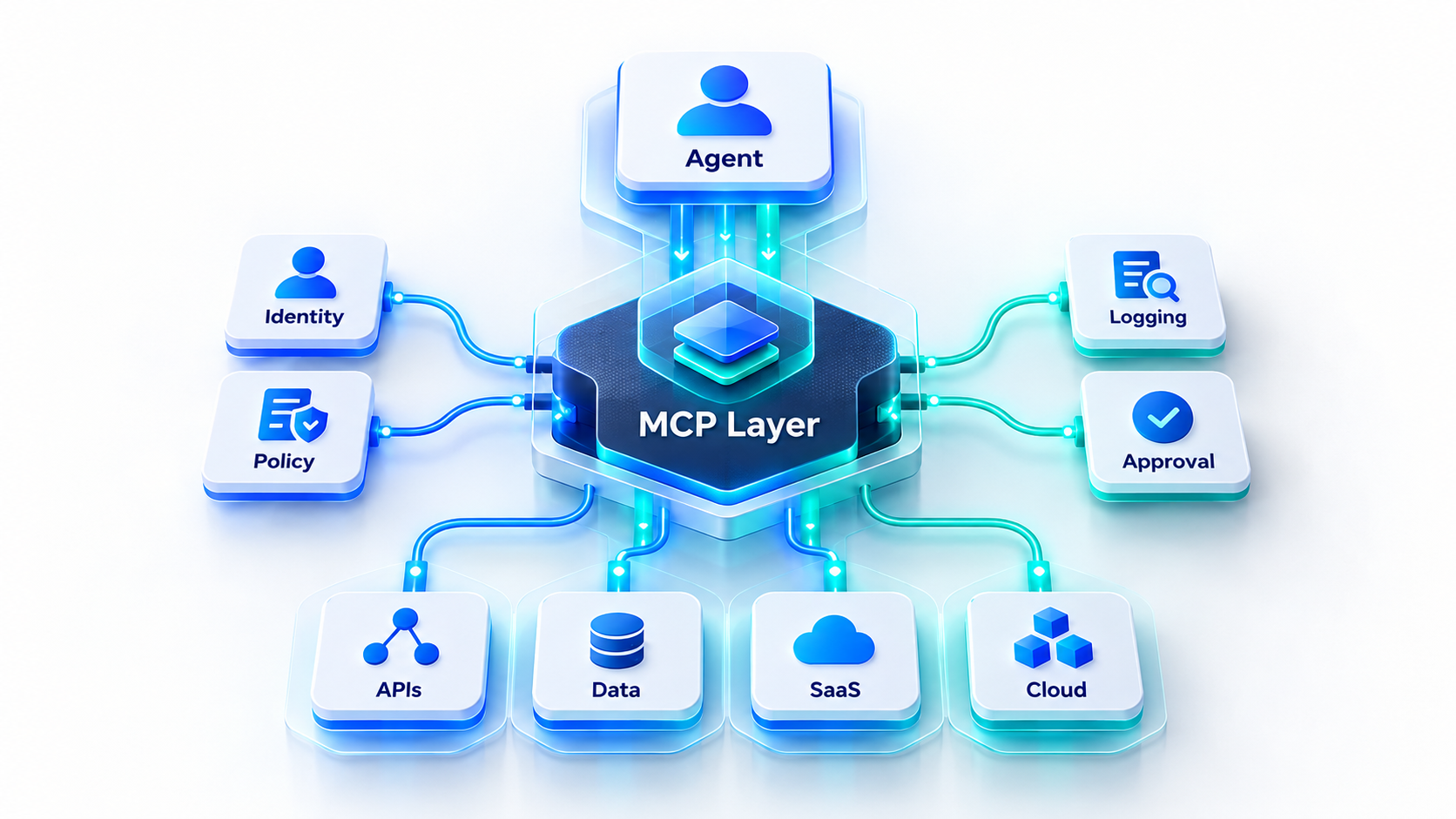
Three jobs, three layers. Keep them apart.
Connection is what MCP standardizes: protocol communication, capability discovery, tool invocation.
Control is what your architecture decides: whether an operation should be available, and whether a given identity gets to use it. That covers authentication, authorization, tool visibility, approval gates, validation, rate limits, audit logging, and credential management.
Execution is the downstream system doing the actual work. Your CRM updates the record. Your ticketing system creates the incident. Your database runs the query.
Collapse these into one layer and you'll eventually ask MCP to do security work it was never built to do. A production pattern keeps them stacked and separate:
AI application
↓
MCP client
↓
MCP capability layer
↓
Identity, policy, validation, approval, logging
↓
Existing APIs and services
↓
Enterprise systems
You already run identity platforms, API gateways, and observability infrastructure. This pattern plugs MCP into that stack instead of building a second one next to it. As agents gain real authority over CRM platforms, ERP systems, and cloud infrastructure, that control layer is what governs the space between an agent deciding something and that agent acting on it. MCP is not that control plane. It's one important, standardized boundary inside it.
Enterprise MCP architecture should start with control before connectivity
Connecting an agent to a system keeps getting easier every quarter. The harder questions start right after that connection works.
Which identity does the agent represent? Which capabilities can it discover? Which actions can it actually request, and against which records? Which of those operations need a human to approve first? And when the agent picks the wrong tool, how do you find out, and how fast?
Answer those honestly before you scale anything. Start with a small set of well-understood capabilities, define permissions around each one, wire tool execution into your existing identity and logging systems, and test agent behavior against something that actually resembles production. Expand from there.
MCP lowers one barrier: the one between your AI application and the systems it needs to reach. The advantage you actually compete on is how well you govern everything that happens after that connection lands.
Applify helps organizations design production AI architectures around agent systems, API integration, AWS-native infrastructure, identity, RAG, observability, security, governance, and orchestration.
If you're evaluating Model Context Protocol, the goal is straightforward. Give your AI applications useful access to enterprise capabilities while keeping the control production systems actually require. Get in touch to see how that foundation can support secure, production-ready agentic AI.
.jpg)