Lift and Shift vs Replatform vs Refactor: Choosing the right migration strategy
Deciding between lift and shift vs replatform vs refactor ultimately requires balancing priorities around speed, cost, risk, and long-term strategic value. A thoughtful, workload-specific methodology, frequently incorporating multiple Rs across different applications, consistently yields the strongest outcomes.

Introduction to cloud migration strategies
Organizations today face increasing pressure to move workloads to the cloud to reduce costs, improve agility, and accelerate innovation. Selecting the appropriate migration approach early on is essential. The comparison of lift and shift versus replatform versus refactor frequently determines overall project success, adherence to timelines, and achievable return on investment.
Applify specializes in guiding enterprises through these critical choices. We combine proven cloud migration company expertise with advanced cloud modernization company capabilities. This comprehensive guide offers a clear, decision-focused analysis of the 6 Rs framework. It includes practical workload examples, an expanded comparison table, and actionable insights to help you align strategies with your unique business context, technical landscape, and goals.
Understanding the 6 Rs of cloud migration
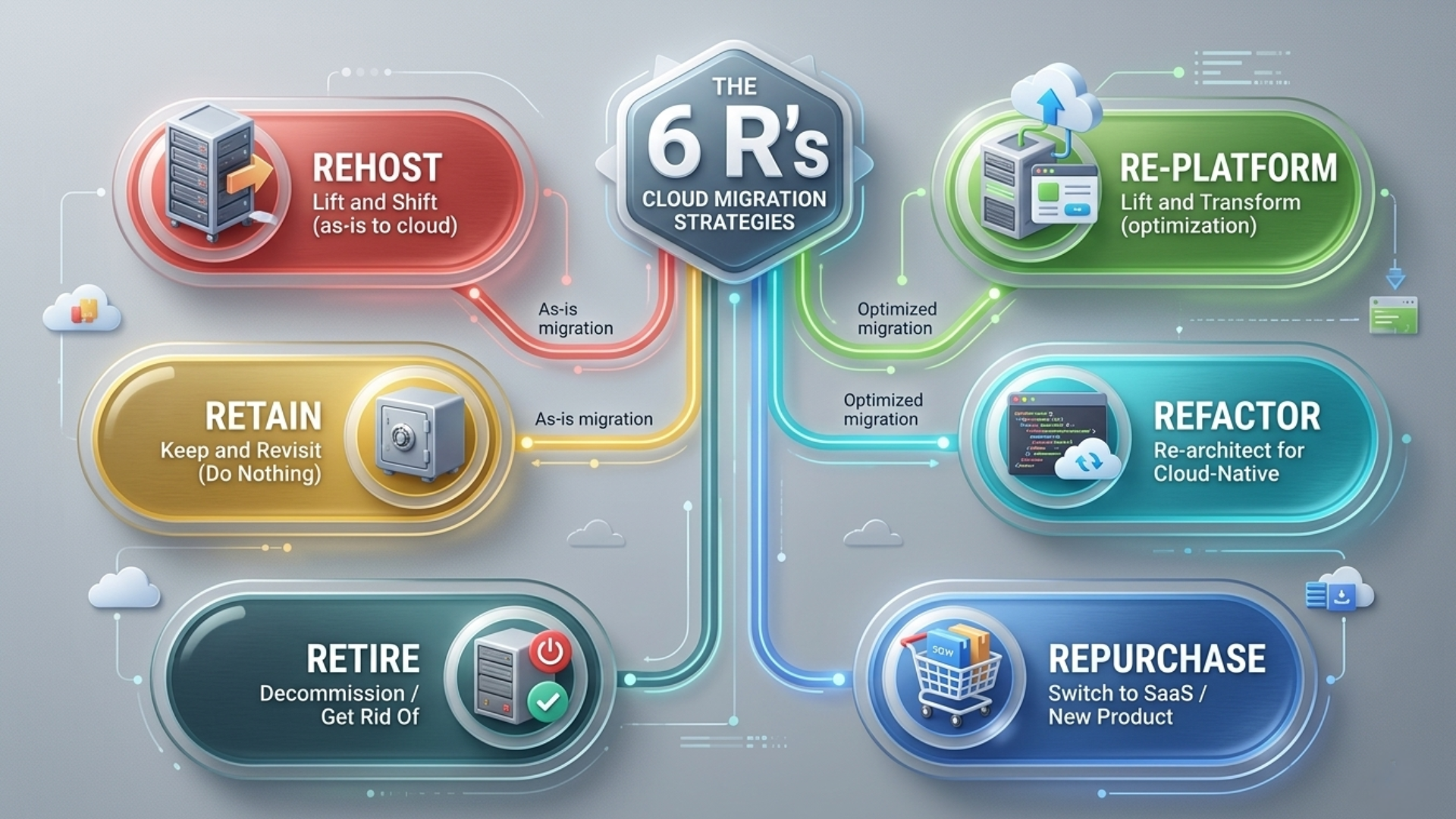
AWS and other industry leaders developed the 6 Rs as a practical decision-making model for cloud migrations. The framework helps organizations evaluate options systematically according to business priorities, technical limitations, available resources, and desired outcomes.
- Rehost (lift and shift) moves applications to cloud infrastructure with virtually no modifications.
- Replatform (lift, tinker, and shift) introduces targeted enhancements like managed services while preserving core logic.
- Refactor (re-architect) redesigns applications to fully leverage cloud-native features such as microservices and serverless architectures.
- Repurchase (drop and shop) replaces existing software with modern SaaS alternatives.
- Retire decommissions applications that no longer deliver business value.
- Retain (revisit) maintains certain workloads on-premises for the time being due to regulatory needs, performance demands, or complex dependencies.
Although this article concentrates on lift and shift vs replatform vs refactor, mastering the complete framework supports better portfolio-level planning. Enterprises commonly apply different Rs across various applications in a single migration initiative, creating a phased and pragmatic path forward.
Lift and shift migration: Speed and simplicity first
Lift and shift, commonly referred to as rehosting, transfers existing servers, virtual machines, applications, and associated data to equivalent cloud resources with minimal or no code changes. Typical targets include Amazon EC2 instances, VMware Cloud on AWS, or similar infrastructure-as-a-service offerings.
Key advantages
- Rapid execution timelines, often measured in weeks instead of months or years.
- Very low risk of business disruption because applications remain functionally unchanged.
- Immediate realization of benefits including avoidance of hardware refreshes, predictable operating expenses, and improved infrastructure reliability.
- Particularly suitable for teams with limited cloud experience or organizations operating under strict deadlines such as data center contract expirations.
Challenges
- Applications retain their original inefficiencies, which can result in unexpectedly higher long-term cloud spending if not monitored.
- Organizations miss out on advanced features like automatic scaling, built-in high availability, or fully managed services.
- Teams continue to handle many traditional operational tasks such as OS patching, backup management, and performance tuning.
Best-fit workloads
This approach excels with stable monolithic applications, older custom-built systems, or virtualized environments involved in VMware to AWS migration. It is also effective for organizations executing urgent data center exits or managing hardware reaching end-of-life.
We have delivered numerous successful lift and shift engagements. These projects allow clients to establish a quick cloud foothold while laying the groundwork for subsequent optimization and modernization phases.
Replatform migration: Balanced optimization
Replatforming serves as the balanced middle path between pure speed and deep transformation. Teams relocate applications to the cloud environment and apply selective, non-invasive changes that unlock the advantages of managed cloud services without rewriting core business logic.
Common examples include moving self-managed databases to Amazon RDS or Aurora, containerizing legacy applications using Amazon ECS or EKS, updating storage layers to managed options, or adjusting operating systems and middleware for better cloud compatibility.
Key advantages
- Moderate investment in effort yields significant gains in performance, availability, scalability, and operational efficiency.
- Substantial reduction in day-to-day administrative work through the adoption of managed services.
- Improved return on investment compared to full refactoring projects, while providing noticeably more value than basic lift and shift.
- Creates a solid foundation that simplifies any future refactoring efforts since foundational cloud services are already integrated.
Challenges
- Demands thorough testing and structured change management to prevent unexpected issues during or after the transition.
- Certain applications may require small configuration updates or minor code adjustments.
- Still necessitates access to resources with relevant cloud optimization skills for the targeted improvements.
Best-fit workloads
Applications burdened by heavy operational overhead related to databases, middleware, or infrastructure management benefit the most. Selective industries such as healthcare cloud migration and financial services cloud migration often select replatforming. This choice helps maintain strict compliance standards while achieving meaningful efficiency improvements.
Our specialized database modernization services combined with cloud operations management ensure replatform projects proceed smoothly with controlled risk and measurable outcomes.
Refactor migration: Full cloud-native transformation
Refactoring, also called re-architecting, requires more substantial modifications to application code, architecture, and overall design. Development teams typically decompose monolithic structures into microservices, adopt serverless computing models, introduce event-driven architectures, or rebuild components around containers and fully managed cloud services.
Key advantages
- Delivers the highest levels of scalability, resilience, fault tolerance, and innovation capacity.
- Achieves superior long-term cost efficiency through consumption-based pricing, automated operations, and reduced infrastructure overhead.
- Supports contemporary development methodologies such as continuous integration and delivery pipelines, infrastructure as code, and easy integration with emerging technologies like artificial intelligence and advanced analytics.
- Helps organizations systematically reduce technical debt and enhance long-term maintainability and agility to meet evolving business requirements.
Challenges
- Represents the largest initial commitment in terms of time, financial resources, and access to specialized talent.
- Involves extended project durations and more complex testing and validation processes.
- Necessitates robust organizational change management programs and focused developer training initiatives.
Best-fit workloads
This strategy is ideal for customer-facing applications, high-traffic SaaS platforms, data-heavy analytical systems, or any workloads that require frequent updates and rapid feature deployment. Companies focused on broad digital transformation or gaining competitive differentiation usually prioritize refactoring for their most strategic applications.
Side-by-side comparison: Lift and shift vs replatform vs refactor
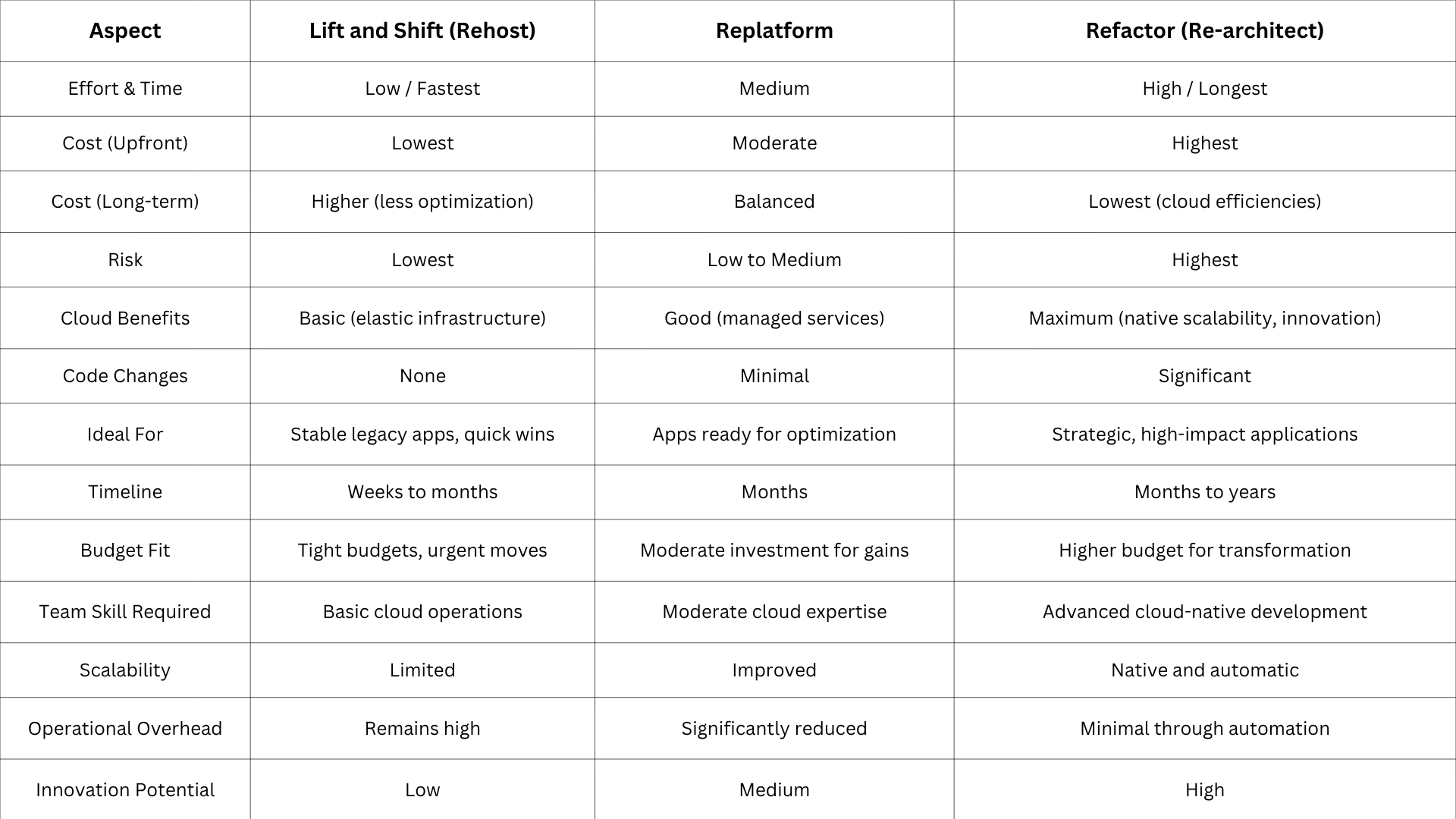
This expanded table functions as a practical reference tool. Successful enterprises frequently blend multiple strategies, applying lift and shift to less critical systems while reserving refactor efforts for core revenue-generating platforms.
Decision framework: Matching strategy to your needs
- Evaluate by workload type
Relatively simple, stable, or rarely modified applications align best with lift and shift. Workloads experiencing ongoing operational challenges with databases, servers, or scaling are strong candidates for replatforming. Mission-critical systems that demand high agility and continuous innovation call for refactoring.
- Consider timeline constraints
Projects driven by urgent data center closures or immediate compliance requirements benefit from lift and shift or replatform approaches. Initiatives with more flexible strategic timelines can incorporate refactoring for high-priority workloads.
- Align with budget realities
Organizations operating with constrained budgets often start with lift and shift and pursue iterative optimization over time. Enterprises with dedicated transformation funding can commit to replatform or refactor strategies to secure stronger long-term financial returns.
Real-world examples and case studies
Numerous organizations initiate their cloud journeys with lift and shift tactics to achieve fast exits from on-premises data centers. They then advance toward replatform and refactor stages for greater value. Our successful migration case study illustrates how phased strategies successfully combine speed with sustainable long-term benefits.
Replatform projects commonly focus on database migrations to managed services. These moves dramatically cut administrative workloads while keeping existing application code intact. Refactoring case studies often highlight SaaS platforms rebuilt with microservices and serverless designs.
Best practices for successful migration
- Execute a detailed application portfolio assessment to categorize every workload according to the 6 Rs model.
- Utilize automation tools and established AWS migration tools to streamline processes and reduce manual errors.
- Embed security and compliance requirements into the project from the initial planning stages, particularly for environments handling sensitive information.
- Develop a clear post-migration optimization roadmap and actively apply cloud cost optimization techniques.
Explore our practical supporting materials including the cloud migration guide and cloud migration ebook.
Common pitfalls to avoid
- Trying to refactor every single application at the same time rather than following a prioritized, phased plan.
- Selecting lift and shift without establishing ongoing cost governance and monitoring processes.
- Underestimating the scope and effort required for comprehensive testing in replatform initiatives.
- Failing to address organizational change management, stakeholder communication, and necessary skills development programs.
How we helps with Cloud migration and modernization
We deliver extensive technical expertise spanning the full spectrum of migration and modernization activities. Our teams possess specialized domain knowledge tailored to healthcare, financial services, and additional regulated industries. Cloud services encompass everything from initial assessment and execution through optimization and continuous management.
Whether the requirement centers on cloud migration for financial institutions, on-premise to cloud migration, legacy software modernization, or comprehensive cloud-native transformation, we consistently produce measurable business results aligned with client objectives.
Choose wisely and iterate
Deciding between lift and shift vs replatform vs refactor ultimately requires balancing priorities around speed, cost, risk, and long-term strategic value. A thoughtful, workload-specific methodology, frequently incorporating multiple Rs across different applications, consistently yields the strongest outcomes.
Our cloud specialists are prepared to assist you with evaluating your current environment, developing a customized migration roadmap, and executing the plan effectively. Reach out today to initiate your cloud migration journey with confidence and expert support.
You may also like