Context intelligence for AI agents: Connecting data to business meaning
Connected data can still lead an AI agent to the wrong answer. Explore how context intelligence gives agents the business definitions, relationships, dates, and source evidence they need to interpret enterprise data and support reliable decisions.

- Connected data needs business definitions, relationships, and rules for agents to interpret it correctly.
- The latest record may not be the right one. Agents must select information relevant to the task and time period.
- Context engineering supplies information to the model; context intelligence gives that information business meaning.
- Entity matching must handle uncertainty and flag conflicting records rather than silently merging them.
- Source evidence, freshness checks, and enforced permissions support reliable, traceable answers.
- Start with one verifiable business question, define its rules and ownership, and test interpretation before expanding.
- Evaluate agents on correct decisions, supporting evidence, and exception handling, alongside cost and latency.
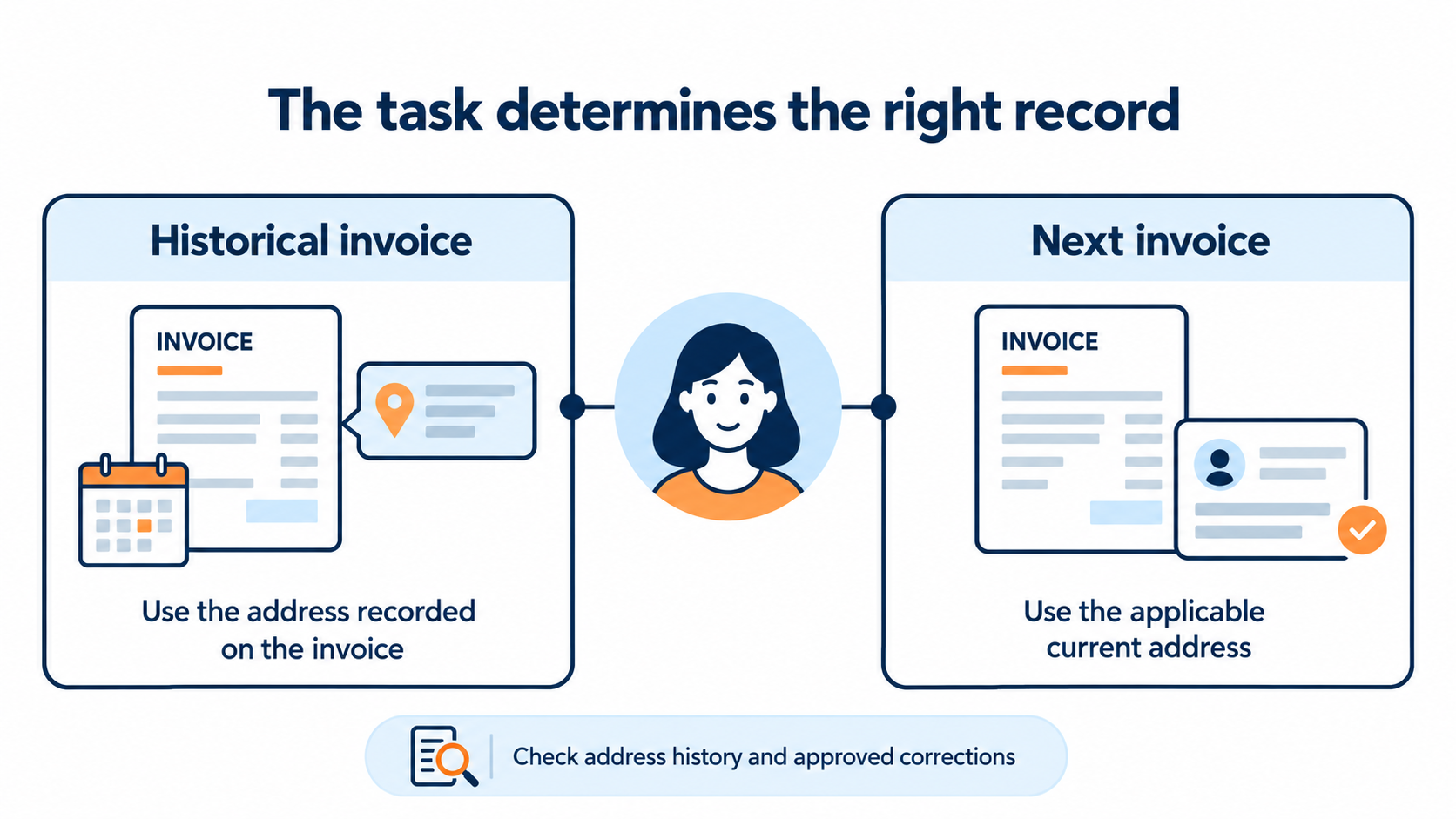
A customer changes its billing address in September. The CRM shows the new address. An August invoice contains the previous one.
An AI agent investigating that invoice retrieves both records. Which address should it use?
Choosing the latest value could produce the wrong answer. To establish what appeared on the August invoice, the agent needs the address recorded on that invoice. Determining which address was valid at the time may also require address history and any approved corrections. Preparing the next invoice requires a different selection. Both records may be correct.
This illustrative example shows why enterprise agents need more than access to connected data. They need information about what records mean, which entities they describe, when they apply, and which rules govern their use.
Context intelligence for AI agents addresses that interpretation problem. For data and AI leaders, the practical objective is to make the business knowledge behind a decision available, maintained, and testable.
What is context intelligence for AI agents?
Context intelligence for AI agents is the capability to supply relevant business meaning, relationships, rules, and source information so agents can interpret and use enterprise data appropriately.
The term describes a working architectural concept rather than a standardized technical specification. Vendors use overlapping labels, including context layer, business graph, and semantic context, with different implementations and coverage.
An AI context layer makes that supporting information available to applications and agents. It might combine business definitions, entity mappings, source metadata, effective dates, and interfaces for retrieving them. It does not have to be a single database or a separate product.
For the billing-address question, the necessary context includes the customer identity, the invoice relationship, the address history, and a rule for selecting the relevant version. Permission checks determine whether the requesting agent may retrieve and use those records.
The value becomes visible when the agent can explain its selection: this invoice recorded this address for this customer on this date, according to the designated source. Whether that address was correct is a separate question for the supporting evidence.
How context intelligence relates to context engineering
Context engineering concerns the information supplied to a model during execution and how that information is managed. Anthropic's guidance includes external data, retrieval, tools, and message history within that discipline.
Context intelligence emphasizes the business meaning and relationships that make the supplied information interpretable. The two practices overlap.
For example, context engineering may determine how the assistant retrieves invoice evidence and keeps relevant results available during the task. The business context model supplies the distinction between a current billing address and an address recorded on a historical invoice.
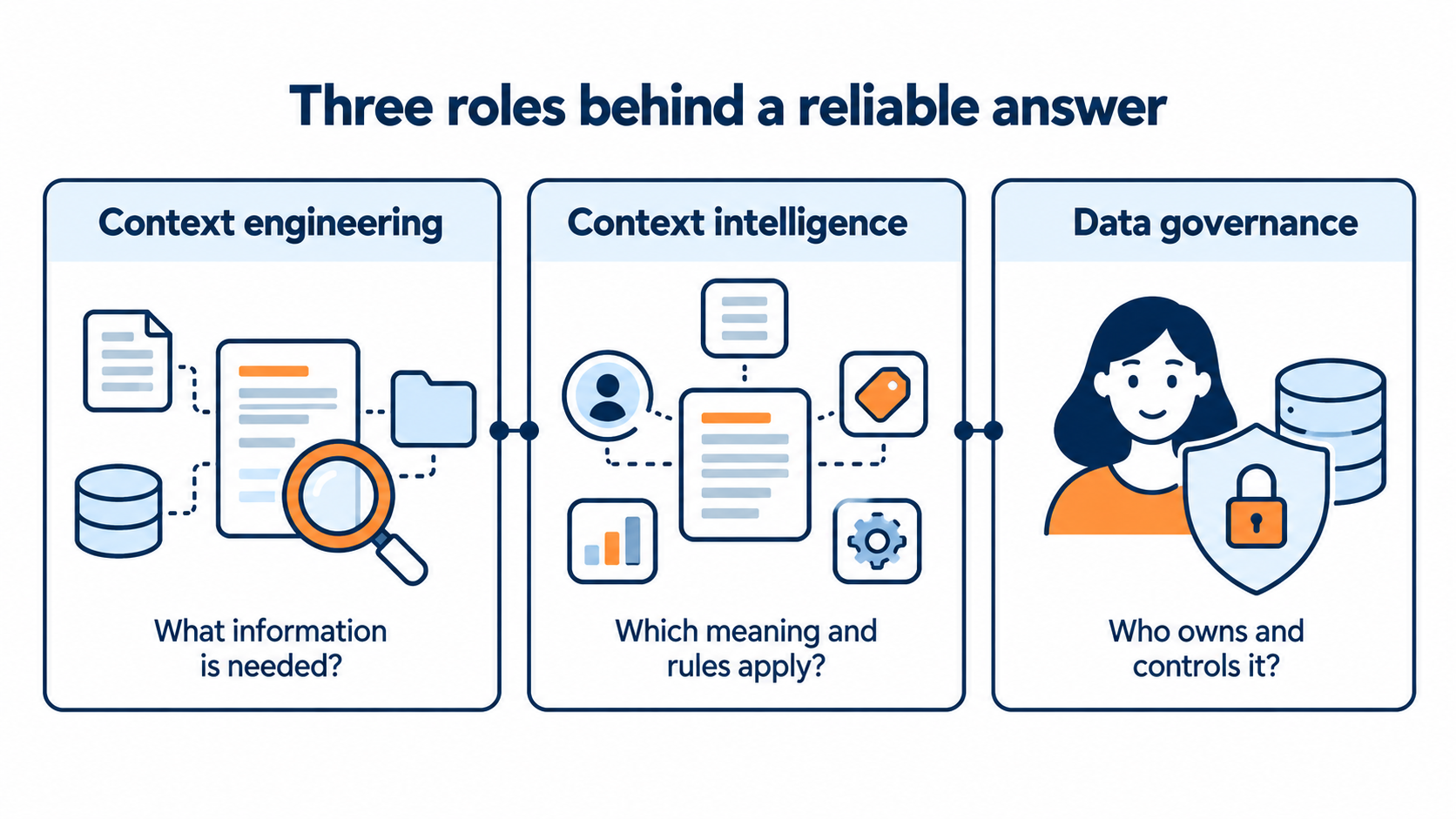
A useful division of responsibility is to ask three questions:
- Context engineering: What information does the model need at this step?
- Context intelligence: What meaning and rules make that information applicable?
- Data governance: Who defines, maintains, approves, and controls it?
These questions help teams identify gaps without treating the terms as competing architectures. An efficient retrieval pipeline can still need better business definitions. A carefully governed glossary still needs a reliable path into the agent's workflow.
The business context an agent needs
Start with the decision the agent is expected to support. The following six requirements provide a practical way to inspect its information needs.
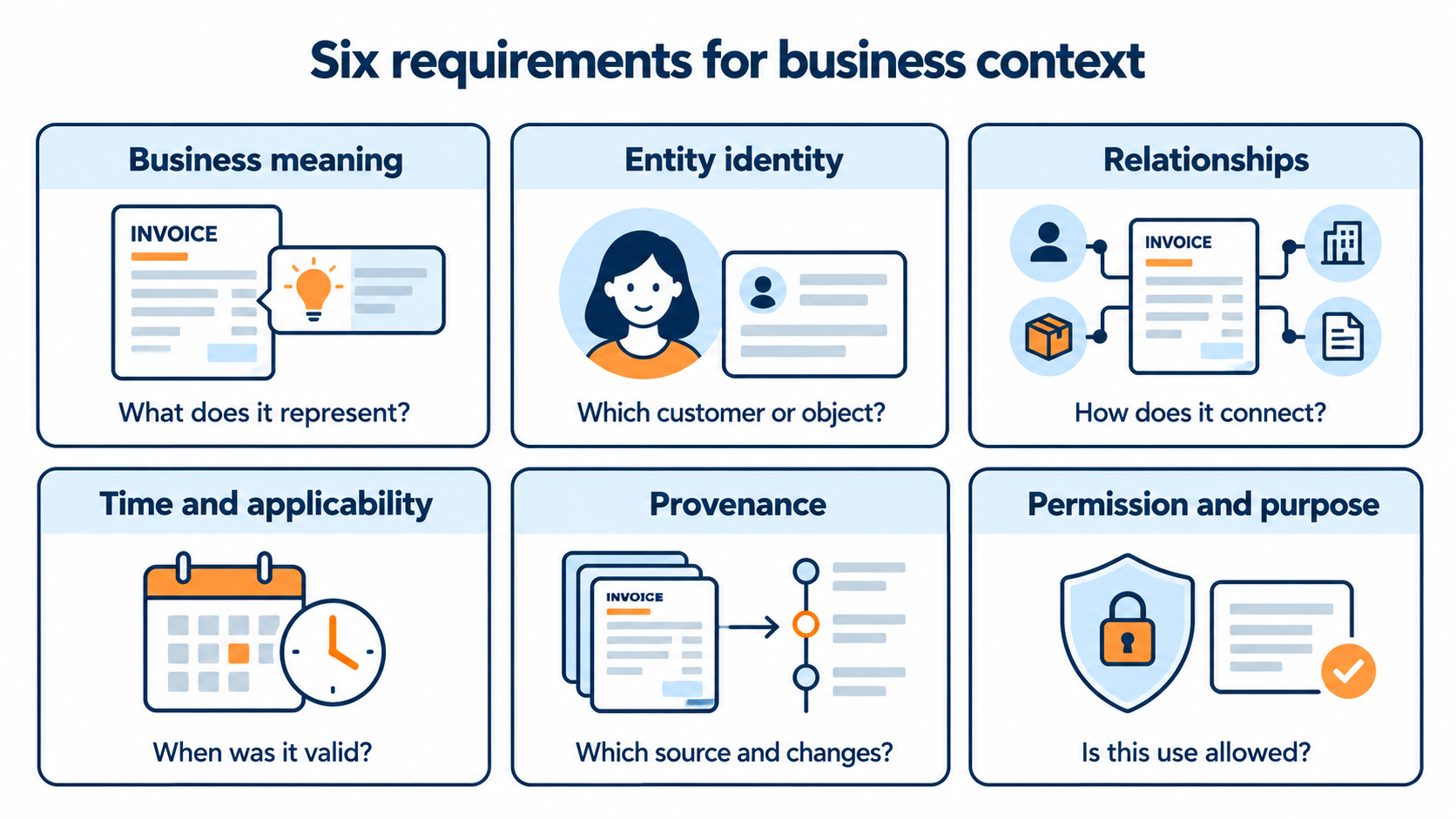
This is an implementation framework, rather than a mandatory schema. Some workflows need extensive historical context; others mainly need consistent metric definitions. Establish the requirements before choosing the storage and retrieval components.
Definitions need operational detail
A semantic layer for AI agents can expose consistent metrics and business definitions. Its usefulness depends on what those definitions contain and how the application uses them.
“Active customer” needs an inclusion rule, a time period, and treatment of cancellations or suspended accounts. Otherwise, sales and finance can produce different counts while using the same label.
Record the calculation and applicable scope, connect the definition to the relevant assets, and identify its owner. Test whether the agent selects that definition for representative questions. Storing an approved term does not establish that every generated query follows it.
Identity matching needs uncertainty handling
Entity resolution links records that may describe the same customer, product, or organization. AWS Entity Resolution, for example, supports rule-based, machine-learning, and provider-led matching approaches.
Matching proposes or assigns links between records according to the configured method. Those links need evaluation against known examples. It does not independently decide which billing address or contract status applies to a task.
Define what happens when evidence is ambiguous. Two companies with similar names should not be merged simply because doing so produces a more complete profile. Some cases should remain unresolved until a person or additional evidence can settle them.
Where knowledge graphs and governance work together
Knowledge graphs for AI agents represent entities, concepts, and relationships that can support connected queries. A graph could link the customer to its contracts, invoices, addresses, and the dates those addresses applied.
Graph systems can also incorporate validation. W3C's SHACL standard defines a language for checking Resource Description Framework (RDF) graphs against specified conditions. A system could test required properties, permitted value types, or relationship constraints. Passing those checks establishes conformity with the conditions tested; it does not prove that every statement reflects reality.
Provenance can be modeled with connected information too. W3C's PROV family models the entities, activities, and responsible agents, including people, organizations, and software, involved in producing data. This supports tracing how a value was created or changed.
The evaluation question is therefore broader than whether a platform connects records. Ask which relationships it models, which conditions it checks, what evidence it preserves, and where access is enforced.
For the invoice investigation, a well-formed address relationship could still point to a wrongly matched customer. The implementation needs matching tests alongside structural validation and temporal selection rules.
A governed lakehouse can support preparation, history, and shared datasets. Other architectures can also supply those capabilities. Choose the foundation around existing systems and workflow requirements, then develop governance and relationship modeling together.
Give your AI agents the context behind your data
What current implementations illustrate
Vendor examples show different parts of the context problem. They are useful references for design decisions, rather than proof that a customer's complete workflow is covered.
AWS: Curated relationships and business models
AWS's context-intelligence announcement describes stewards reviewing inferred relationships and attaching business definitions and usage rules. The June 17, 2026 announcement labels AWS Context “coming soon.” That announcement does not establish general availability of the managed service.
The separate AWS Context Ontology Accelerator is an open-source accelerator released on July 31, 2026. It uses AI to draft a business ontology that domain experts review, edit, and approve. An ontology is a formal model of business concepts and their relationships. The accelerator requires deployment and operation, and its release does not establish availability of the managed AWS Context service.
The practical design lesson is to place domain review between inferred relationships and production use.
Atlan: Business definitions linked to assets
Atlan's Business Graph documentation describes business terms connected to data assets. Its Business Graph policies govern glossary metadata, including term changes, ownership, certification, and associations. Read permission for glossaries, terms, and categories is granted by default and cannot be restricted through Business Graph policies.
These controls illustrate metadata governance. They should not be treated as equivalent to enforcing access to underlying customer records. Teams need to inspect the separate controls governing source data and the agent's retrieval path.
How to build an enterprise context layer
Begin with one business question that has a verifiable answer. For the invoice assistant, that might be: “Which billing address applied when this invoice was issued, and what evidence supports it?”
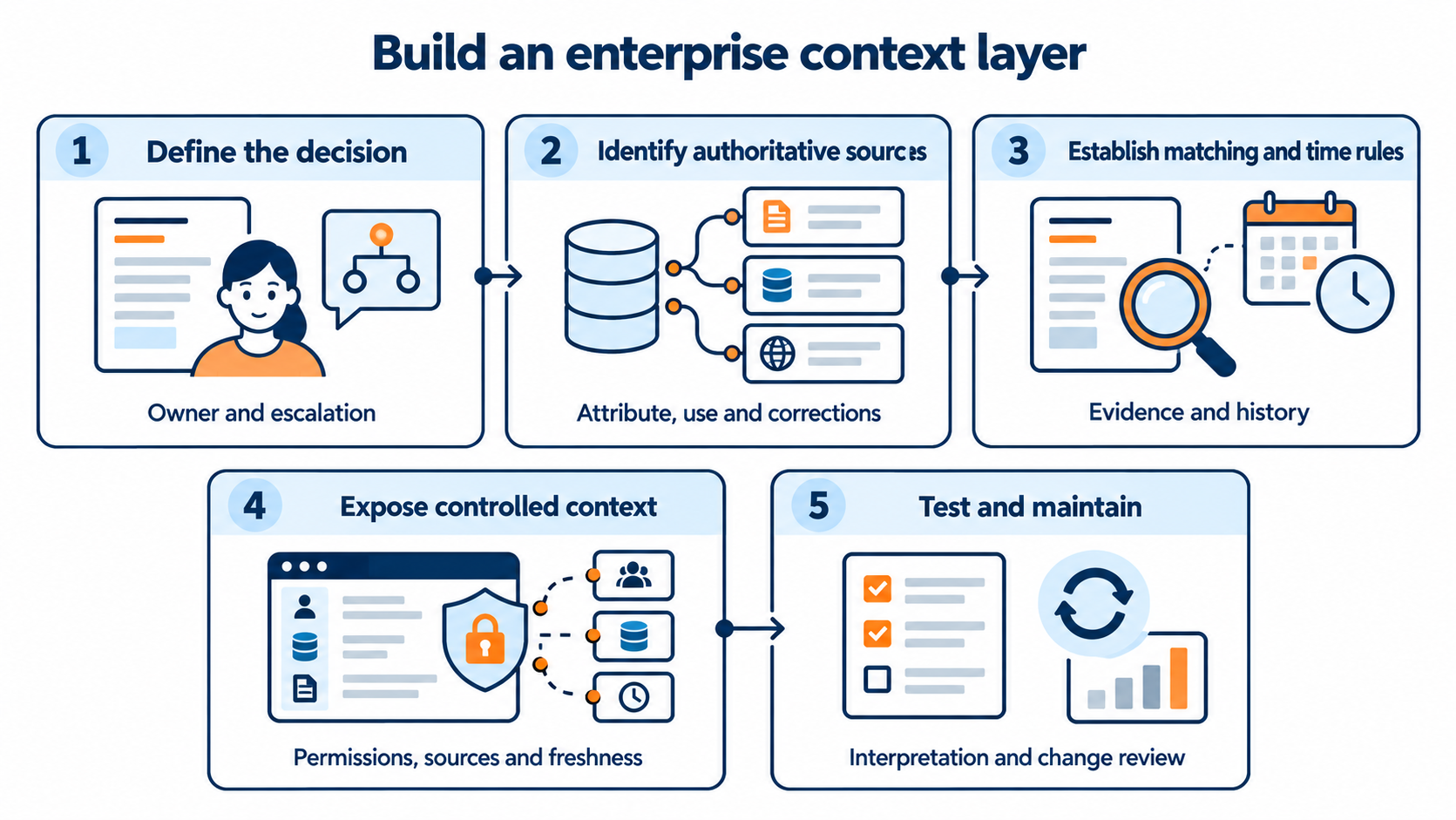
1. Define the decision and its owner
Agree on the task, expected output, and escalation conditions with the business owner. Distinguish investigating an issued invoice from generating a new one. Those tasks may require different rules and permissions.
2. Identify authoritative sources for each attribute
List the source fields needed to answer the question. Specify which system is authoritative for each attribute and use. The CRM may hold the current contact address, while the issued invoice preserves the address used for that transaction.
Document how approved corrections affect historical records. A record captured in August and a correction entered in September may require both an effective date and a recorded date to explain what changed.
3. Establish matching and temporal rules
Define how customer identifiers connect across systems, and retain evidence for those mappings. Preserve historical versions where the workflow requires them.
For this illustrative design, the investigation retrieves the issued invoice and its recorded address first. Supporting address history helps explain the later change. If authoritative records conflict, the assistant flags the discrepancy instead of silently choosing a value.
4. Expose context through controlled interfaces
Make the required definitions, records, relationships, and provenance available through queries or tools appropriate to the workflow. Include effective dates, source references, and source refresh or retrieval timestamps in results. Define acceptable freshness for the task and how the agent should handle evidence that falls outside it.
Enforce permissions in trusted services. Making a field visible in a catalog does not mean every agent should retrieve its contents. Access to supporting evidence also needs review, especially when explanations could expose restricted information.
5. Test interpretation and maintain the model
Evaluate retrieval and the final answer together. A correct source document is insufficient if the agent applies the wrong date or associates it with the wrong customer.
Assign responsibility for definition changes, new integrations, and exceptions. Monitor dependencies so that changes to source fields or business rules trigger review of the affected context and test cases.
Evaluate decisions, explanations, and exceptions
A useful evaluation set includes normal requests and cases where the agent should ask for clarification or escalate. Agree on expected answers with business owners before running the tests.
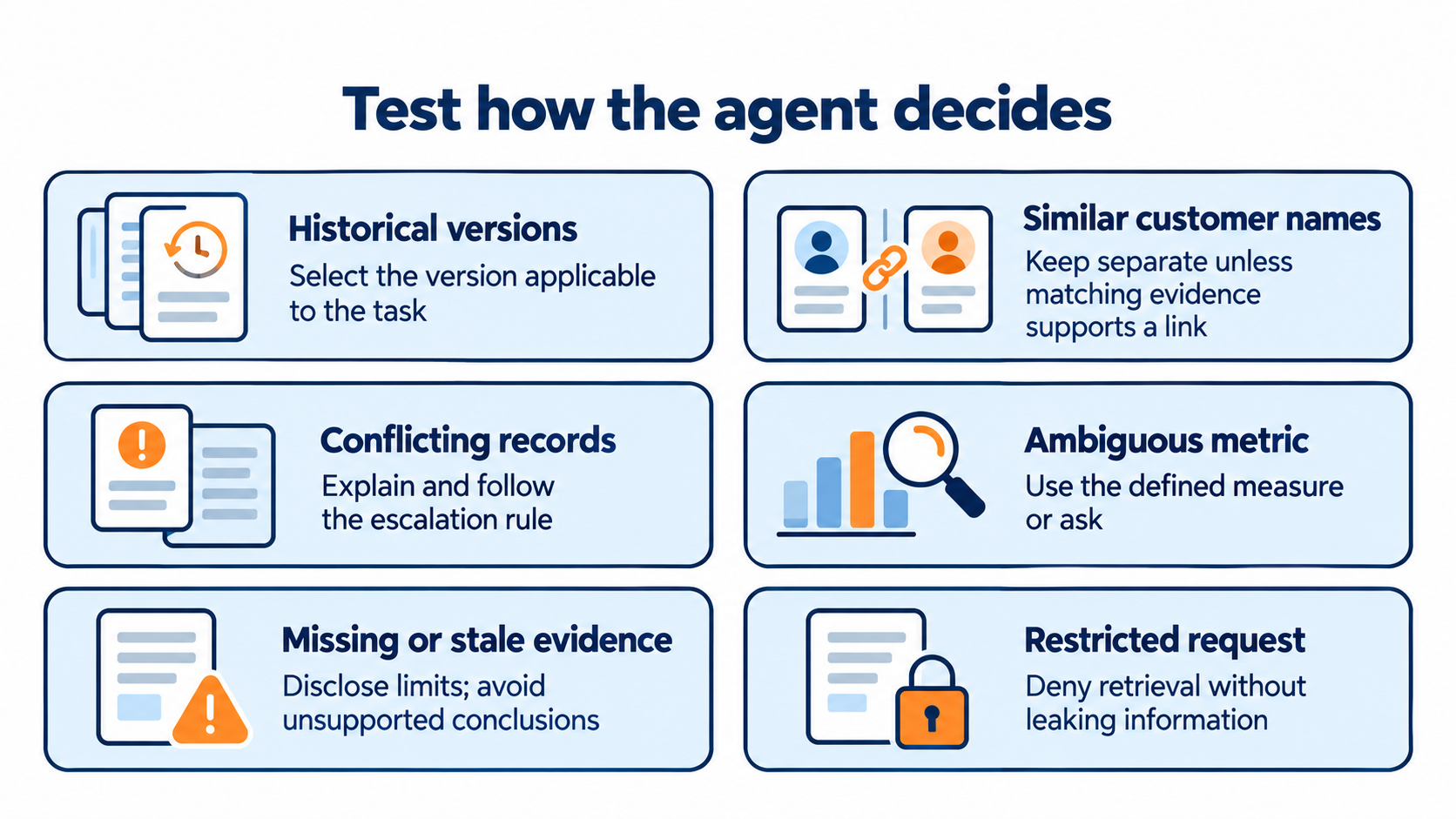
Measure incorrect matches and missed matches separately. Track temporal selection, definition selection, source freshness, evidence coverage, and handling of denied requests. Include human correction effort, latency, and cost per accepted task.
These measures reveal different problems. An increase in connected records may conceal incorrect merges. Faster answers may create more review work. Evaluate success against the task's acceptance criteria and operating costs.
For the invoice assistant, the test succeeds when it selects the applicable address, identifies the supporting source and date, and handles uncertainty according to the agreed rule. A fluent answer alone is insufficient evidence.
Connect the data foundation to the agent's decision
LakeStack's product overview describes transformation patterns, continuous validation, data-quality rules, access controls, lineage, and a semantic layer for consistent definitions. These capabilities are relevant to preparing and governing information used by agents.
The complete workflow still needs customer-specific entity mappings, temporal rules, retrieval design, and evaluation. Those decisions determine whether the prepared data supports the question being asked.
Use the LakeStack product overview to assess the foundation against one defined workflow. Start with a question whose answer the business can verify, document the evidence and rules it requires, and test whether the agent applies them consistently before expanding its scope.