Why AI agents need an operating system
What does it take to trust an AI agent with business tasks? Explore the operating layer behind production agents, from memory and identity to policy enforcement, observability, and evaluation, with examples from Amazon Bedrock AgentCore.


- Production AI agents need infrastructure for controlled execution, memory, identity, tool access, policy enforcement, observability, and evaluation.
- An AI operating system describes this supporting architecture rather than a formally standardized product category.
- Permissions and policy checks must constrain agent actions outside model reasoning.
- Memory preserves context; operational logs and downstream records provide evidence for investigations.
- Observability shows recorded activity. Evaluation determines whether the agent’s behavior met business requirements.
- Amazon Bedrock AgentCore provides modular building blocks, but organizations must configure controls, integrations, and operational ownership.
- Reassess production readiness whenever models, tools, policies, or agent permissions change.
An AI support agent reviews a customer's account, checks a billing record, and closes a support ticket. Its summary says the issue has been resolved. The workflow completes without an error, and the ticket leaves the queue.
A week later, the customer disputes the resolution. The charge remains, and the customer says they never authorized the proposed action.
The support manager now needs evidence that the closing summary cannot provide. Which identity initiated the workflow? What did the agent retrieve from the CRM and billing system? Which operations did it request? Which permissions applied? What did those systems ultimately change? The manager also needs to determine whether the resolution complied with the company's support policy.
The agent proved that its workflow could execute. The dispute exposes a different requirement: the company must be able to operate that workflow dependably, investigate its actions, and enforce boundaries before consequential steps occur.
Companies deploying production agents need infrastructure around model reasoning. Execution environments, memory, identity, controlled tool access, policy checks, telemetry, and evaluation determine how an agent operates inside a business system. An AI operating system is a useful architectural description for this supporting layer.
What is an AI operating system?
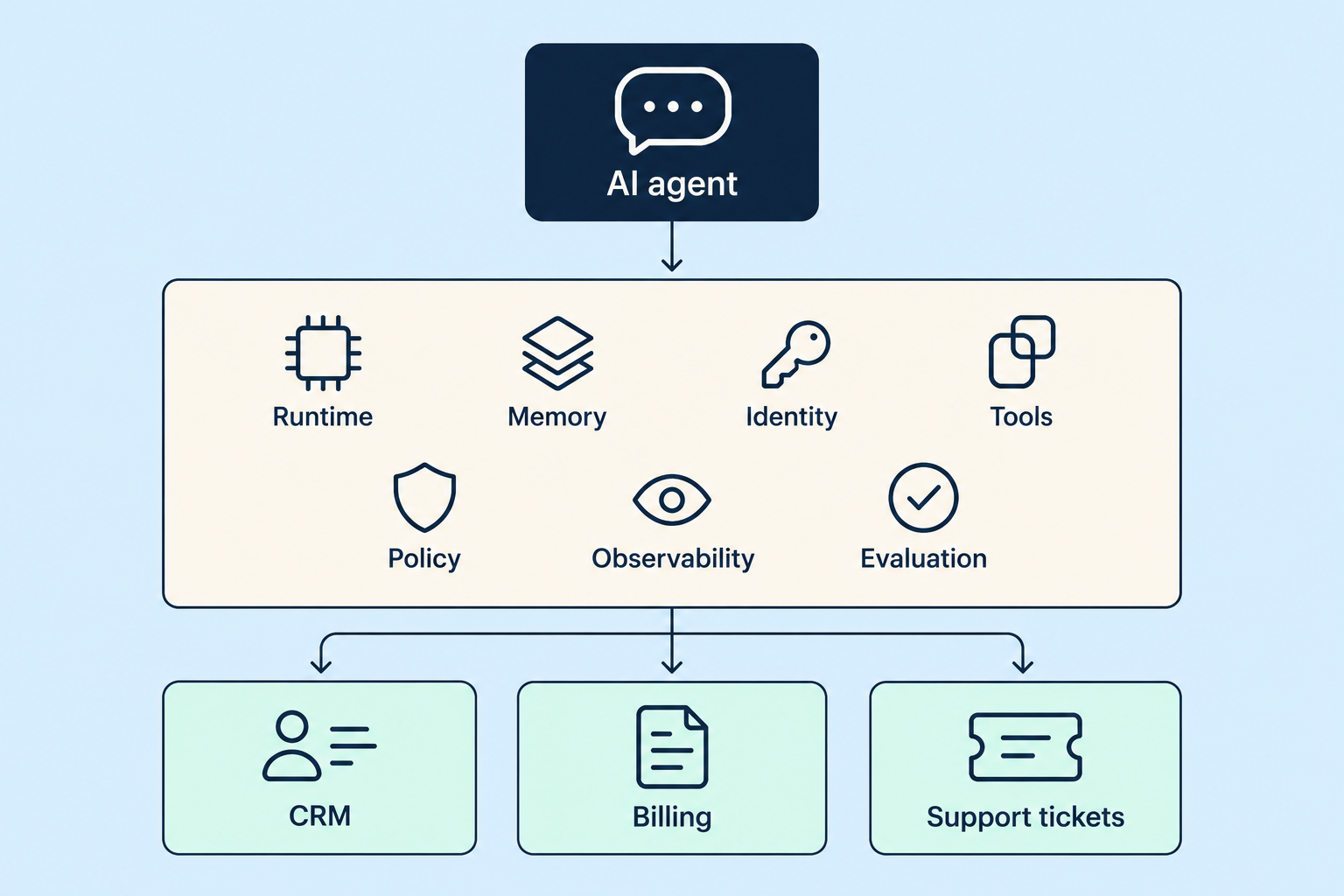
In the context of enterprise agents, an AI operating system is the infrastructure and control layer that helps agents execute tasks, retain appropriate context, access enterprise capabilities, and expose their activities for operational review.
The term describes an architectural approach rather than a formally standardized product category. Agents continue to execute on conventional computing infrastructure, while organizations assemble the required capabilities from managed services, internal platforms, and existing security systems. An AI operating layer addresses the operational requirements created by software that can select and execute actions with varying degrees of autonomy.
Consider the difference between a conventional API application and an agent. A conventional service generally follows a sequence defined in application logic. An agent can decide which available tool to call next based on the task and the information it receives. Its permissible actions still need to be constrained through application design and enforceable policy.
The resulting architecture must establish where the agent runs, whose authority it uses, what it can remember, which tools it can reach, and what happens when its reasoning produces an unsafe or incorrect request.
Why a working agent needs production infrastructure
Agent demonstrations often use a narrow set of tasks, known data, and a small collection of connected tools. Production introduces changing information, unexpected requests, concurrent users, and failures in downstream systems.
A support agent might receive incomplete account details while the billing service is temporarily unavailable. It might retry a request after a timeout even though the original operation succeeded. A new user might ask it to retrieve an account outside the user's authorized scope. Its memory might contain an outdated preference while its logs retain too little information to investigate an incident.
Each situation requires an operational decision. The application must know whether to stop, retry, request approval, escalate, or return an error. Teams also need evidence showing how those decisions were executed.
Solving these requirements separately inside every agent creates duplicated engineering work and increases the chance of inconsistent controls. Shared infrastructure can provide a common foundation for deployment, identity, tool connectivity, tracing, and quality assessment. Companies still need to configure those capabilities according to their systems and risk requirements. Teams formalizing those decisions can also use an AI readiness assessment to examine whether the surrounding data, controls, and operating model are ready for production AI.
The seven capabilities of an AI operating layer
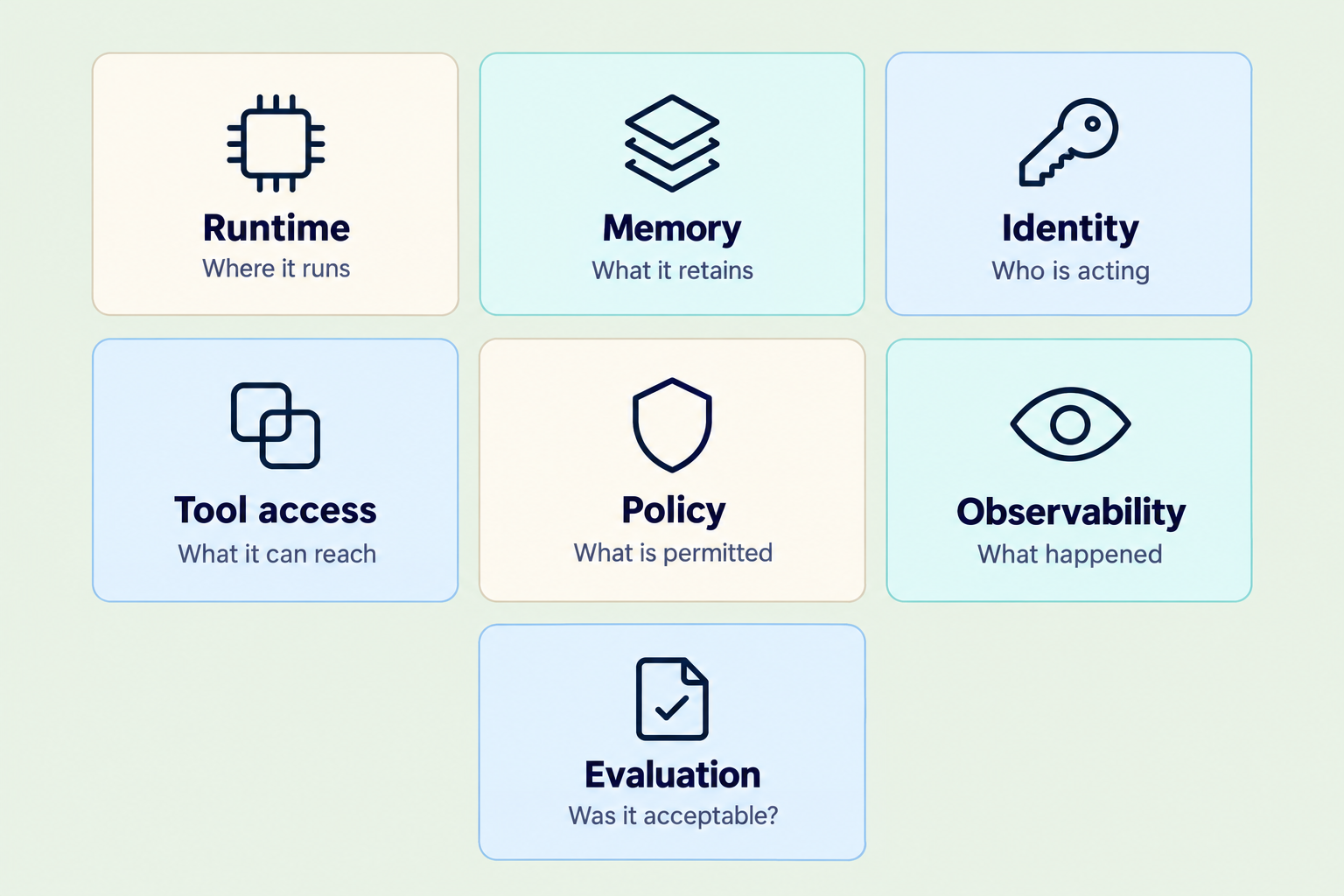
The operating layer becomes easier to evaluate when its responsibilities are divided into concrete capabilities. Each one answers a different production question.
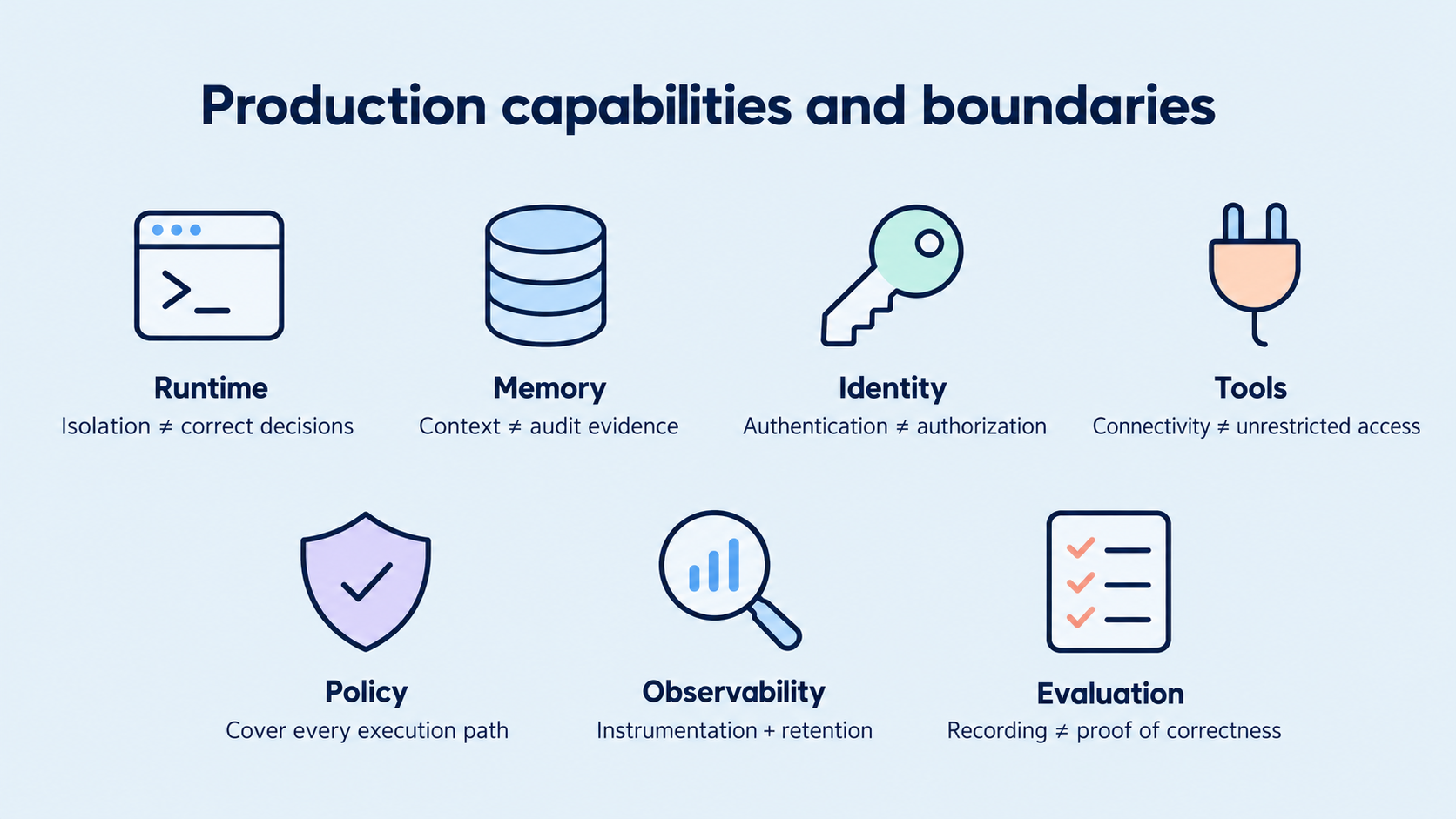
Runtime determines where execution happens
An AI agent runtime provides the environment in which agent code and related tools execute. Production systems may need isolated sessions, concurrency management, time limits, dependency management, and predictable behavior for long-running tasks.
Isolation can prevent one execution session from sharing its working environment with another. For example, AgentCore Runtime uses isolated sessions with separate execution environments and configurable lifecycle limits. Operational limits can also keep unproductive agent loops from consuming resources indefinitely. These mechanisms govern execution conditions. They cannot determine whether the agent's final decision complies with the business process. Evaluation and external controls must address that requirement.
Memory preserves context under defined rules
A multi-step assistant needs short-term context to continue a conversation. Some workflows also benefit from recalling approved information between sessions, such as a user's preferences or the status of an ongoing case.
Persistent memory requires explicit decisions about what to store, how long to retain it, when to retrieve it, and whose information can be included. A support agent should not carry one customer's private context into another customer's session.
Memory serves a different purpose from operational evidence. Remembering a customer's communication preference will not prove which billing endpoint an agent called or whether a refund was recorded. Incident investigation requires reliable telemetry and records from the systems that performed the action.
Identity establishes who is acting
An agent may act under a service identity, on behalf of a signed-in employee, or through credentials delegated for a specific operation. AI agent identity management establishes that relationship and supports controlled credential access. In AWS, AgentCore Identity uses workload identities and can broker access to credentials for agents acting on behalf of users.
Authorization must then determine which resources and actions are permitted. The same agent may be allowed to read billing status while requiring employee approval before issuing a refund. Downstream systems also need to enforce the appropriate permissions rather than trusting the agent's own description of its authority.
Tool connectivity gives agents access to business systems
Agents become useful when they can interact with applications that hold current information and perform work. A tool layer can expose selected CRM operations, ticket actions, document searches, and internal services through reusable interfaces.
The exposed operations should match the agent's task. An agent investigating payment disputes, for example, might need account lookup and case creation while having no access to unrestricted billing-administration functions.
Policy enforcement puts decisions outside model reasoning
An agent can request an action that conflicts with company policy even when its instructions tell it to follow that policy. Enforceable checks can determine whether the requested operation is allowed to proceed.
A company might allow an agent to prepare a refund recommendation while requiring an authorized employee to approve the transaction. Higher-risk actions can also require validation of customer identity, account status, monetary limits, and request parameters before execution.
Those controls need to apply to every relevant execution path. A policy that checks requests through one gateway will not automatically govern a separate direct connection from the agent to the underlying API.
Observability records execution for investigation
AI agent observability connects a workflow with operational evidence. Useful telemetry may identify the initiating user, agent session, requested tool, supplied parameters, execution result, error, duration, and relevant correlation IDs.
That visibility depends on instrumenting the application and downstream services, retaining suitable records, and protecting sensitive information in logs. An execution trace can document recorded activity. It cannot independently prove the final state of every connected business system or expose every internal aspect of model reasoning.
Evaluation tests whether the behavior was acceptable
Observability explains recorded execution. Evaluation examines whether the resulting behavior met the required standard.
A support agent may call the expected tools and still apply an incorrect policy. Production-readiness tests should therefore cover normal cases, missing information, unauthorized requests, tool failures, and situations that require escalation. Teams should repeat those tests after changes to models, prompts, tools, or business rules.
The distinction is important because an agent can be operationally visible while repeatedly making an unacceptable decision.
Are your AI agents ready to act in business systems?
How Amazon Bedrock AgentCore supports an AI operating layer
Amazon Bedrock AgentCore provides a practical AWS example of modular infrastructure for deploying and operating agents. AWS describes AgentCore as a platform whose capabilities can be used together or independently and with different models and agent frameworks. It provides managed building blocks while leaving organizations responsible for how those components connect to their systems, controls, and business policies.
Several AgentCore services map directly to the seven capabilities described above.
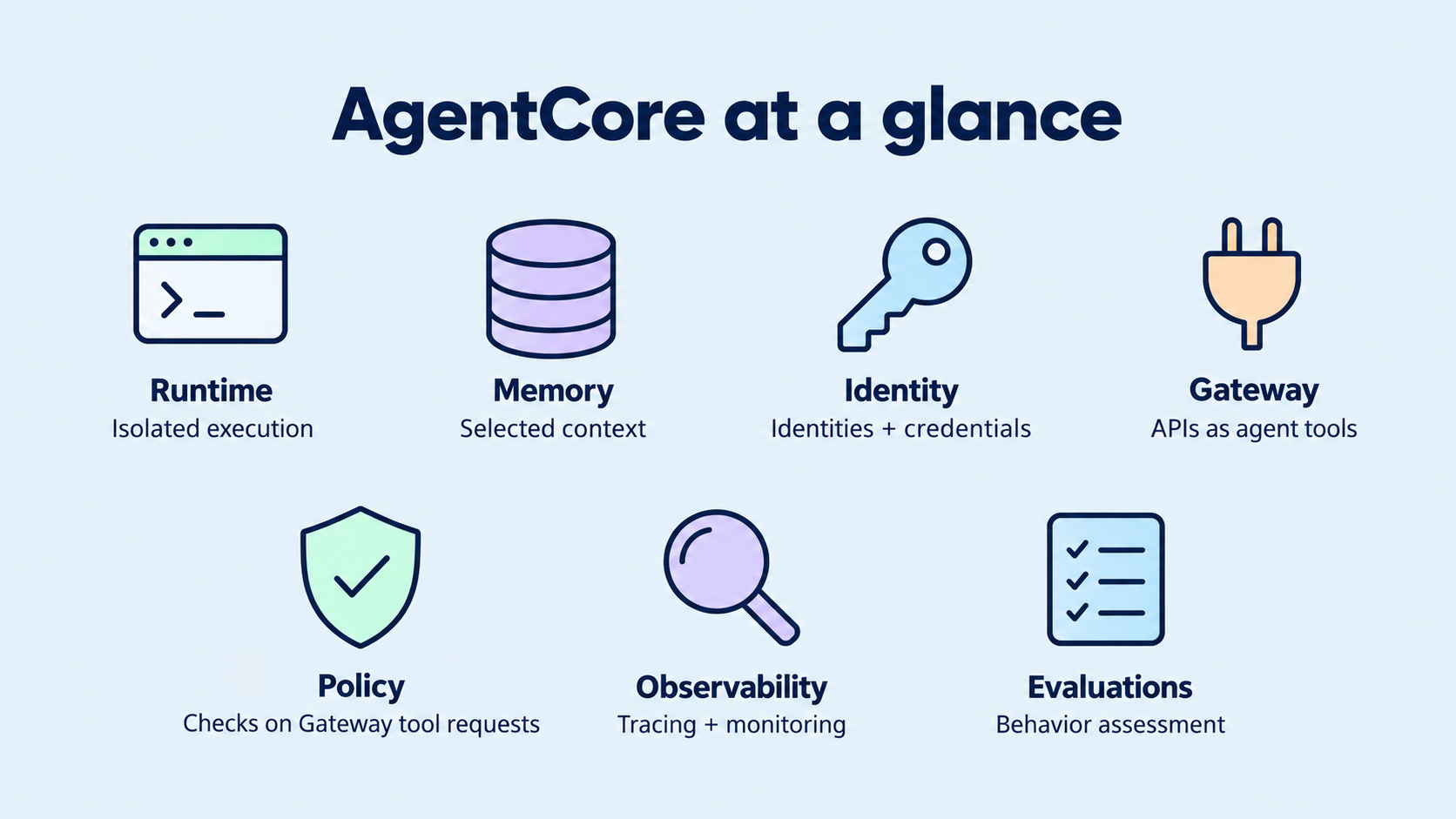
Runtime · Memory · Identity · Gateway · Policy · Observability · Evaluations
AgentCore includes other capabilities, but these seven establish the operating-layer discussion. AWS announced AgentCore general availability on October 13, 2025. AgentCore Evaluations reached general availability in March 2026, after first appearing in the service documentation in late 2025.
One technical boundary deserves particular attention. AgentCore Policy evaluates requests routed through AgentCore Gateway against configured policies before allowing supported tool access. Organizations therefore need additional safeguards for tools or connections that bypass the gateway.
AgentCore Memory can retain conversational context and selected information between interactions. Whether a particular detail is available later depends on memory configuration, actor and session scoping, memory strategy, and retrieval behavior. Likewise, AgentCore Observability provides service metrics and can surface trace-derived data when the required observability configuration and application instrumentation are in place. Teams still need suitable telemetry and retention settings before relying on those records during an investigation.
Managed infrastructure can reduce the amount of common platform work a team needs to develop independently. It still leaves usage costs, business integrations, operational ownership, and acceptable-agent-behavior decisions with the organization.
A managed platform doesn't configure itself for your environment
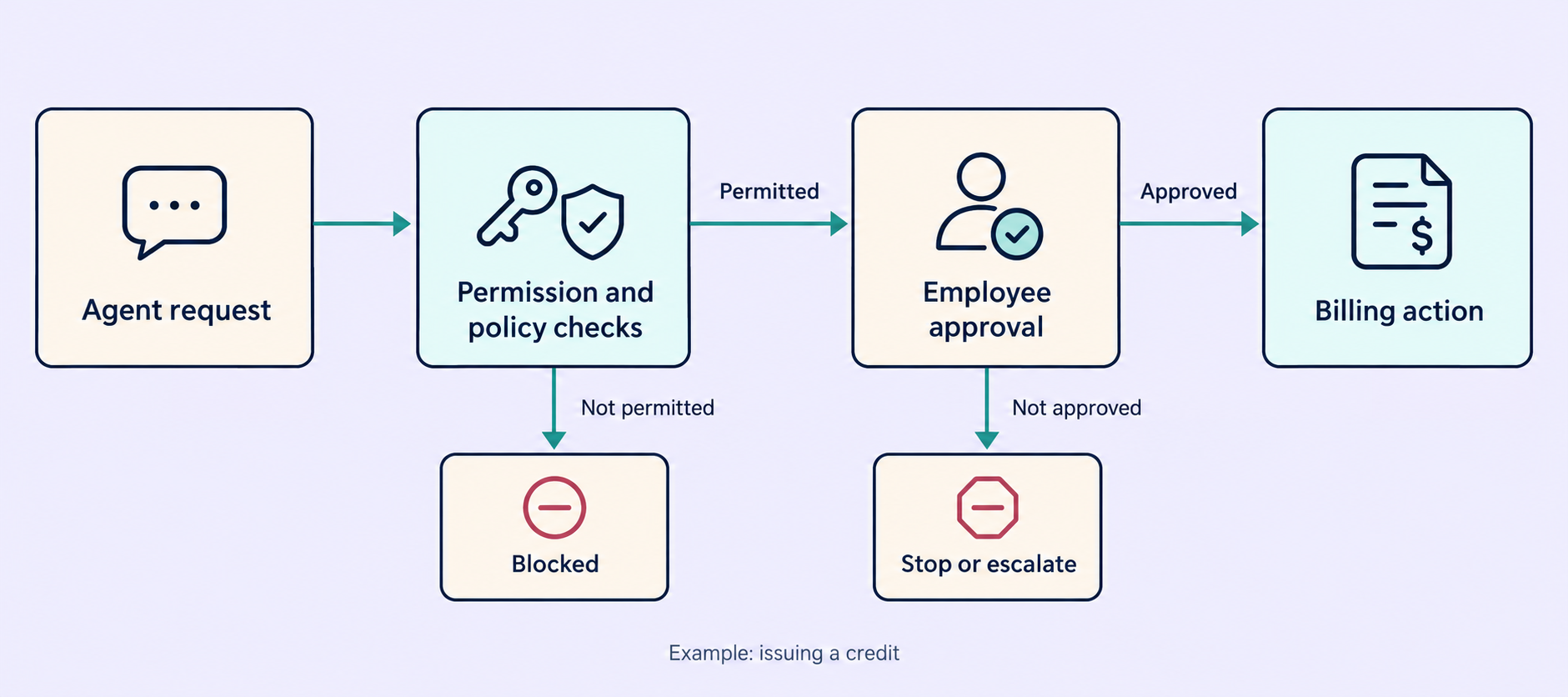
The architecture becomes specific when an agent enters a company's production systems. A platform can provide identity integration and policy capabilities, but the business must decide whose identity the agent should represent and which actions that identity may perform.
Consider a billing-support workflow. Reading an invoice, drafting an adjustment, and issuing a credit may require three different levels of authorization. The company needs to decide whether a customer request is sufficient to initiate an adjustment and when an employee must approve the result.
Memory creates another set of decisions. Customer preferences may be useful for future conversations, while payment details may be unsuitable for persistent agent memory. Retention periods and access rules should follow the organization's data policies.
Execution design creates further responsibilities. If an agent calls an external system and receives a timeout, repeating the request may cause a duplicate change. Engineers need suitable idempotency controls, result checks, recovery behavior, and escalation rules. The agent should also have limits on retries, duration, and potentially costly tool calls.
Observability requires decisions about instrumentation and access to evidence. Logs containing account numbers or personal details may need redaction, restricted access, and defined retention. A security team investigating a disputed action may need correlated records from the agent platform, API gateway, and billing system.
AI agent governance depends on these concrete choices. Policies, identity controls, evaluation criteria, and incident procedures become effective when teams define ownership and ensure that relevant execution paths pass through the required controls.
Return to the disputed ticket: What should the team be able to investigate?
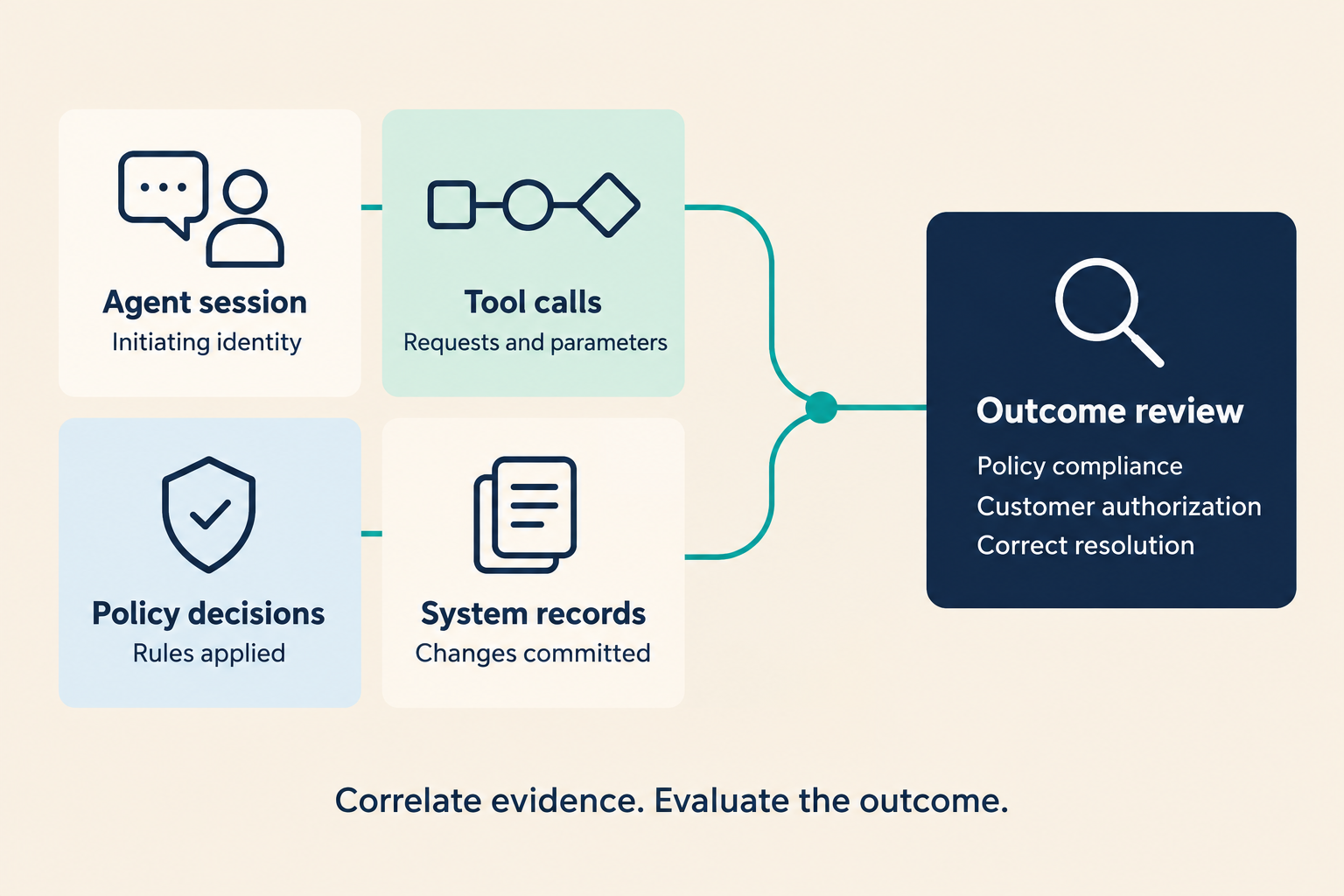
Return to the support agent that closed the disputed customer case. An operating layer configured for this environment could allow investigators to establish which user initiated the request and which agent session processed it.
Correlated traces could identify the tools the agent invoked and the parameters recorded for each call. Policy decisions could show whether the requested operation passed the defined access rules. CRM and billing logs could establish what changes their systems committed, including whether an attempted adjustment succeeded.
The team would still need to evaluate the business outcome. Did the support policy permit closing the ticket? Was customer authorization required? Did the agent interpret the available evidence correctly? A trace of successful API calls cannot answer those questions by itself. Evaluation criteria, transaction records, and the relevant policy version remain necessary.
The investigation might reveal a permissions problem, incomplete telemetry, an inaccurate model decision, a stale memory entry, or a defect in the underlying billing process. Each finding points to a different correction.
Production infrastructure makes this kind of investigation more feasible when the organization has deliberately configured and connected the necessary controls. Evidence that was never collected cannot be reconstructed reliably after an incident.
How to assess AI agent production readiness
Before deploying an agent that can act in business systems, engineering, security, and process owners should review the operating environment together. The following questions provide a practical starting point rather than a formal certification standard.
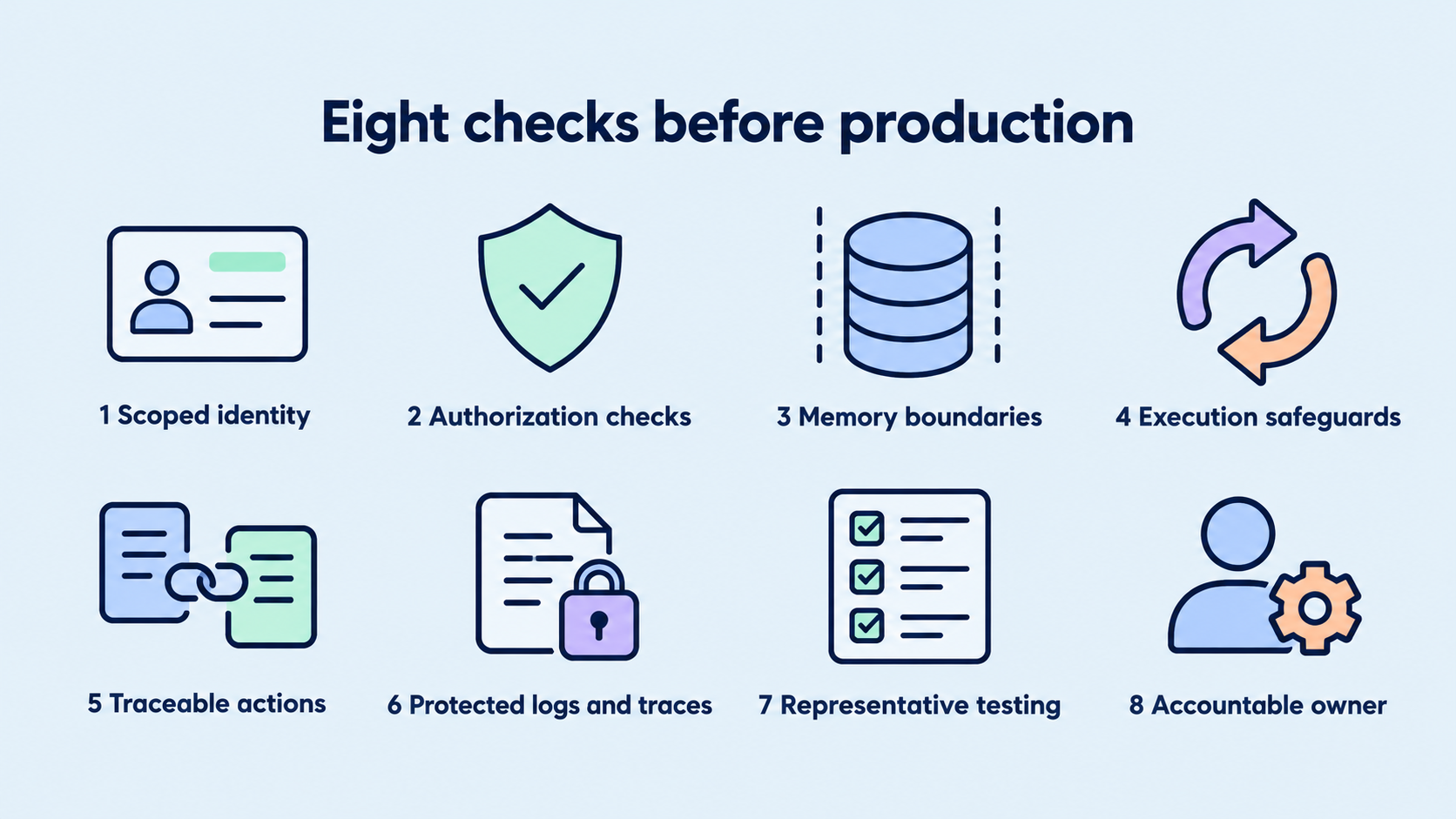
A positive answer requires evidence from deployment configuration and operational tests. Teams should repeat the review when agents receive additional tools or authority because the risk profile can change even when the underlying model remains the same.
The operating layer determines whether an agent can earn production trust
An agent that completes a demonstration has shown that its instructions, model, and tools can work together for a particular task. A business that depends on the agent needs stronger evidence around execution, permissions, continuity, incident investigation, and ongoing quality.
An AI operating layer provides a way to organize those requirements. Managed services such as Amazon Bedrock AgentCore can supply reusable runtime, memory, identity, gateway, policy, observability, and evaluation capabilities. Each deployment still requires decisions about how those capabilities connect with business processes, existing systems, and organizational responsibilities.
Applify helps organizations design and integrate production AI agents around their data, enterprise applications, access controls, and operational requirements. An implementation should begin with the work an agent is authorized to perform and the evidence the business will need when that work is questioned.
Explore Applify's AI agent development services to discuss the architecture and controls required for agents operating in your environment.