AI cost optimization: How to reduce costs without compromising business value
A lower model bill doesn’t always mean cheaper AI. Explore AI cost optimization strategies across models, prompts, retrieval, caching, and agents to reduce cost per successful task while maintaining quality and business value.


- Measure AI efficiency by cost per successful task, including retries, corrections, and human review.
- Track the full operating cost across inference, retrieval, infrastructure, and agent execution.
- Match model capability to task complexity, using smaller models where they meet quality requirements.
- Reduce unnecessary context, improve retrieval, and cache reusable work.
- Use batch inference when immediate responses add no business value.
- Set limits on agent steps, retries, and tool calls to control spending.
- Test each optimization against quality, latency, reliability, and business outcomes.
A company processes 10,000 documents through an AI application. The model bill stays within budget, yet employees spend hours correcting extracted fields, reviewing uncertain responses, and reprocessing documents the application failed to complete.
Another implementation costs more per request but produces fewer errors. Employees review fewer outputs, and a greater share of documents reaches the required quality threshold.
The second system may be cheaper for the business.
AI cost optimization examines the resources required to complete useful work rather than treating model price as the complete measure of efficiency.
Production AI applications can consume resources through inference, retrieval, storage, external tools, orchestration, monitoring, retries, and human review. As usage grows, small inefficiencies inside each request can compound into significant operating expenditure.
The useful question for a business leader is therefore not simply, “How much does this model cost?”
A better question is, “What does it cost us to complete one acceptable unit of work?”
What is AI cost optimization?
AI cost optimization is the practice of reducing avoidable expenditure in an AI workload while maintaining defined requirements for quality, latency, security, reliability, and business outcomes.
For generative AI applications, the work can include model selection, prompt and context design, retrieval, caching, inference architecture, agent execution, deployment, and cost attribution.
A customer-support assistant illustrates why these components need to be evaluated together.
Its expenses can include model tokens, retrieved company information, vector searches, application infrastructure, validation checks, and employee review. If a weak answer causes another model invocation or an employee escalation, that failure contributes to the economics of the task as well.
The AWS Well-Architected Generative AI Lens recommends treating cost as a design consideration when selecting models and evaluating the smallest suitable model against workload requirements before moving to greater capability. AWS Well-Architected guidance on cost-aware model selection
AI cost management therefore begins with workload requirements and measurable outcomes. Cost reduction is useful when the system continues to meet those requirements after the change.
The AI bill extends beyond model tokens
Inference receives significant attention because model providers publish token prices, yet a production application can have several other cost drivers.
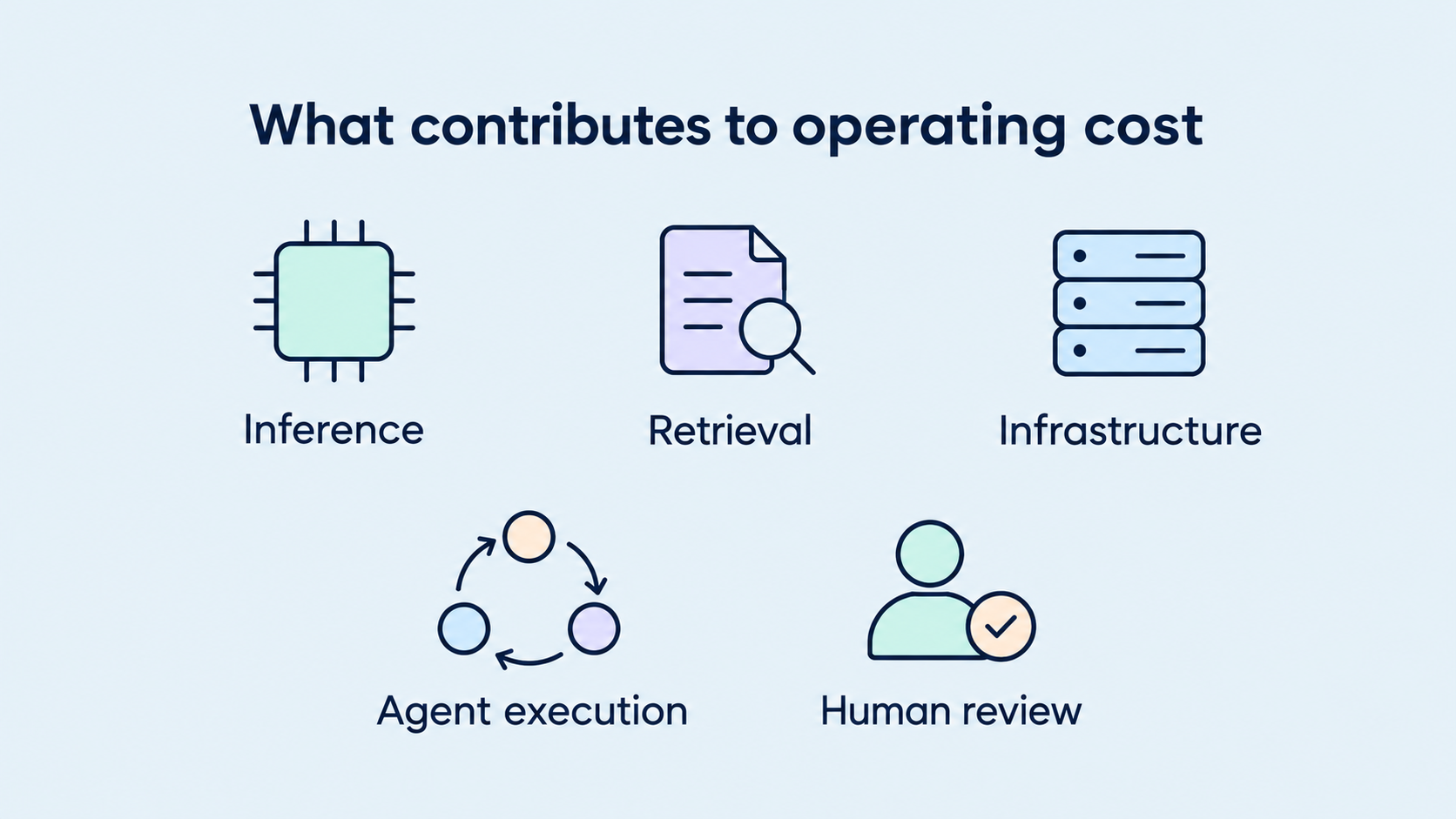
A document-processing application may use an embedding model, vector database, language model, application backend, monitoring system, and validation service. Agentic applications can introduce additional model calls and tool activity as a workflow progresses through several steps.
A useful cost model separates these components.

The categories need consistent definitions to avoid counting the same expense twice.
Cost attribution should then connect expenditure with an application, workload, customer, or business process.
A growing cloud bill does not tell a leader whether demand increased, an architecture became inefficient, or the application started producing more valuable output.
Measure cost per successful task
A cheaper model call does not guarantee a cheaper business process.
FinOps provides a useful framework for this distinction through unit economics. The FinOps Foundation recommends relating technology expenditure to units that represent organizational value, such as cost per transaction, case resolved, customer, workload, or AI action. It also specifically notes that generative AI measurement can progress from cost per token toward outcome-oriented measures such as cost per assist or cost per agent action.
For many AI applications, one useful metric is:
Cost per successful task = attributable operating cost ÷ tasks meeting acceptance criteria
The numerator can include inference, retries, retrieval, infrastructure, and applicable correction costs. The denominator counts work that meets a defined quality threshold.
The definition of success needs to match the workflow.
A document-extraction task could require every mandatory field to pass validation. A customer-support task might require a resolved issue that does not reopen within a defined period.
Why the smaller AI bill can still produce worse economics
Consider two hypothetical document-processing workflows attempting 10,000 tasks under the same acceptance criteria.
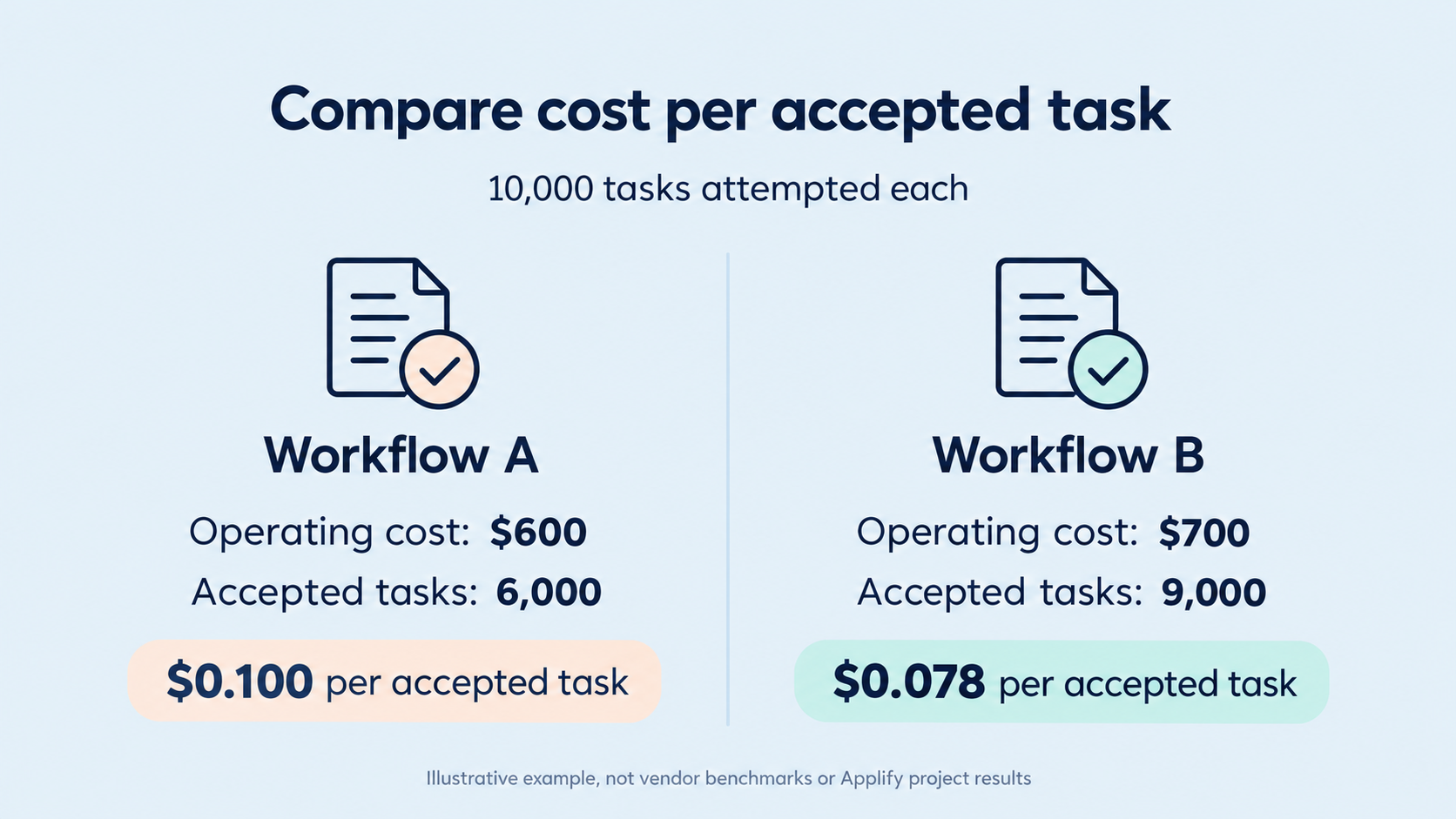
Workflow B spends $100 more during the measurement period but produces 3,000 additional accepted outputs. Its cost per accepted task is about 22% lower using the unrounded calculation.
The comparison should also account for processing time, error severity, employee review, and the economic value of each completed task.
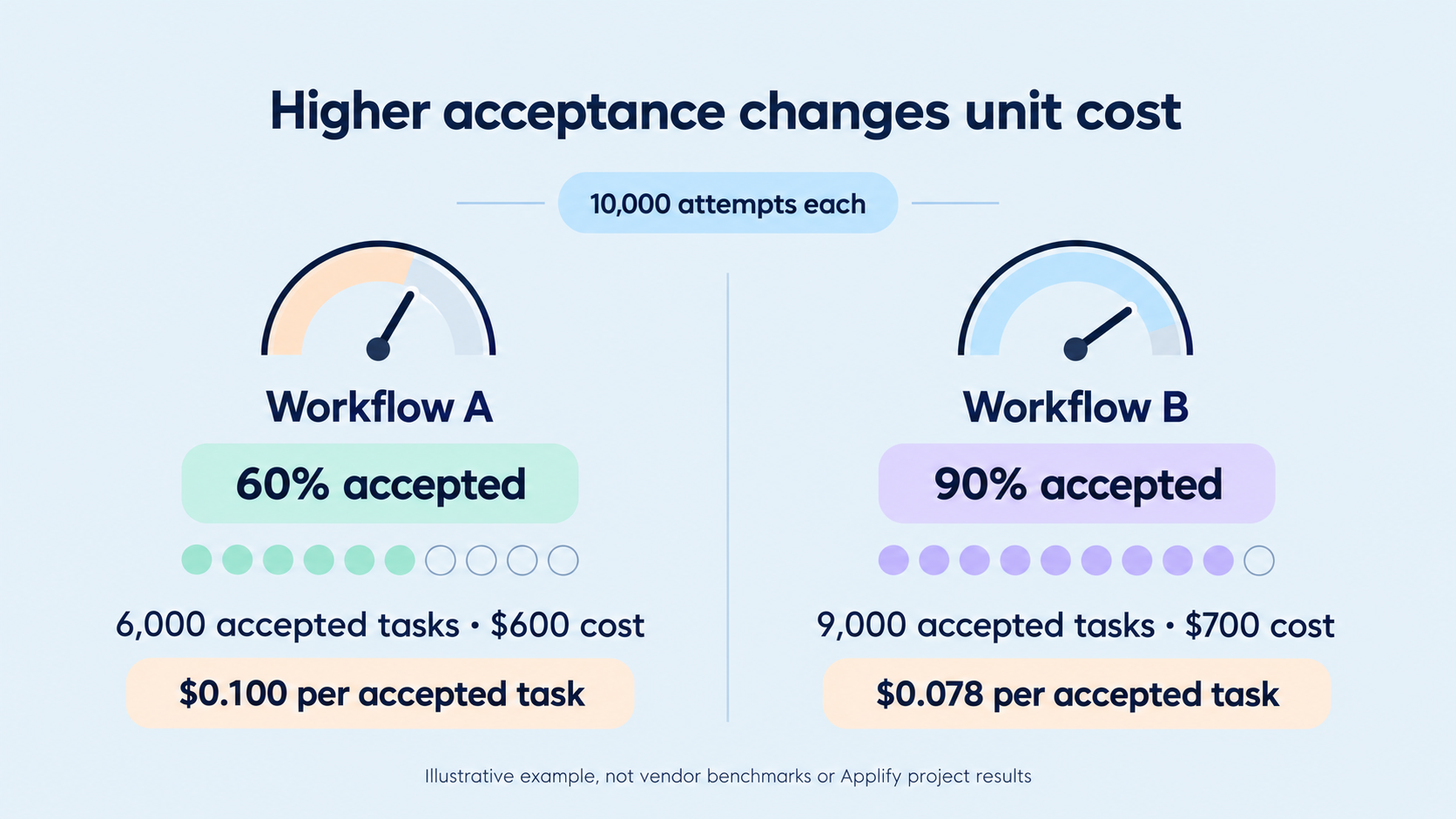
This is why AI cost optimization needs a unit-economics measure rather than a model-price comparison alone.
Business savings and AI operating costs are different measurements
AI can reduce the cost of a business process while the AI system itself still carries meaningful operating expenses.
Those two measurements should remain separate.
Applify reports this distinction indirectly in a 2025 remote-patient-monitoring project built with AWS and generative AI. The implementation used services including Amazon SageMaker, Amazon Bedrock, Amazon Comprehend Medical, and AWS Lambda. According to Applify's published case study, the customer achieved $2.5 million in annual cost savings alongside a 35% reduction in clinical reporting time. These are company-reported customer outcomes rather than independently verified benchmarks.
Those figures describe the value created in the healthcare operation. They do not establish what the models cost to serve, how much each prompt cost, or whether a different inference architecture would have reduced the AI bill further.
An AI cost review should measure both sides when the data is available:
- What does the AI workload cost to operate?
- What economic value does the resulting work create?
Optimizing one without measuring the other can lead to poor decisions.
Match model capability to task complexity
Model selection directly influences inference expenditure.
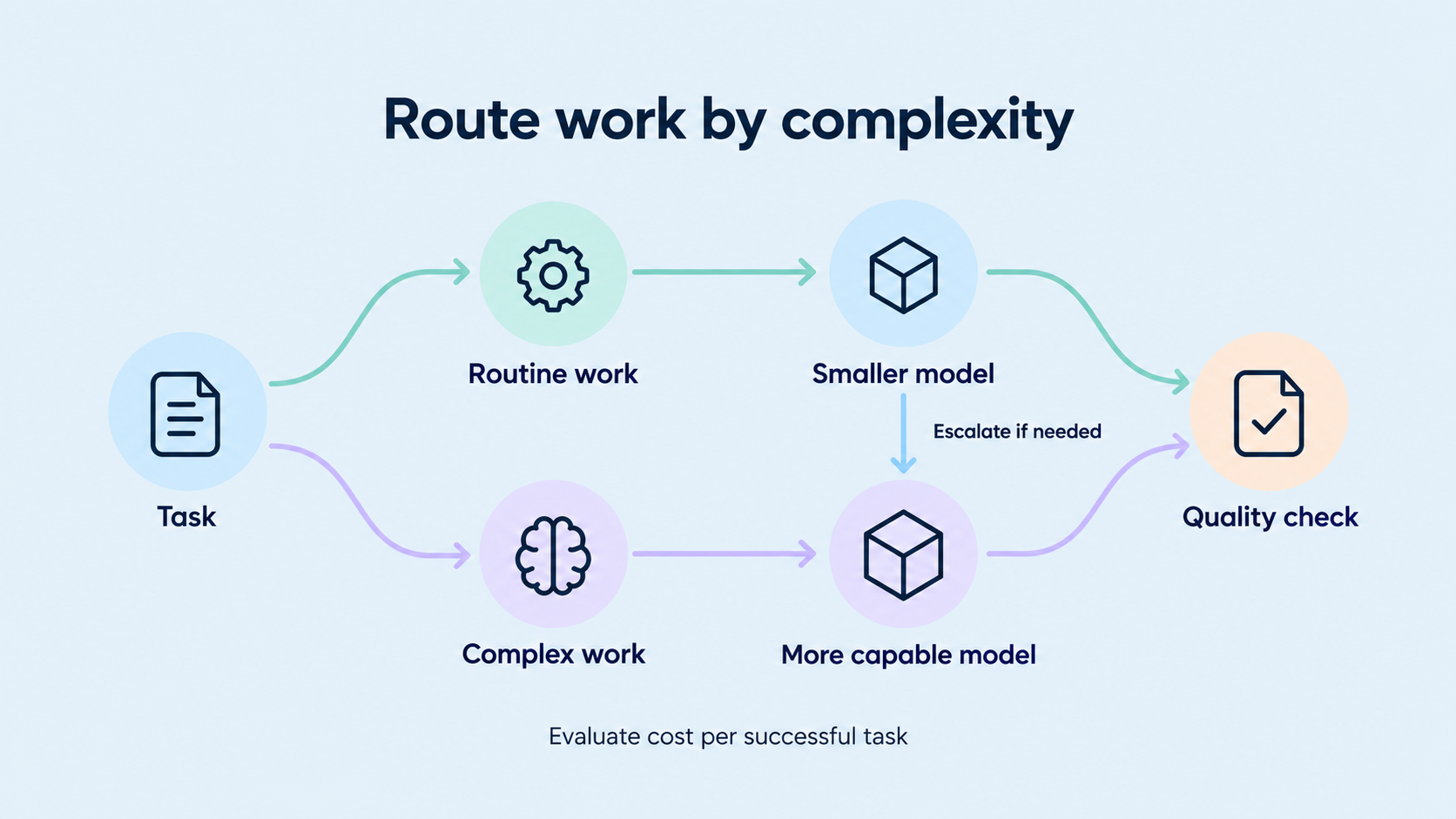
A workflow may contain classification, extraction, summarization, planning, and complex analysis. Each operation can require a different level of model capability.
An insurance document workflow, for example, might identify document type, extract policy fields, validate information, interpret unusual clauses, and prepare a review summary.
Classification and structured extraction can be candidates for smaller models if they meet the acceptance threshold. Unusual policy interpretation may require greater reasoning capability.
Model routing gives teams a way to make this decision at the task level.
The architecture can send predictable work to a lower-cost model and escalate uncertain or complex requests when evaluation indicates that greater capability is required.
The mechanism works only when quality is measured. A lower-priced model that generates more retries, corrections, or escalations can increase the cost of completing the workflow.
A model evaluation should therefore compare accepted outputs, latency, failure behavior, escalation rate, and cost per successful task.
What does a successful AI task cost your business?
Reduce token consumption by removing unnecessary context
Many generative AI pricing models charge according to processed input and generated output.
The input can contain system instructions, user messages, conversation history, retrieved information, examples, and tool results.
Every piece of context should have a reason to be there.
A customer-support assistant may repeatedly send a large instruction set, several earlier turns, and multiple policy documents even when the current question concerns one narrow issue.
A more selective context assembly process could provide the current request, a compact representation of relevant history, and the specific policy content required to answer it.
AWS identifies prompt length, output length, prompt caching, and cost-aware filtering as distinct cost optimization areas in its current Generative AI Lens.
Removing context indiscriminately is risky. Missing instructions or evidence can lower answer quality and increase retries.
The optimization target is therefore information density: enough context to complete the task without repeatedly processing content that does not influence the answer.
Treat retrieval cost as part of the AI workload
Retrieval-augmented generation adds external information to model context, but retrieval creates its own consumption profile.
Documents may need chunking and embedding. Vector stores require storage and query resources. Some architectures use hybrid search, reranking, query transformation, or several retrieval attempts before generation.
Those components can increase both cost and latency.
Duplicate documents increase storage and embedding work. Broad retrieval can send low-value chunks into the model context. Repeated reranking can add inference or infrastructure activity without a proportional improvement in answer quality.
The retrieval configuration should therefore be evaluated against the task.
A policy assistant may need a small number of highly relevant passages. Research-oriented workflows can justify broader retrieval when additional sources improve acceptance rates.
Useful measurements include retrieval volume, retrieved-token count, reranking activity, latency, answer acceptance, and cost per successful task.
For applications using RAG, the objective is to retrieve enough evidence to support the answer while avoiding context the model does not need.
Cache repeated work when the economics support it
Repeated context creates an opportunity to avoid recomputation.
Prompt caching lets supported inference services reuse processing associated with stable prompt content. Examples include system instructions, reference documents, long tool definitions, and other prefixes reused between calls.
The savings can be significant when repeated context represents a large share of the input.
A 2025 AWS customer case study describes how Care Access used Amazon Bedrock prompt caching in medical-record processing and reported an 86% reduction in data-processing costs and 66% faster processing. The workload repeatedly analyzed large medical records for different questions, which made reusable prompt content a meaningful cost driver.
The mechanism is important. Prompt caching creates value when subsequent requests reuse eligible prompt content.
Response caching solves a different problem. It stores a previously generated answer and returns it when the same result remains appropriate.
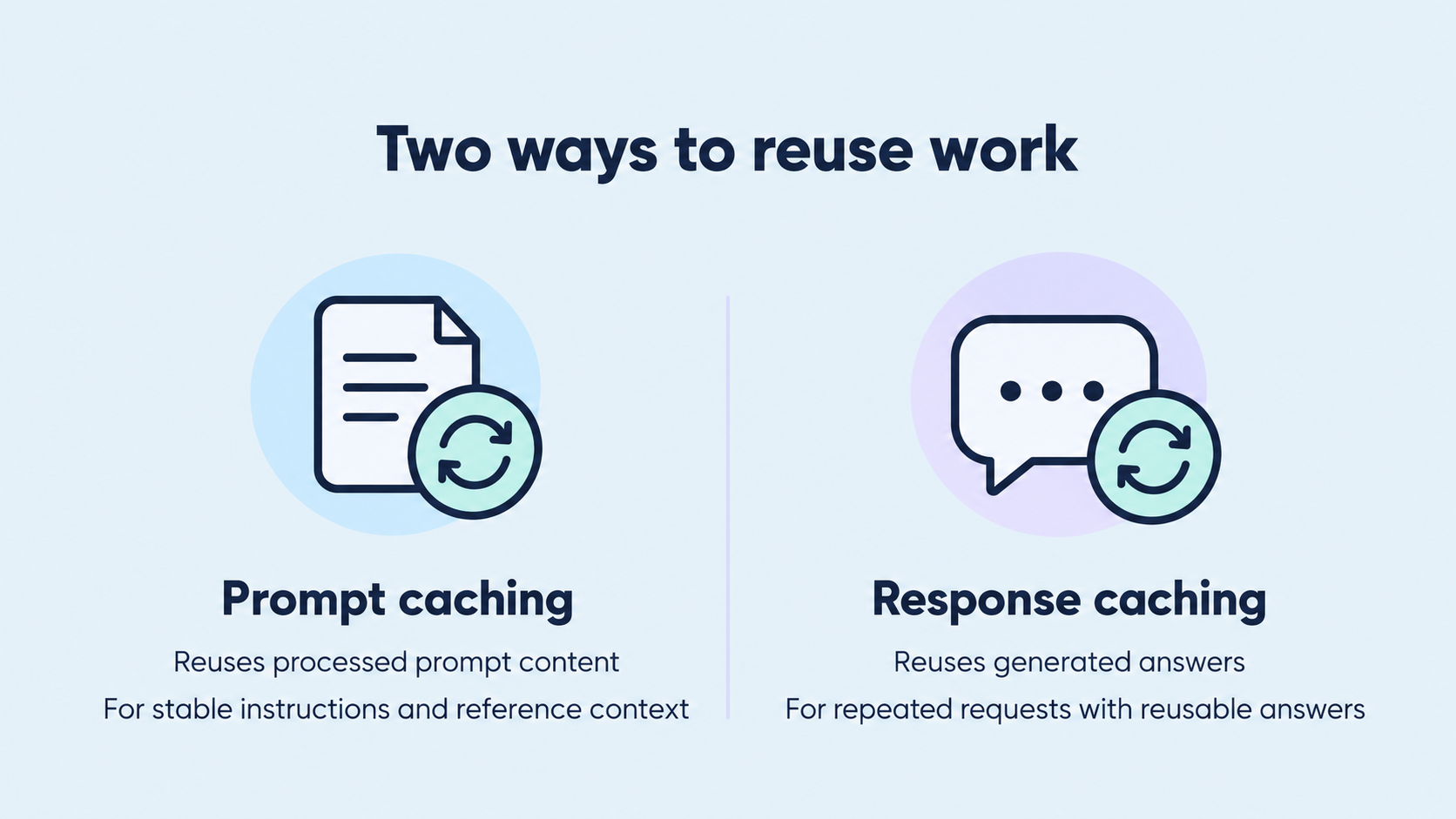
Each approach requires rules for cache validity, authorization, and freshness.
A customer-specific answer, for example, should not be returned to another user simply because the question appears similar.
Teams should measure cache hit rate, cache-related charges, total application savings, invalidation behavior, and output quality rather than quoting a provider's cache discount as a reduction in the complete application bill.
Use batch inference when immediate output has no business value
Some AI tasks need interactive responses. Others can finish later without affecting the business process.
Scheduled classification, bulk summarization, enrichment, evaluation jobs, and offline document processing can be candidates for asynchronous inference.
The timing requirement creates the optimization opportunity.
Amazon Bedrock currently offers batch inference for selected foundation models at 50% lower pricing than corresponding on-demand inference, subject to model availability and configuration
A team still needs to account for storage, orchestration, data preparation, and other services used around the batch workload.
The decision therefore begins with the service-level requirement.
If a result is needed tomorrow morning, paying an interactive inference premium to receive it within seconds may add cost without adding business value.
Put explicit cost boundaries around agentic AI
Agentic workflows can generate several inference and tool operations from one user request.
An agent might interpret a task, create a plan, retrieve information, call a tool, inspect the response, revise its plan, and repeat the sequence.
Weak stopping conditions can turn this flexibility into unpredictable expenditure.
A failed tool may trigger repeated calls. An uncertain agent may continue searching for information it already has. Multi-agent workflows can add additional reasoning and coordination steps.
Current AWS Agentic AI Lens guidance recommends matching reasoning depth to task complexity, setting token and iteration ceilings, reusing cached information, and attributing expenditure to the workflow or agent that caused it.
Useful controls can include maximum reasoning steps, model-request budgets, retry limits, execution timeouts, tool-call limits, and escalation conditions.
The system should also know when to stop autonomously.
Continuing an unsuccessful agent loop may cost more than escalating the task to an employee.
Compare managed and self-hosted inference using total ownership cost
Managed APIs and self-hosted models have different cost structures.
Managed inference shifts infrastructure operation to the provider and can charge through tokens, requests, throughput, or service tiers.
Self-hosting gives an organization greater control over deployment and infrastructure but introduces compute, utilization, scaling, monitoring, reliability, security, upgrades, and engineering effort.
Utilization often changes the economics.
A dedicated inference environment serving stable, predictable demand may use provisioned resources efficiently. An irregular workload may leave infrastructure idle between traffic spikes.
Engineering time also belongs in the comparison.
A self-hosted environment needs people to maintain the serving stack, diagnose performance problems, manage model versions, secure the environment, and maintain availability.
The correct comparison is therefore total cost of ownership under the expected demand pattern.
Neither deployment model has an automatic cost advantage.
FinOps for AI should connect consumption with business outcomes
AI cost management becomes more useful when finance and engineering can identify what generated the spend.
Infrastructure-level reporting can show service charges. AI applications need a second layer of attribution tied to workloads and outcomes.
Useful dimensions can include application, tenant, model, workflow, request type, accepted outcome, retry count, retrieval activity, and agent.
AWS expanded this capability in April 2026 by introducing granular Amazon Bedrock cost attribution that automatically attributes inference cost to the IAM principal making the request. AWS positions the capability as a foundation for chargeback, optimization, and financial planning.
Infrastructure attribution still needs to connect with business data.
A support application that costs more this quarter may be serving twice as many users successfully. Another application may spend more because retry rates increased.
Those situations require different responses.
FinOps for AI gives engineering, finance, product, and business owners a shared way to review those tradeoffs.
Build AI cost optimization as a repeatable operating process
AI optimization should continue after deployment because models, pricing, traffic patterns, retrieval requirements, and user behavior change.

A practical review cycle can use five steps.The sequence prevents teams from applying fashionable optimizations without evidence that the selected component is causing the problem.
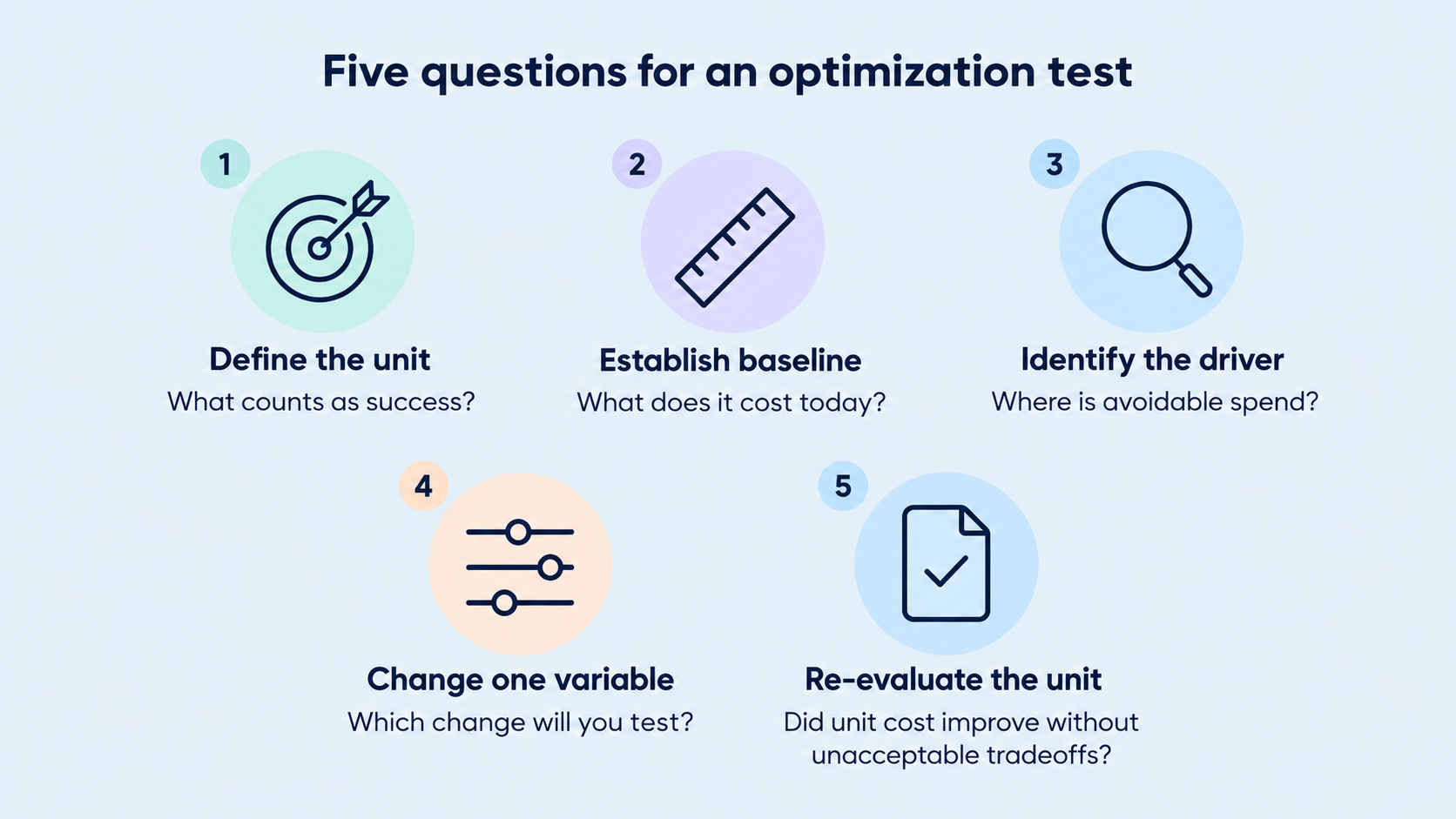
A workload dominated by inference may benefit from model selection or prompt changes. Retrieval-heavy workloads may benefit from indexing, chunking, or selection changes. Agent workflows may need tighter execution boundaries.
Each intervention can introduce a tradeoff.
A shorter context can lower answer quality. A cheaper model can increase escalations. A cache can return stale information. A routing layer can introduce extra latency and maintenance.
Testing those effects against production-like evaluation data turns cost optimization into an engineering discipline rather than a monthly bill-reduction exercise.
Better AI economics begin with successful work
Production AI should be evaluated by the cost of delivering useful outcomes rather than the price of an individual token.
Model selection, prompts, retrieval, caching, inference architecture, agents, and infrastructure all influence expenditure. Quality, latency, human intervention, and failure rates determine whether those resources create acceptable work.
Cost per successful task gives business and technical leaders a shared measurement for reviewing these decisions.
The metric also creates a practical optimization rule:
Reduce the resources required to complete acceptable work, then verify that the work still meets its business threshold.
Applify helps businesses evaluate generative AI workloads, design production architectures, and improve the economics of AI applications through model evaluation, application integration, cloud architecture, retrieval, agents, and performance optimization.
For organizations preparing to scale an AI workload or investigating rising operating expenditure, a structured review can identify which optimization levers deserve engineering effort.
Explore Applify's generative AI consulting services to discuss the architecture, operating costs, and production requirements of your AI applications.