AWS re:Invent 2025 recap- What mattered and what leaders should do next
Explore the top AWS re:Invent 2025 highlights and announcements. Learn what changed in AI, cloud, data and security and what leaders should prioritize next.
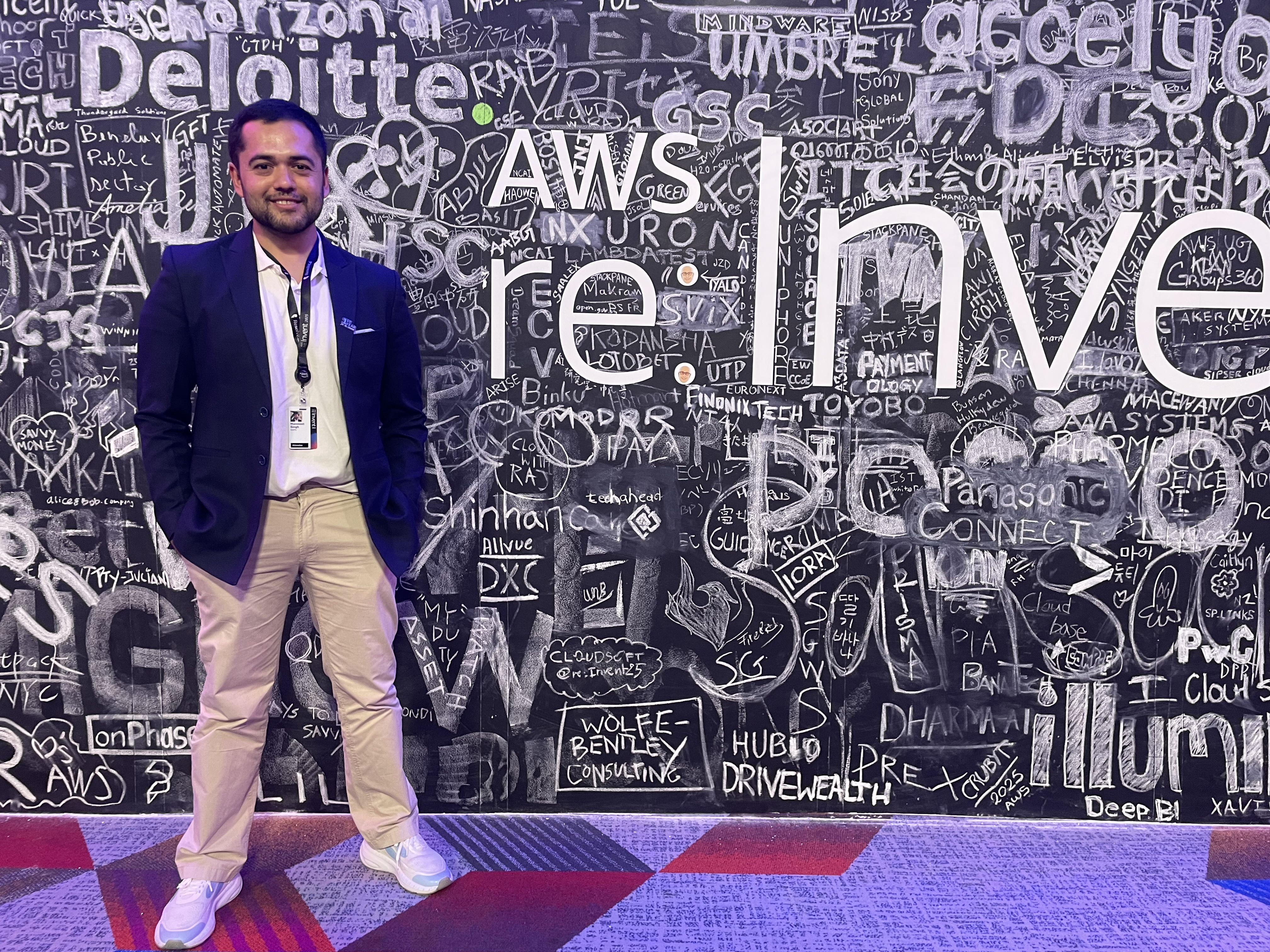
AWS re:Invent 2025 once again demonstrated why it remains the most influential global event for cloud, AI and enterprise technology. With thousands of builders, product teams, partners and organizations gathering in Las Vegas, the tone of this year’s conference was clear. The industry is now shifting from experimentation with generative AI to scaled enterprise deployment powered by automation, governance and intelligent cloud platforms.
Across conversations, announcements and customer stories, one theme stood out. 2025 is the year AI and cloud maturity moved from proof of concept to standard operating model.
For enterprises, AWS re:Invent 2025 was not just a showcase of new capabilities. It was a roadmap for what leaders, architects and transformation teams must prioritize as AI operations, scalable compute and trusted data foundations become business-critical.
Key themes emerging from AWS re:Invent 2025
The year AI became operational
Generative AI took center stage again, but this time with a noticeable evolution. Rather than focusing only on model performance, AWS emphasized production readiness, multi-agent workflows and governance.
Several announcements accelerated this shift including:
- The general availability of foundation models including Amazon Nova Premier, Nova Sonic, Claude 4 family and DeepSeek-R1 inside Amazon Bedrock
- Expansion of multimodal capabilities including text, audio, images and video
- Model distillation to accelerate inference while lowering operational cost
- Multi-agent orchestration that coordinates complex workflows autonomously
With the introduction of AgentCore, organizations can now deploy AI agents with memory, identity, secure browser access and code execution. This brings a new era where AI systems do more than respond. They analyze, plan and act.
Security and governance also matured significantly. Updated Bedrock Guardrails now include multimodal safety, enterprise policy enforcement and automated reasoning checks to reduce hallucination.
For organizations preparing AI transformation, these advancements reinforce the importance of AI ready data and scalable pipelines. Strategies now require more than model selection. They require responsible deployment frameworks, secure operations and enterprise-grade foundations.
Developer experience shifted to autonomous workflows
If 2024 was the year developers used AI tools, 2025 is the year developers will build with intelligent AI copilots operating inside their workflows.
Amazon Q Developer became the center of this shift, now deeply embedded across consoles, IDEs and command line interfaces. With Model Context Protocol support and integration with MCP servers for AWS services, developers can now automate tasks that previously required manual configuration or advanced cloud experience.
The introduction of Kiro and expanded agentic tooling signals a future where development is iterative, collaborative and partially automated.
This trend will accelerate demand for cloud modernization, automated pipelines and secure developer environments. Organizations beginning this journey can explore our expertise in cloud services, modern DevOps models and AI-assisted engineering practices.
Compute scale and economics entered a new era
AWS announced major improvements across compute capacity, pricing models and instance performance. AI workloads are now more cost aligned with usage, making large-scale experimentation and production deployment more accessible.
Key announcements included:
- New EC2 classes including C8gn, R8i, I8ge and the M8i family
- Up to 45 percent cost reduction for GPU-accelerated EC2 instances
- Amazon EKS expansion supporting up to 100,000 worker nodes
- Serverless improvements including increased Lambda payload size and ECS managed compute
Project Rainier, AWS’s AI supercomputing system built with Anthropic, marks a significant milestone in distributed model training. With nearly 500,000 Trainium2 chips integrated into a high-bandwidth cluster architecture, enterprise AI development has entered a hyperscale era.
These updates reaffirm that organizations pursuing enterprise AI success need flexible architectures and strategic cloud migration planning. Cost optimization, workload placement and modernization strategies are now core leadership topics.
Storage and databases became AI native
Data architecture was another defining theme. AWS introduced advancements that transform object storage and databases into AI-aware systems.
Notable releases included:
- Amazon S3 Vectors for natively storing and querying embeddings
- Amazon S3 Tables for Apache Iceberg compatibility
- Aurora DSQL general availability
- DynamoDB multi-Region strong consistency
- S3 Express One Zone performance and cost improvements
The message to leaders is clear. Cloud data estates are no longer designed only for analytics. They must now support multimodal data ingestion, AI retrieval, agent memory and real-time context awareness.
Platforms such as LakeStack by Applify will be essential in helping organizations transition from fragmented data systems to unified, intelligent and governed data platforms that support generative AI at scale.
Security and governance became embedded
Enterprise AI at scale requires rigorous compliance, policy enforcement and secure operating models. This year, AWS introduced updated foundational controls including:
- AWS Trust Center for transparency and compliance reporting
- Automatic WAF protection for DDoS threats
- Verified Access for secure connectivity
- Encryption and identity improvements across IAM and KMS
- Organization wide notification and CloudTrail visibility improvements
Governance is no longer treated as a later phase in AI adoption. It is now an entry requirement.
What these announcements mean for leaders
While the pace of innovation continues accelerating, the message from AWS re:Invent 2025 was practical and actionable.
Organizations now need to focus on:
- Scaling AI from pilots to platforms
- Building secure and governed data foundations
- Optimizing cloud infrastructure for sustainable cost
- Empowering developers with AI enabled workflows
- Modernizing legacy workloads to leverage cloud native services
This requires strategy, architecture and execution alignment across business leaders, solution architects, product owners and cloud engineering teams.
How Applify is acting on these industry shifts
For Applify, AWS re:Invent 2025 was a milestone moment. The event helped accelerate the roadmap for LakeStack, our platform designed for cloud modernization and generative AI readiness.
We are committed to translating these learnings into meaningful outcomes for customers across modernization programs, cloud architecture, intelligent automation, data platform readiness and generative AI adoption frameworks.
To continue exploring what this means for your teams, read: Automated data cleansing with LakeStack
Final reflection
AWS re:Invent 2025 made one thing clear. The organizations that thrive in the coming years will be those that operationalize AI, modernize cloud foundations and embrace automation as a core capability.
The next era of cloud is not only faster or more scalable. It is smarter, governed and built for intelligent systems that act alongside teams and products.
As the industry now prepares for what comes next, the question for leaders is not whether AI and cloud transformation will reshape business. It is how fast strategy, culture and technology can align to unlock the opportunity ahead.