Mainframe to cloud migration: a practical roadmap for enterprise teams
Many large organizations continue to rely on mainframes for their core transaction processing, data management, and mission-critical applications. However, the high costs, talent shortages, and lack of agility associated with these legacy systems are driving a strategic shift toward the cloud. Mainframe to cloud migration represents a significant opportunity for enterprises to reduce operational expenses, accelerate innovation, and build resilient, scalable architectures.

Many large organizations continue to rely on mainframes for their core transaction processing, data management, and mission-critical applications. However, the high costs, talent shortages, and lack of agility associated with these legacy systems are driving a strategic shift toward the cloud. Mainframe to cloud migration represents a significant opportunity for enterprises to reduce operational expenses, accelerate innovation, and build resilient, scalable architectures.
This comprehensive guide offers a practical, step-by-step roadmap designed specifically for enterprise IT and business teams. It covers thorough assessment, strategy selection using the 7 Rs framework, detailed risk mitigation tactics, and ongoing modernization.
At Applify, we help organizations execute seamless cloud migration and cloud modernization initiatives. Our expertise ensures that enterprises in regulated sectors like financial services and healthcare achieve both immediate value and long-term digital transformation.
Why enterprises are accelerating mainframe to cloud migration
Mainframes have provided unmatched reliability and processing power for decades. Yet today they present several pressing challenges:
- Rising costs: Hardware maintenance, software licensing, and energy consumption continue to escalate, often consuming significant portions of IT budgets.
- Talent shortages: Experienced mainframe programmers skilled in COBOL, PL/I, and related technologies are retiring, making it difficult and expensive to maintain systems.
- Limited agility: Rigid architectures hinder rapid feature development, integration with modern digital channels, real-time analytics, and AI/ML initiatives.
- Scalability constraints: Handling variable workloads or peak demands requires expensive over-provisioning.
- Compliance and security pressures: While mainframes are secure, integrating with modern tools and meeting evolving regulations like HIPAA, PCI DSS, and GDPR becomes increasingly complex.
By pursuing mainframe to cloud migration, organizations typically realize 30-60% or greater reductions in infrastructure costs, faster time-to-market, improved resilience, and access to a broader talent pool. For financial institutions and health systems, this also means enhanced customer experiences, better data insights, and stronger competitive positioning.
Explore our specialized offerings: cloud migration for financial institutions and cloud migration for health systems.
Key benefits of mainframe modernization in the cloud
Migrating to the cloud delivers transformative advantages:
- Cost optimization: Shift from capital-intensive fixed costs to flexible, pay-as-you-go models with built-in tools for cloud cost optimization.
- Elastic scalability: Automatically handle fluctuating demands using services like AWS Auto Scaling and serverless computing.
- Accelerated innovation: Adopt microservices, containers, event-driven architectures, and generative AI capabilities.
- Enhanced resilience and disaster recovery: Leverage multi-AZ deployments, automated backups, and global infrastructure.
- Improved security and compliance: Benefit from AWS’s shared responsibility model and extensive certifications.
- Data-driven capabilities: Enable real-time analytics, data lakes, and seamless integration with modern applications.
These benefits align closely with broader cloud-first innovation for agile enterprises. Read more in our insights on benefits of cloud adoption.
Choosing the right migration strategies: the 7 Rs explained
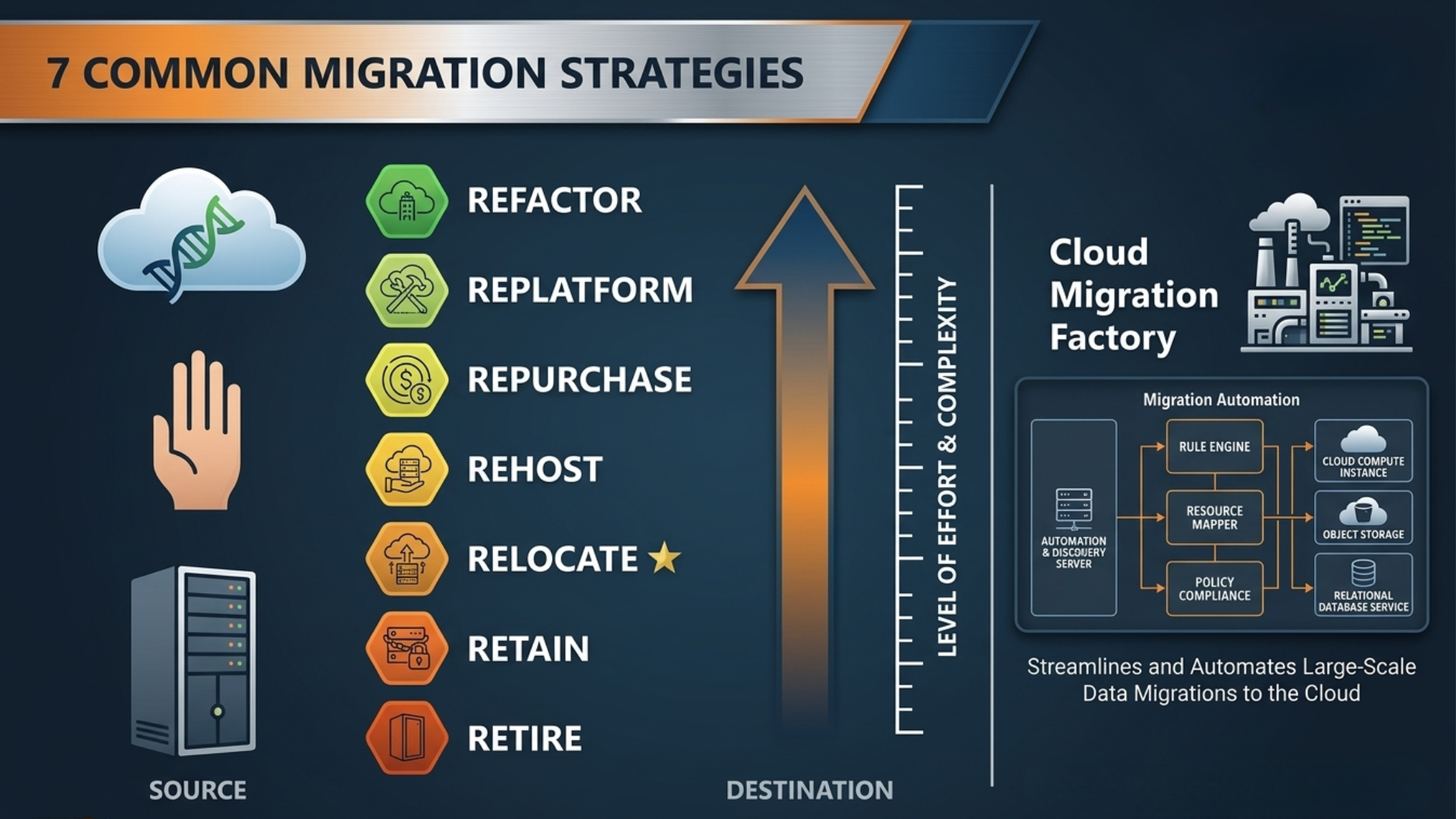
A successful mainframe to cloud migration begins with selecting appropriate strategies for each workload. AWS’s 7 Rs framework provides a structured approach:
- Rehost (lift-and-shift): Move applications to AWS with minimal changes, often using EC2 instances or managed runtimes for rapid value.
- Replatform: Optimize for the cloud by moving databases to Amazon RDS, refactoring batch jobs, or containerizing applications while preserving core logic.
- Refactor (re-architect): Redesign into cloud-native microservices using Java, Python, or serverless for maximum agility and innovation.
- Repurchase: Replace legacy functionality with SaaS solutions where business needs allow.
- Retire: Decommission unused or redundant applications identified during assessment.
- Retain: Keep select workloads on-premises or in hybrid mode temporarily due to complex dependencies or regulatory reasons.
- Relocate: Shift VMware-based environments smoothly to AWS VMware Cloud.
Our experts work with your teams to evaluate workloads holistically, prioritizing based on business value, complexity, and risk. Our legacy software modernization company services guide these decisions.
The three-phase AWS migration methodology
We employ a proven three-phase methodology - Assess, Mobilize, and Migrate & Modernize, inspired by AWS Migration Acceleration Program (MAP) principles. This structured approach reduces risk, ensures alignment with business goals, and facilitates incremental value delivery.
Phase 1: Assess – Laying a strong foundation
Comprehensive discovery is critical for mainframe environments, which often involve decades of accumulated complexity.
Key activities include:
- Full inventory of applications, databases (Db2, IMS, VSAM), batch processes, CICS transactions, and integrations.
- Dependency mapping, performance benchmarking, and data flow analysis.
- Technical debt assessment and code quality reviews.
- Business case development, including total cost of ownership (TCO), ROI projections, and risk analysis.
- Organizational readiness evaluation covering skills gaps, change management, and governance.
Our cloud consulting expertise delivers detailed assessments using tools like AWS Migration Hub, mainframe discovery scanners, and automated analyzers. This phase typically uncovers quick wins such as retiring unused systems or replatforming straightforward workloads.
Download our free cloud migration guide for detailed assessment checklists and templates.
Phase 2: Mobilize – Planning and preparation
With insights from the assessment, teams build detailed execution plans:
- Design secure AWS landing zones, networking, identity management, and hybrid connectivity.
- Define migration waves, prioritization criteria, and detailed runbooks.
- Establish governance, security controls, compliance frameworks, and monitoring foundations.
- Create a Cloud Center of Excellence (CoE), deliver training, and address skills gaps through targeted programs.
- Conduct pilot migrations to validate tools, processes, and expected outcomes.
- Develop risk mitigation and contingency plans, including rollback strategies.
Our AWS Well-Architected review services ensure architectures align with security, reliability, performance, and cost best practices from the outset.
Phase 3: Migrate & Modernize – Execution and continuous improvement
Execute migrations in controlled waves while progressively modernizing:
- Implement selected strategies using AWS services such as AWS Mainframe Modernization for replatforming and automated refactoring.
- Replicate data with near real-time change data capture (CDC) to minimize downtime.
- Perform extensive testing: unit, integration, performance, parallel runs, and user acceptance.
- Manage cutovers with automated orchestration and rigorous monitoring.
- Transition to cloud operations with Infrastructure as Code, CI/CD pipelines, and automated scaling.
Post-migration, focus on optimization through database modernization, DevOps automation, microservices adoption, and serverless architectures. Services like our cloud operations management and cloud cost optimization ensure sustained efficiency and innovation.
Detailed step-by-step practical roadmap
Here is an expanded, actionable roadmap your teams can adapt:
- Secure executive sponsorship and form a cross-functional team: Include mainframe SMEs, cloud architects, application owners, security, compliance, and business stakeholders.
- Conduct in-depth discovery workshops: Map all workloads, interfaces, and data dependencies over several weeks.
- Prioritize applications: Score based on business criticality, technical complexity, risk, and potential ROI.
- Develop granular migration and modernization plans: Include timelines, resource needs, success metrics, and communication plans.
- Execute pilot migrations: Start with low-risk workloads to refine processes and build confidence.
- Migrate in prioritized waves: Monitor closely, optimize, and document lessons learned.
- Validate and cut over: Use blue-green or parallel operations for zero-downtime transitions.
- Decommission legacy infrastructure: After stability is confirmed.
- Measure outcomes and optimize continuously: Track KPIs such as cost savings, performance improvements, uptime, and developer productivity.
For environments with VMware components, leverage our VMware to AWS migration expertise.
Comprehensive risk mitigation strategies
Mainframe migrations involve notable risks including downtime, data inconsistencies, performance degradation, extended timelines, and organizational resistance. Proven mitigation approaches include:
- Adopt phased, wave-based execution rather than big-bang cutovers.
- Implement automated testing suites and parallel system running for validation.
- Use robust data validation, backup, and reconciliation processes.
- Invest heavily in change management, training, and communication.
- Partner with experienced providers to apply battle-tested methodologies and tools.
Additional insights are available in our article on on-premise to cloud migration.
Real-world success stories and case studies
We have guided multiple enterprises through similar transformations. Review our on-premise to cloud migration case study for measurable results in cost reduction and performance gains.
Industry examples using AWS Mainframe Modernization demonstrate successful replatforming and refactoring patterns across financial services, healthcare, and other sectors.
Overcoming common challenges in mainframe migrations
- Legacy code complexity: Apply automated analysis and incremental refactoring supported by AWS tools.
- Data migration complexities: Utilize CDC and specialized file transfer tools for high-fidelity transfers.
- Integration and hybrid operations: Build API layers and event-driven bridges.
- Regulatory compliance: Design with security and governance in mind from day one.
Post-migration optimization and long-term cloud-native evolution
Migration is not the end but the beginning of ongoing modernization. Embrace database modernization, cloud-native web development, serverless backend development, and SaaS suite capabilities to drive further innovation.
Implement regular AWS Well-Architected reviews, FinOps practices, and DevOps automation for continuous improvement. Our cloud-native app development services help unlock new digital customer experiences.
Future trends in mainframe to cloud migration
Emerging technologies like agentic AI for automated code transformation, advanced data replication, and hybrid cloud strategies are accelerating modernization. Organizations that combine migration with broader digital transformation initiatives position themselves for sustained competitive advantage.
Start your mainframe to cloud journey with Applify
Mainframe to cloud migration is a strategic enabler of enterprise agility and innovation. With Applify’s cloud migration company expertise and cloud modernization company services, your organization can navigate this journey confidently.
Contact our team for a no-obligation assessment or explore our cloud migration ebook to get started.
You may also like