Mainframe Modernization on AWS: Patterns, tools, and lessons from the field

Mainframe systems have powered mission-critical operations in finance, healthcare, insurance, and government for decades. Yet their high operational costs, lack of agility, and talent shortages drive enterprises toward the cloud. Mainframe modernization on AWS offers a structured path to reduce costs, accelerate innovation, and unlock cloud-native capabilities while preserving decades of embedded business logic.
This technical deep dive equips enterprise architects with practical patterns, AWS-native tools, and field-tested lessons. At Applify, we specialize in end-to-end cloud migration and modernization services, helping large organizations execute complex legacy-to-AWS transformations with minimal risk.
Why mainframe modernization on AWS matters for enterprises
Mainframes deliver unmatched reliability for high-volume transaction processing but come with significant drawbacks. Monthly MIPS-based licensing, rigid batch schedules, and scarce COBOL/PL/I expertise create bottlenecks. Organizations face pressure to modernize for digital agility, real-time analytics, and AI integration.
AWS addresses these challenges through managed and self-managed runtimes, automated refactoring, agentic AI capabilities, and hybrid coexistence strategies. Benefits typically include 30-70 percent infrastructure cost reduction, faster release cycles via DevOps practices, and seamless integration with services like Amazon Aurora, Amazon EKS, AWS Lambda, and Amazon Bedrock for generative AI.
Enterprise architects must balance risk, speed, and business continuity. Successful programs combine thorough assessment, incremental migration, targeted modernization, and ongoing optimization. As of 2026, AWS has evolved its offerings, with AWS Transform for mainframe introducing agentic AI to accelerate analysis, planning, refactoring, and reimagining phases, often reducing timelines from years to months.
Our cloud consulting services consistently demonstrate that early strategic alignment between business objectives and technical patterns yields the highest ROI.
Common modernization patterns for mainframe workloads
Enterprise architects typically evaluate several patterns based on application complexity, business criticality, timeline, and risk tolerance.
- Replatforming (lift-and-shift with minimal changes)
Recompile COBOL/PL/I applications on AWS managed or self-managed runtimes while modernizing infrastructure. This delivers quick wins in cost and operations without altering core logic. AWS Mainframe Modernization with Rocket Software (formerly Micro Focus) supports this by providing compatible execution environments on Amazon EC2 or containerized setups. It preserves programming languages while enabling cloud DevOps native operations.
- Automated refactoring
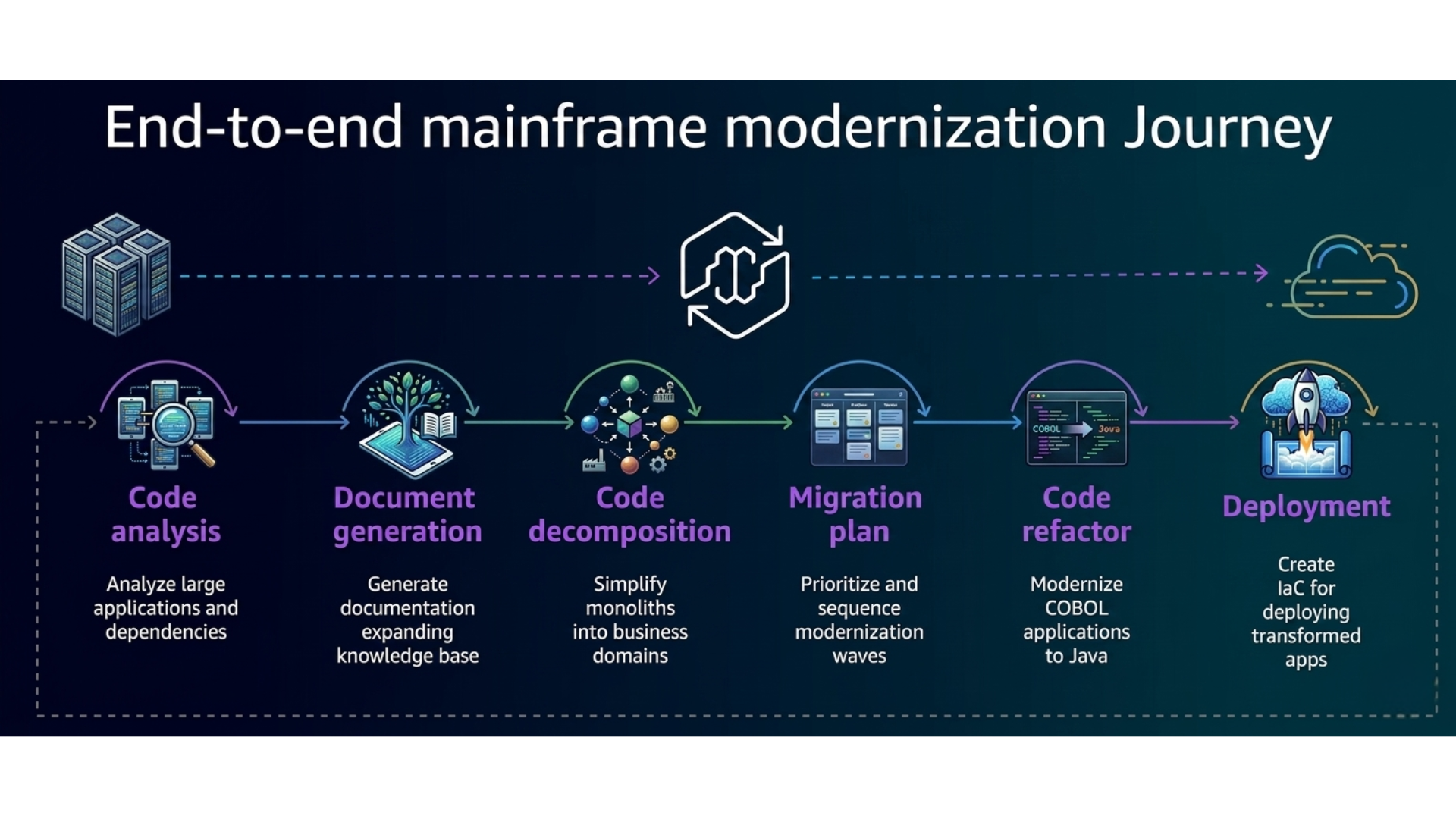
Convert legacy code to modern languages and architectures. AWS Blu Age, now integrated into AWS Transform for mainframe, transforms COBOL into Java Spring Boot applications, mapping VSAM/IMS/DB2 to relational or NoSQL stores. This pattern unlocks microservices, containers, serverless, and cloud scalability. Model-driven transformations avoid common pitfalls like “JOBOL” (COBOL-in-Java), producing clean, object-oriented code.
- Rehost or emulate
Run mainframe workloads on AWS with emulators for the fastest path. Suitable for non-strategic applications or interim steps before deeper modernization. Tools like AWS Application Migration Service (AWS MGN) facilitate server replication and cutover.
- Strangler fig pattern (incremental modernization)
Gradually replace legacy components with cloud-native services while maintaining hybrid integration via APIs, event buses, or change data capture (CDC). This minimizes disruption for large monoliths and supports phased business value delivery.
- Data liberation and augmentation
Extract and replicate data to AWS using AWS Database Migration Service (DMS) or CDC tools like Precisely, enabling modern analytics, data lakes, and AI without full application migration. This pattern is particularly valuable for augmenting mainframe functions with cloud innovation.
- Reimagine
Completely rethink applications using agentic AI in AWS Transform for mainframe to move to event-driven, microservices, or serverless architectures.
We recommend starting with a detailed assessment to select the optimal pattern per workload. Our legacy software modernization expertise ensures the right fit for each enterprise context.
AWS tools and services for mainframe modernization
AWS provides a mature, integrated toolchain tailored for enterprise-scale transformations.
AWS Mainframe Modernization service and AWS Transform for mainframe
This platform supports replatforming and automated refactoring. Note that as of late 2025, the fully managed runtime experience is no longer open to new customers; focus has shifted to self-managed runtimes and AWS Transform for mainframe. Key capabilities include:
- Replatform with Rocket Software for COBOL recompilation and execution.
- Automated refactoring powered by Blu Age technology.
AWS Transform for mainframe with agentic AI
Built on AWS’s extensive migration experience, this service uses agentic AI to streamline analysis, planning, code refactoring, and application reimagining. It accelerates projects by automating dependency mapping, business rule extraction, and transformation, significantly cutting timelines and costs.
AWS Blu Age for automated refactoring
Blu Age excels at converting COBOL, PL/I, NATURAL, and other legacy languages into maintainable Java applications. It handles data files (VSAM → relational), screens (BMS → modern web frameworks like Angular/React), and batch jobs (JCL → AWS Step Functions or AWS Batch). Blu Insights (now part of AWS Transform) supports analysis, dependency mapping, and custom refactoring rules.
Enterprise architects appreciate its support for Telon-generated code, performance optimization, and integration with Amazon Q Developer for further AI-assisted refinements.
AWS Application Migration Service (AWS MGN)
AWS MGN facilitates lift-and-shift of servers and workloads to AWS, useful for initial rehosting or hybrid phases. It provides automated replication, cutover orchestration, and post-migration optimization. Combine it with mainframe-specific tools for comprehensive strategies.
Supporting AWS services
- AWS Database Migration Service (DMS) and Schema Conversion Tool (SCT): For homogeneous or heterogeneous database migrations from DB2/IMS to Amazon Aurora or RDS.
- Amazon Q Developer and AWS CodeWhisperer: Assist with code understanding, generation, and optimization during refactoring.
- AWS Well-Architected Framework: Guides security, reliability, performance, and cost optimization. Our AWS well-architected review services help validate architectures.
We integrate these tools into proven delivery frameworks. Explore our cloud modernization offerings for expert implementation.
Technical deep dive: COBOL refactoring and database modernization
COBOL refactoring involves several detailed phases that require careful planning:
- Discovery and analysis: Use Blu Insights or equivalent tools to map dependencies, identify dead code, assess complexity, and extract business rules. Agentic AI in AWS Transform enhances this with automated insights.
- Code transformation: Automated conversion to Java with business rule preservation. Custom rules handle proprietary macros, Telon patterns, or embedded SQL. The output follows Spring Boot best practices for maintainability.
- Data migration: Map hierarchical or flat files to Amazon RDS, Aurora PostgreSQL, or DynamoDB. Use AWS DMS for ongoing synchronization during transition, ensuring data consistency in hybrid environments.
- UI/UX modernization: Convert 3270 green screens to responsive web interfaces using modern frameworks, improving user experience and accessibility.
- Testing and equivalence: Rigorous functional, performance, regression, and parallel testing. Tools like AWS Mainframe Modernization support automated test case generation and validation against mainframe outputs.
Database considerations: Modernize from DB2/IMS to Aurora PostgreSQL or Amazon RDS for PostgreSQL for better scalability and managed operations. Implement data lakes for analytics using services highlighted in our cloud-based financial data lakes solutions. Handle challenges like embedded SQL, date logic quirks (e.g., Y2K remnants), and performance tuning of generated Java code through profiling, caching, query optimization, and asynchronous processing.
Additional depth comes from handling Assembler code conversion to COBOL or directly to modern languages, expanding talent pools.
Implementation best practices and lessons from the field
From numerous engagements, including those similar to our on-premise to cloud migration case study, key lessons and best practices emerge:
- Start with a proof of concept (PoC) on a non-critical module to validate patterns, tools, performance, and costs.
- Adopt DevOps and CI/CD early: Modernized applications thrive with pipelines on AWS CodePipeline, CodeBuild, and CodeDeploy, enabling frequent, safe releases.
- Hybrid integration during transition: Use Amazon API Gateway, Amazon EventBridge, Amazon MQ, and CDC for reliable communication between legacy and cloud components. The strangler fig pattern is highly effective here.
- Security and compliance: Leverage AWS IAM, encryption at rest/transit, AWS Security Hub, and services aligned with our cloud security for financial services and healthcare guidance.
- Talent and change management: Upskill teams on Java, cloud, and modern practices. Partnering with experts like us accelerates this through knowledge transfer.
Cost optimization: Right-size instances, use Savings Plans and Reserved Instances, implement auto-scaling, and monitor with AWS Cost Explorer and AWS Budgets. Our cloud cost optimization services deliver sustained savings post-modernization.
Performance equivalence: Address potential Java overhead through detailed profiling, connection pooling, batch processing redesign, and caching layers (e.g., Amazon ElastiCache).
Additional best practices include standardized development environments, identification of field-developed solutions, code compatibility fixes, and comprehensive testing strategies.
Challenges and mitigation strategies
Mainframe modernization projects face several common hurdles:
- Complexity and unknown dependencies: Mitigate with thorough automated analysis using AWS Transform and Blu Insights.
- Data consistency and volume: Use CDC and phased migration with dual writes or reads during cutover.
- Performance and latency: Conduct load testing and optimize iteratively; leverage AWS Graviton processors for cost-performance balance.
- Talent shortages: Combine refactoring (which brings modern skills) with training and expert partnerships.
- Business disruption risk: Employ strangler fig, parallel runs, and canary deployments.
- Cost overruns: Detailed estimation, PoCs, and continuous optimization prevent surprises.
Measuring success and post-modernization operations
Define KPIs early: infrastructure cost savings, transaction latency, deployment frequency, developer productivity, and business metrics like time-to-market for new features. Post-migration, leverage our cloud operations management for monitoring with Amazon CloudWatch, AWS X-Ray, and proactive optimization using AWS Compute Optimizer.
Modern applications open doors to microservices, event-driven architectures, and generative AI integrations. Explore our guide on application modernization for deeper insights.
How we deliver mainframe modernization on AWS
We combine deep AWS partnerships with proven methodologies in cloud services. Our services encompass assessment, migration via AWS database migration service expertise, VMware-to-AWS transitions where relevant, full modernization, and managed operations.
We have supported transformations documented in case studies like Godaddy to AWS migration and Paiverse cloud-to-cloud migration, bringing the same rigor, risk mitigation, and value realization to mainframe programs.
Our approach emphasizes minimal disruption, knowledge transfer, long-term value through cloud-native architectures, and continuous improvement.
Future trends in mainframe modernization
Looking ahead, agentic AI (as in AWS Transform), serverless integration, and deeper data analytics with Amazon SageMaker will further accelerate transformations. Enterprises will increasingly combine replatform for quick wins with refactoring and reimagining for strategic differentiation. Sustainability goals also favor cloud migration due to AWS’s efficient infrastructure.
Accelerate your mainframe journey with confidence
Mainframe modernization on AWS is no longer a distant goal but a practical, phased reality enabled by powerful tools like AWS Transform for mainframe, Blu Age technology, AWS MGN, and supporting services. Enterprise architects who select the right patterns and partner with experienced teams achieve faster time-to-value and sustainable competitive advantage.
Ready to assess your mainframe portfolio? Contact our cloud experts today. Download our cloud migration guide or explore the ebook on cloud migration for more insights. Let’s transform your legacy systems into agile, future-ready platforms.
You may also like