What Is Semantic Ontology, and Why Does Enterprise AI Need It?
AI can access your data and still miss how your business works. Discover how semantic ontology connects business concepts, relationships, and rules to give enterprise AI the context it needs for more reliable decisions.
Enterprise AI can pull in more data than ever. But access alone is not enough; a system also needs business context to reason well.
A team lead asks an AI assistant which customer orders are at risk because a supplier shipment is late. To answer this, the system needs procurement data, inventory levels, production plans, sales commitments, shipment status, and customer priority. It also needs to know how these pieces connect.
A search tool can find supplier documents. A dashboard can show delayed shipments. A language model can summarize both. The harder task sits underneath all three: linking a supplier to a part, that part to a work order, the work order to a product, and the product to a customer promise. The system also needs a clear meaning for "at risk."
A semantic ontology can help solve this problem. It gives software a structured map of business concepts and shows how those concepts relate, a machine-readable model of concepts, relationships, and rules. AI systems now reason across many domains and take action inside real workflows. This kind of model matters more every year.
What semantic ontology means in an enterprise AI architecture
A semantic ontology is a machine-readable model of a business domain's concepts, the relationships between them, and the rules that govern those relationships.
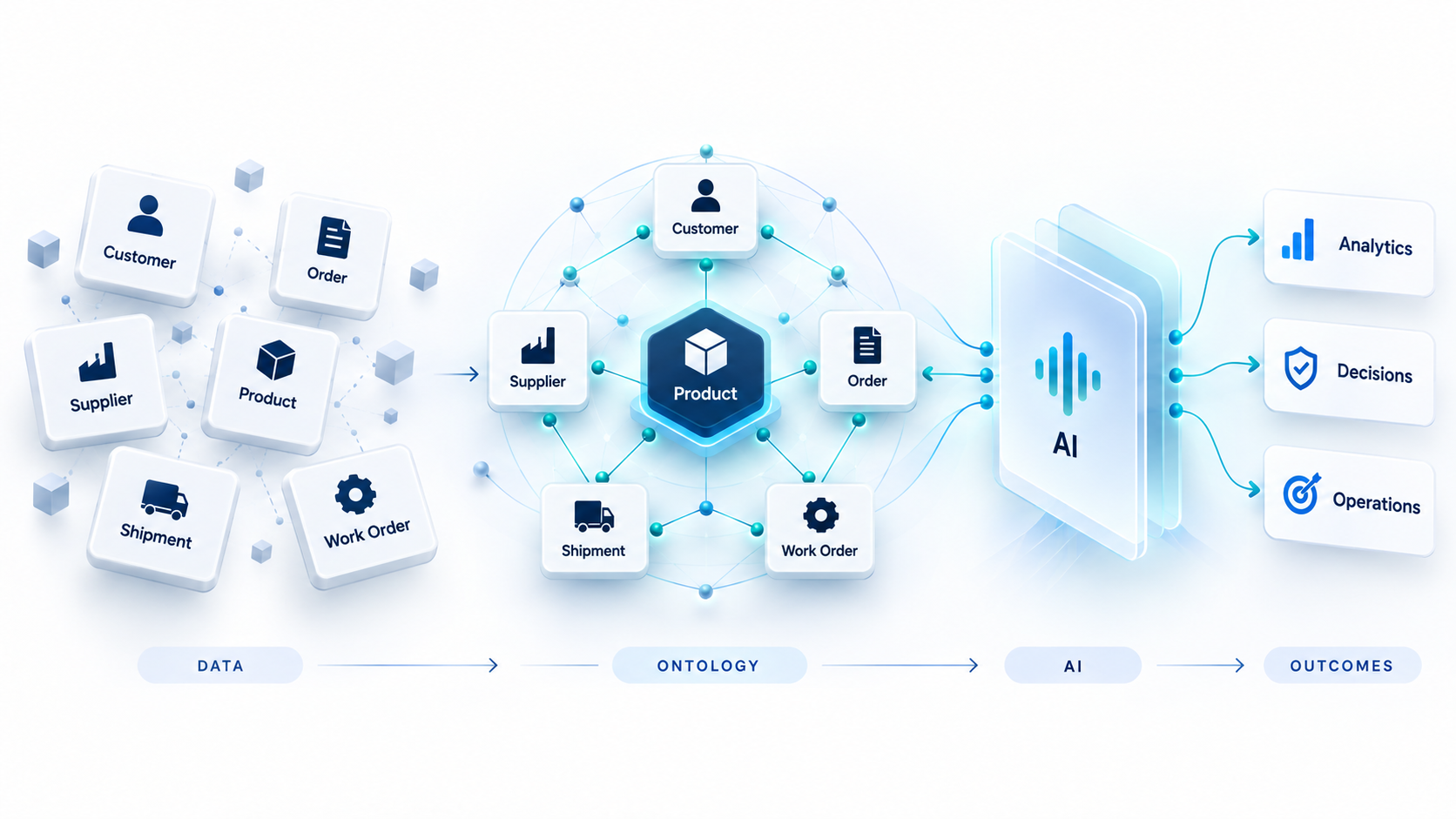
Take a manufacturing ontology. It could define Customer, Order, Product, Supplier, Component, Work Order, Shipment, and Contract, then state a simple chain: a customer places an order, an order contains a product, a product depends on a component, and a supplier provides that component.
This model gives each relationship formal meaning that software can read directly. It can also express rules like classification, inheritance, and limits. AI systems get a governed view of the business instead of guessing at every link on their own.
Enterprise AI is moving from data access toward business context
Data platforms have spent years improving storage, transformation, governance, cataloging, and query speed. Human analysts benefit most from these tools, since they already bring deep business context to their work.
An analyst may know one team calls a billing account a "customer," while another team uses the same word for a parent company. She may know which status field is stale, which records to skip, and which metric definition fits a given report.
AI agents don't carry that knowledge in. When an agent reasons through a process, gaps in context matter, a missing link can lead to a confident but wrong answer.
The real question goes past data access: can AI read the business behind the data, and apply the rules that shape a decision?
Data access gives AI information. Business context gives that information meaning.
RAG retrieves useful information while ontology structures business meaning
Retrieval-augmented generation still holds real value for grounding language models in enterprise information. A policy assistant can pull the right handbook section and hand it to the model.
Operational questions often need more. Take this one: "Which high-priority orders could miss their date because Supplier A is five days late?" Documents may mention the supplier, but the full answer depends on several linked facts and live conditions.
The AI may need to trace a chain from Supplier to Component to Work Order to Product to Customer Order. It may also need current inventory, backup supplier options, production schedules, shipment estimates, and order priority.
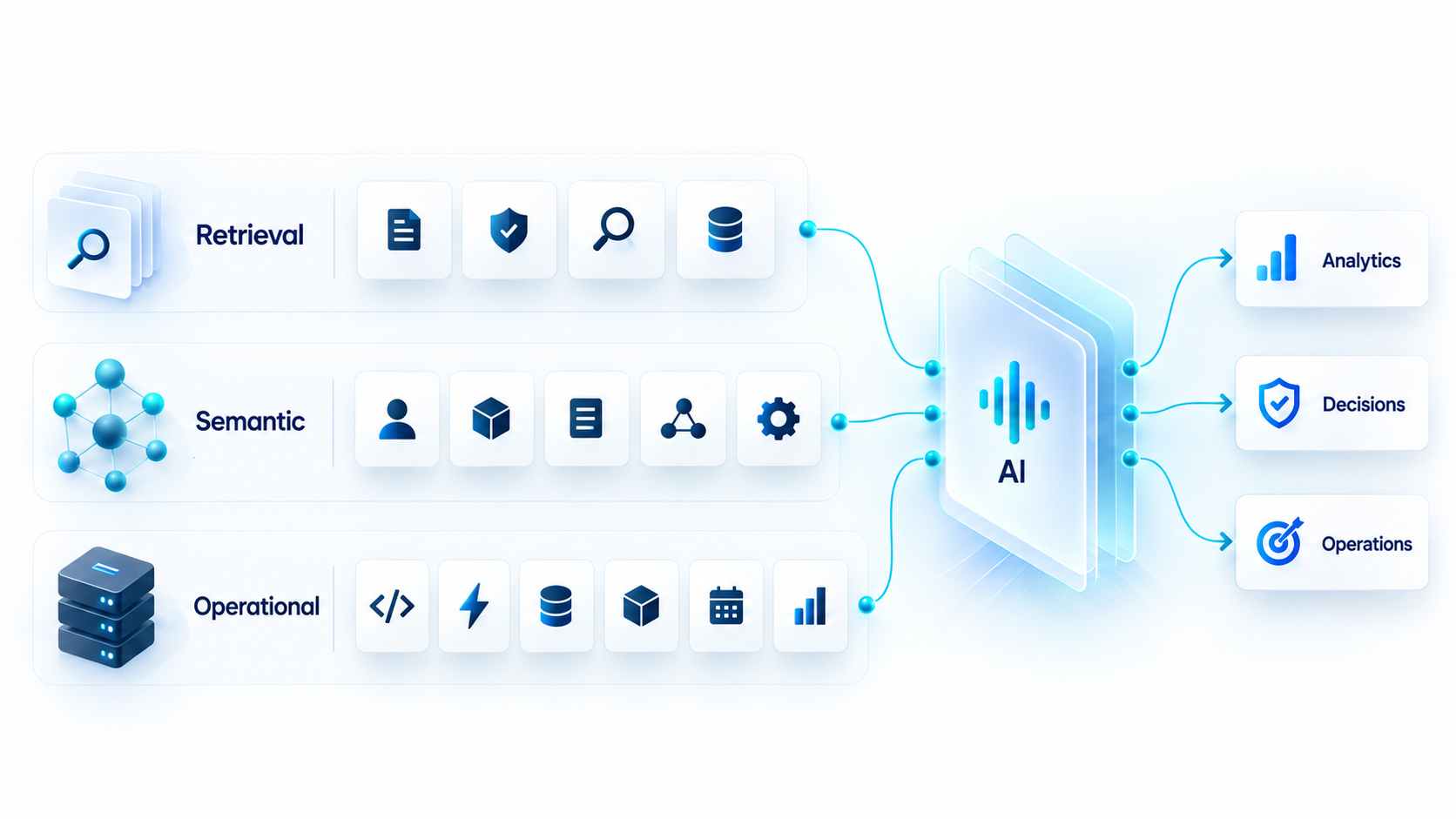
Three context layers help split these needs apart. Retrieval context decides what information the model gets. Semantic context explains what that inform
ation means. Operational context supplies live state through APIs, events, and live systems.
RAG drives retrieval context, and semantic ontology builds semantic context, while operational systems supply the state that shifts by the minute. The best enterprise use cases often need all three.
Retrieval, semantic, and operational context each play a different role in enterprise AI reasoning.
Semantic ontology works beside the data capabilities enterprises already use
Ontology sits next to other data tools, and each one answers a different question.
A schema covers fields and data types. A catalog helps teams find data assets. A glossary sets shared terms across the company. A semantic model defines meaning for reports. A knowledge graph maps connected facts. Vector search finds similar content, and RAG feeds evidence to a language model. Ontology formalizes meaning, relationships, and rules for software.
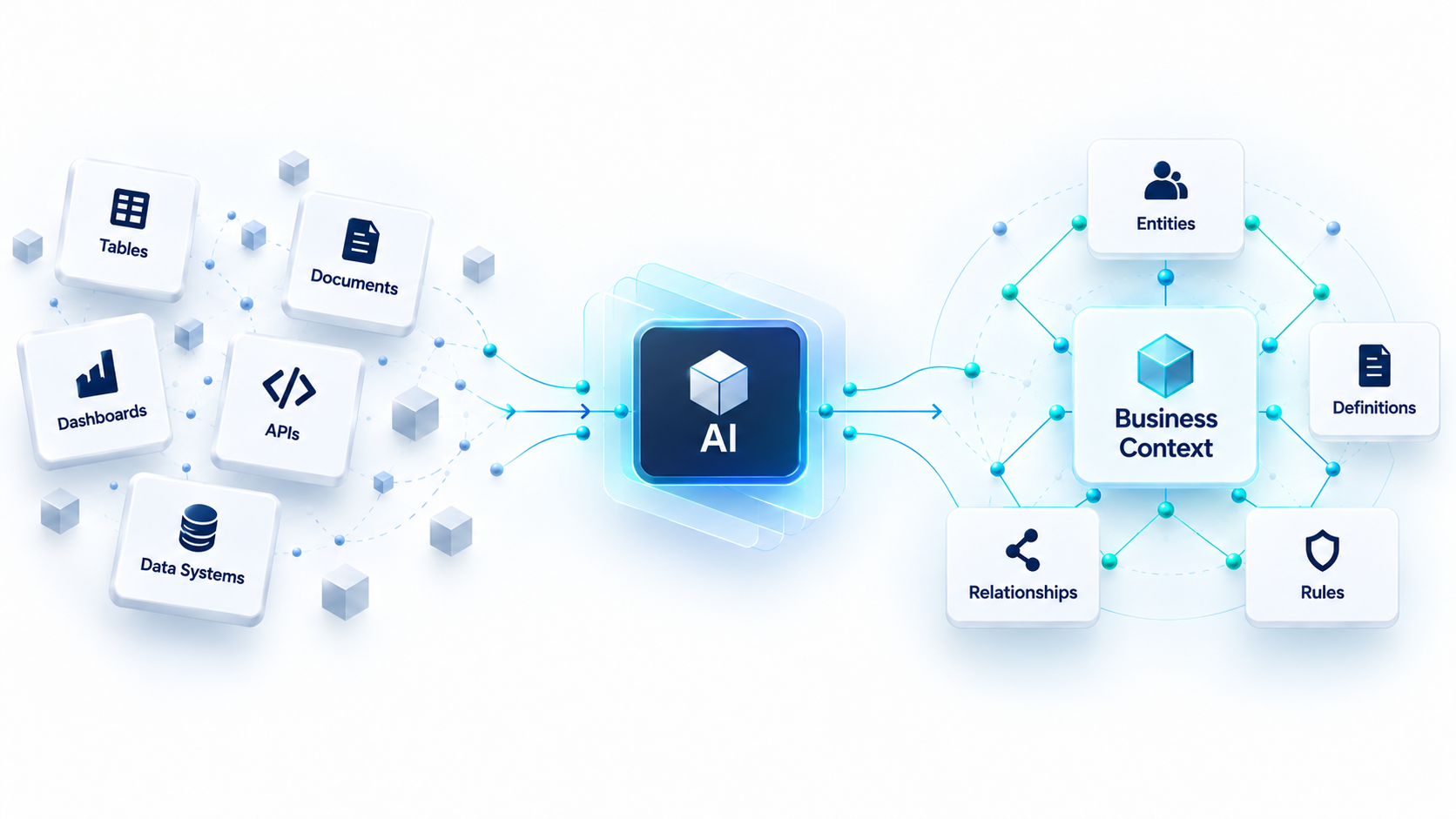
The goal is to link these tools together wherever AI needs solid business context. A mature setup ties ontology concepts to tables, columns, APIs, events, graph entities, and metrics.
Ontology and semantic layers solve related but different problems
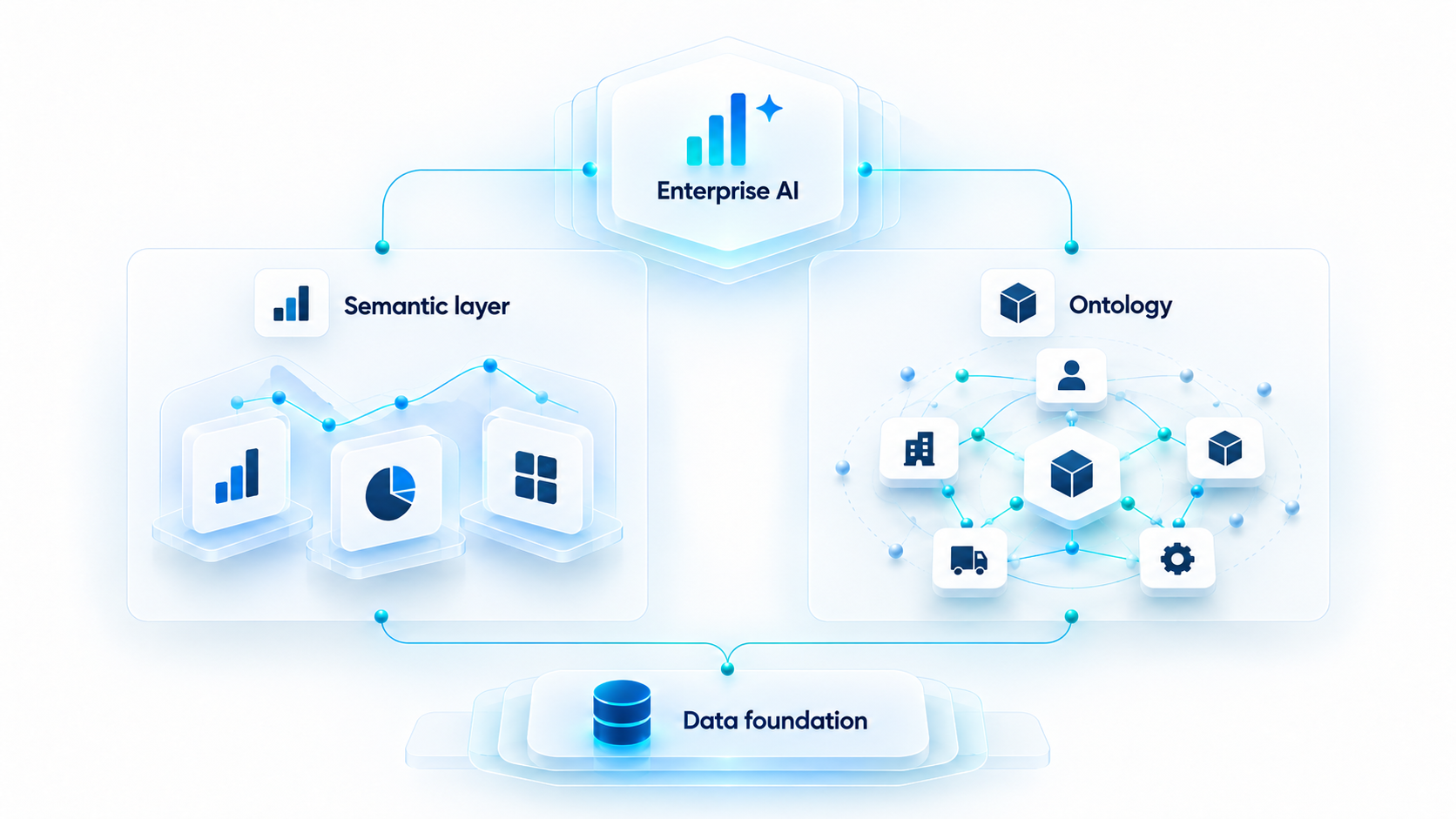
People often ask "ontology vs semantic layer." Both give business meaning to data, but their scope tends to differ.
A semantic layer usually centers on analytics. It can define revenue, gross margin, customer acquisition cost, and order value, with clear metric names and hierarchies that matter for reporting.
An ontology reaches into a broader domain model. It can define what a Customer, Account, Contract, Order, Product, Supplier, and Shipment means, then set the rules that govern how these entities relate.
Many enterprise AI setups can benefit from both. Metrics answer questions about measurement, while ontology helps the system grasp the entities behind those numbers.
Semantic layers organize analytical meaning. Ontologies formalize broader domain entities, relationships, and rules.
Ontology and knowledge graphs provide different layers of connected meaning
Ontology and knowledge graphs work closely together, but they play different roles.
An ontology can define that a customer places an order. A knowledge graph records the real case: Acme Ltd placed Order #4821. The ontology supplies the reusable model, and the graph records real facts pulled from business data.
Graph tools can hold both schema and instance data, which can blur the line in practice. The real question is whether the relationships carry governed meaning. A connected graph without shared definitions still leaves an AI system guessing.
Formal reasoning gives semantic ontologies additional value for AI agents
Relationships grow more useful with formal rules attached. Ontology languages can support inference, which lets a system derive a fact it never stored directly.
Say an ontology defines GoldCustomer as a type of PreferredCustomer. If Customer ABC gets classified as a GoldCustomer, software can infer that Customer ABC also belongs to the PreferredCustomer class. The same logic can support other rules too.
For enterprise AI, this saves real work. The language model no longer has to rebuild logic from scratch each time - key rules can live in the ontology, where AI services query them directly.
Semantic readiness should become part of enterprise AI readiness
AI-readiness checks often cover data quality, governance, security, infrastructure, and integrations. These checks still matter, but they miss one thing: whether AI reads the business consistently.
A company can run clean pipelines and strong datasets while different systems still clash on basic terms. What counts as a "customer"? What counts as an "account" or a "transaction"? Technical readiness can hide weak semantic readiness underneath it.
A semantic-readiness check looks at a few things: whether key entities have consistent definitions, whether relationships are explicit, whether entity resolution works across systems, and whether software can read the key rules. It also checks whether provenance and freshness are visible, and whether definitions have named owners and version control.
The check can go further and test whether the AI can explain which facts and rules shaped its answer. This matters more as AI touches customers, finance, and regulated work.
Ontology adds the strongest value in high-context AI use cases
Some AI use cases stay simple and gain little from a formal ontology. Handbook search mostly needs strong retrieval and permissions. Ticket summarization mostly needs classification and a language model. Revenue reporting often fits an existing semantic model.
The case for ontology grows under certain conditions: a use case spans several business domains, needs deep relationship tracing, applies strict business rules, needs an audit trail, resolves the same entity across systems, or gives an agent power to act.
Start with high-value decisions first, then find the concepts and rules that need formal treatment. This keeps the model tied to real use cases and avoids building a broad ontology nobody uses.
Enterprises will likely combine explicit semantics with model inference
AI teams have two broad options today. They can encode meaning through ontologies, graphs, and rules, or hand raw material like schemas, documents, and memory to a language model and let it interpret meaning as it runs.
Explicit semantics build consistency and clear audit trails. Dynamic inference saves modeling effort and adapts fast to new information.
A practical setup splits the work: high-risk rules and policies get formal treatment, while lower-risk context stays open for the model to interpret. Draw this line by weighing what a wrong inference costs and how often the meaning changes.
AI can reduce the manual effort required to create ontologies
Ontology work has long meant heavy manual effort. Experts had to define concepts and relationships by hand, then map constraints and build governance manually too.
Newer tools can generate draft ontology structures by pulling from catalogs, schemas, semi-structured data, documents, and language-model-assisted input. Experts then review, refine, and approve these drafts.
Human review still matters, since a generated link can look right and still be wrong. AI can shift some of the work from manual writing to guided review, reducing ontology-authoring effort when experts validate the drafts.
Semantic ontology needs lifecycle governance like other enterprise assets
Business definitions shift over time as products, operating models, policies, and systems change. An ontology needs steady ownership to keep pace.
Useful governance tools include versioning, approvals, change comparison, publishing, rollback, provenance, mappings, and testing. Clear ownership matters most of all - these tools help teams track which definition an AI system used, and when.
Governance matters even more when agents act on ontology data. A stale rule can shift a decision even when the underlying data stays fresh.
The AI data foundation is evolving into an enterprise context foundation
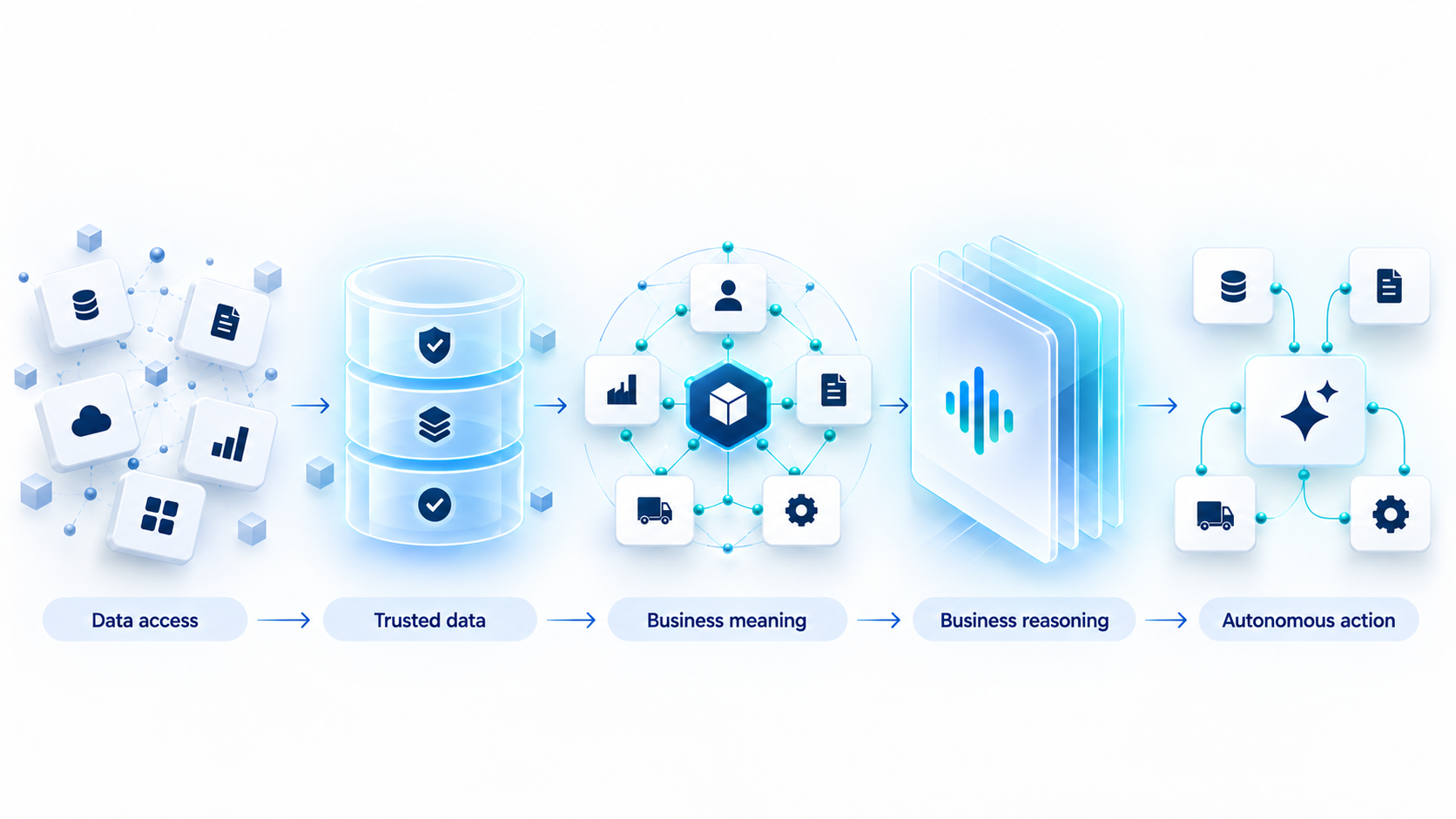
Data architecture has spent years on access, trust, governance, and analytics. Agentic AI adds one more demand: software must now read business meaning with less human help.
A useful path runs through five stages: data access, trusted data, business meaning, business reasoning, and finally autonomous action. Each stage needs more context and control than the one before it.
Data access asks one thing: can AI reach the data? Trusted data asks if that data is reliable and cleared for use. Business meaning asks if AI grasps what the data represents. Business reasoning adds relationships and consequences, while autonomous action adds live state, policies, and controls.
Semantic ontology is especially useful in the middle stages, where it gives AI a structured way to read entities and rules before it acts.
As AI moves toward action, the architecture needs richer context at each stage.
Business context should guide the semantic architecture decision
Leaders face one core question: how much business meaning does a system need, and how does that answer decide how much the organization can trust its output?
Simple retrieval cases need light semantic modeling. Cross-domain reasoning needs more, and so do regulated decisions, complex dependencies, and autonomous workflows.
The field is moving toward a mix of tools: governed data, semantic models, ontologies, knowledge graphs, retrieval, operational APIs, provenance, business rules, and agent controls. Together, these form a machine-readable layer over scattered data.
The market still needs stronger proof here. Teams want clear numbers on cost and accuracy gains, the governance burden, and when ontology beats plain model inference. The direction is worth testing, since enterprises keep giving AI more responsibility inside core processes.
Build a data foundation that gives AI enough business context to reason
Enterprise AI often needs more than retrieval. It needs to grasp what information means, how entities relate, which rules apply, where data came from, and what holds true right now.
This capability rests on the architecture below the model. As organizations keep building generative and agentic AI, the strength of the data foundation will shape every decision AI supports.
Applify helps organizations build that foundation. We bring together data engineering, governance, semantic context, and AI-ready architecture. Get in touch to know how your data environment can support AI that reasons with stronger context, consistency, and control.