



.png)


Why traditional purchasing is breaking the GTM engine
Most enterprise deals do not fail because buyers do not want to buy. They fail, or stall, because the buying process was designed for a world that no longer exists. A world of annual contracts, single vendors, and procurement teams with the bandwidth to manage every step manually.
AWS data shows that embedding a Buy with AWS experience on a partner website can reduce procurement time by up to 60 percent. On a six-figure deal, that is not just efficiency. That is weeks of engineering time, sales resource, and executive attention recovered and redirected.
Two mechanisms in particular are changing how this plays out in practice: Buy with AWS and the AWS Marketplace Channel Partner Private Offer, known in the industry as CPPO. They solve different problems, at different stages of the deal. Understanding both, and how they interact, is increasingly a competitive requirement for ISVs and channel partners operating in the cloud GTM space.
The market signal that makes this urgent
$163B projected hyperscaler marketplace GMV by 2030, with AWS leading by a considerable margin (Omdia/Canalys via PartnerInsight, 2025)
Three years ago, Canalys (now Omdia) forecast that hyperscaler marketplaces would reach $85 billion by 2028. That forecast has since been revised upward to $163 billion by 2030. The acceleration reflects a fundamental shift in how enterprise software is being evaluated, approved, and purchased.
Omdia chief analyst Jay McBain, one of the most cited voices on cloud partner ecosystems, notes that by 2030, 59% of marketplace deals will include or be led by channel partners. For ISVs building their go-to-market motion today, that is not a trend to monitor. It is an architecture decision that affects how deals are structured right now.
99% of the top 1,000 AWS customers had at least one active Marketplace subscription in 2024 (AWS Marketplace Center of Excellence, 2024)
AWS Marketplace is not a listing platform anymore. For the buyers that matter most to most ISVs, it is a primary procurement channel with existing governance, existing billing relationships, and, increasingly, existing committed spend that needs to be deployed against qualified solutions.
What is 'Buy with AWS'?
Most buyers do not begin inside a marketplace. They start on a vendor or partner website, where they read documentation, compare pricing, and form intent. The problem has historically been what happens at the moment that intent is strongest: the buyer is pushed off-site to complete the purchase elsewhere.
That friction has a cost. Context switches at the point of highest intent are where deals stall. The buyer has to re-engage procurement, re-enter their AWS account details, or wait for a sales rep to follow up with a link. Each step is a moment where momentum is lost.
Closing the gap between intent and action
Buy with AWS closes that gap by allowing ISVs and partners to embed an AWS-native purchasing experience directly on their website. The buyer can move from interest to subscription without leaving the page. The transaction runs through AWS Marketplace, so all existing billing governance, security controls, and committed spend eligibility remain intact.
What changes is not the mechanics of the transaction, but the felt experience of the purchase. Buyers using committed AWS spend, or operating within an AWS Enterprise Discount Program, can apply that spend against the purchase immediately, without a separate negotiation or a delay while procurement verifies budget availability.
From a partner visibility standpoint, Buy with AWS also solves a longstanding attribution problem. When buyers leave a partner site to complete a purchase, what happens next is often invisible. Keeping the interaction on-site gives partners clear data on where interest builds, where it stalls, and where conversion happens. That signal has direct implications for pipeline management and GTM investment decisions.
What is CPPO?
Channel Partner Private Offers operate on a different dynamic. Where Buy with AWS accelerates the self-serve path, CPPO is designed for the more complex, relationship-mediated deals that still represent the majority of enterprise software revenue.
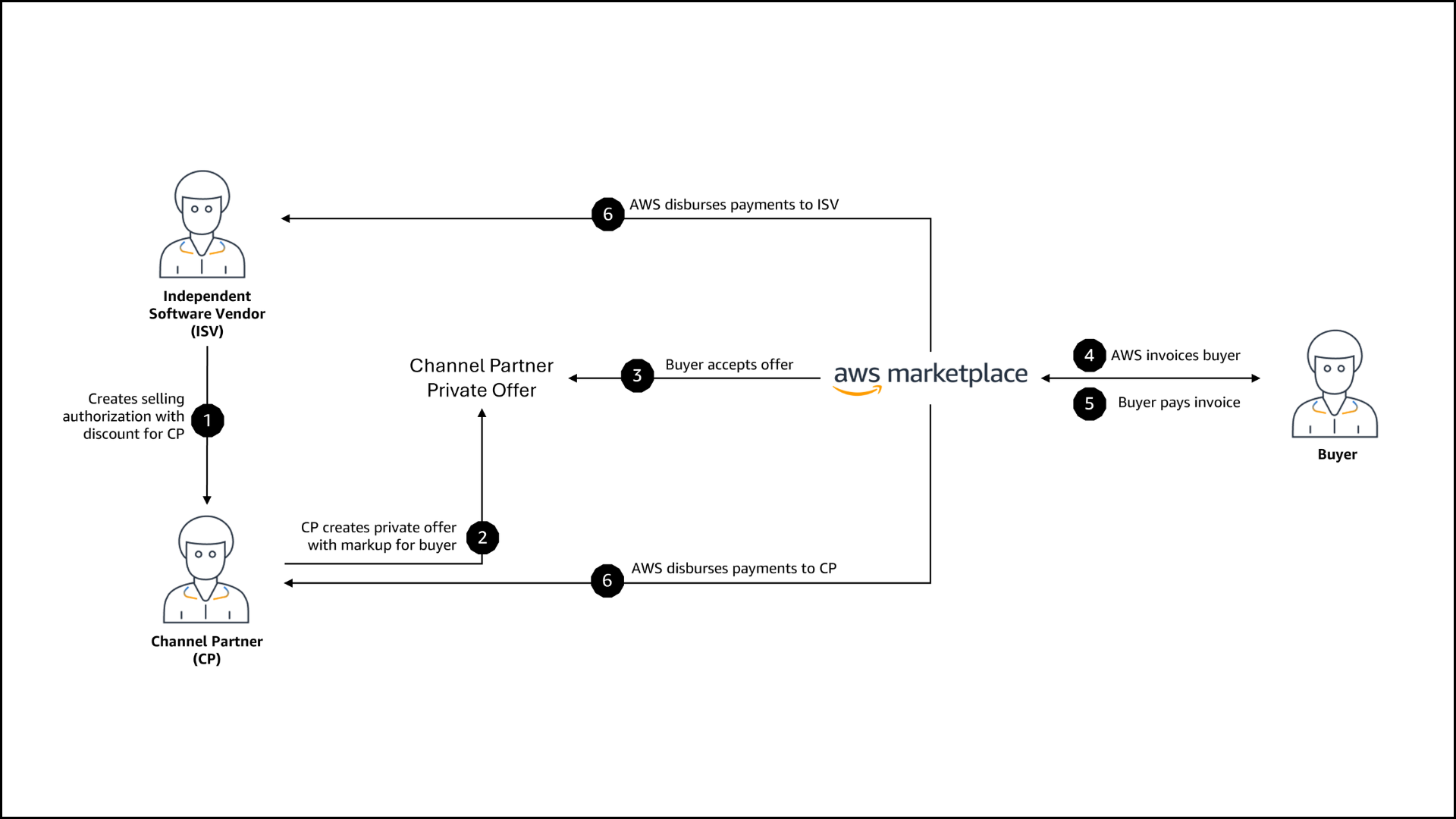
The core mechanic is straightforward: an ISV authorises a channel partner to resell their software on AWS Marketplace, extending wholesale pricing so the partner can construct a custom offer for the end customer. That offer can include modified pricing, amended contract terms, bundled implementation services, and ongoing support, all presented as a single, coherent package.
2x CPPO private offers are, on average, twice the deal size of direct-to-customer private offers (PartnerInsight / AWS Marketplace data, 2025)
Why partner-led deals are structurally faster
For buyers, this changes the felt complexity of the purchase. Instead of managing separate conversations with the software vendor, the implementation partner, and their own procurement team, they work with one partner who already understands their environment and has structured an offer that reflects their specific constraints. AWS still handles billing, tax calculation, and payment distribution in the background, so the administrative overhead on all sides is reduced.
For ISVs, CPPO removes one of the most common barriers to closing partner-influenced deals: the moment when the partner and the vendor are both trying to own the commercial relationship, and the deal stalls in the middle. With CPPO, roles are defined within the same commercial framework. The ISV sets the floor. The partner shapes the offer. The customer buys from a trusted relationship. Everyone operates within AWS's billing infrastructure.
The committed spend dynamic that most ISVs are underestimating
There is a commercial mechanic underneath both Buy with AWS and CPPO that does not get enough attention in most explanations of these tools: committed cloud spend.
Enterprise customers who have signed AWS Enterprise Discount Programs or made cloud commitment agreements have a budget allocated to AWS services that they need to deploy. Purchasing software through AWS Marketplace counts against that commitment. That means a buyer evaluating two solutions, one available on AWS Marketplace and one requiring a separate procurement process, has a structural financial reason to prefer the Marketplace option, independent of any feature comparison.
For ISVs without a Marketplace listing, this is increasingly a disqualifier at the procurement stage, not the evaluation stage. The buyer has already decided. The purchasing mechanism is what fails them. Both Buy with AWS and CPPO are designed to ensure that the purchasing mechanism does not become the reason a deal does not close.
What to watch: common implementation mistakes
LaunchX works with ISVs and channel partners navigating their first and their fiftieth AWS Marketplace transactions. Three patterns come up repeatedly as sources of avoidable friction.
- Pricing strategy for CPPO wholesale rates: ISVs often set wholesale margins that make sense for direct sales but create insufficient margin for partners to bundle services competitively. This gets renegotiated, which slows the first few CPPO deals and erodes partner confidence. Set the floor with the partner's commercial model in mind from the start.
- Buy with AWS contract entitlement mapping: embedding the button is the easy part. Mapping entitlements from the AWS Marketplace transaction to the vendor's provisioning and billing systems is where implementation delays typically occur. Validate this end-to-end before going live.
- Co-sell alignment before CPPO launch: CPPO works best when the ISV and partner have a shared pipeline, not just a pricing agreement. ISVs that launch CPPO without a co-sell motion in place find that partners bring the mechanism but not the deals.
The strategic implication for ISVs and partners in 2026
Canalys research cited by AWS shows that 80% of partners now see AWS Marketplace as a key part of their co-sell motion, with 65% reporting higher close rates and 54% seeing larger deal sizes. These are not marginal improvements. They reflect a structural shift in where and how enterprise software decisions get made.
The ISVs and partners that are capturing this shift are not necessarily the ones with the best products. They are the ones whose purchasing experience matches how enterprise buyers actually want to buy: using existing infrastructure, within existing budget frameworks, through trusted relationships that reduce the internal coordination cost of a new vendor.
Buy with AWS and CPPO are not features. They are a GTM architecture. The question for any ISV or partner reading this is not whether these tools are relevant to their market. At the scale AWS Marketplace is operating, they almost certainly are. The question is how much of the deal velocity advantage is being left on the table by not having them embedded in the commercial motion yet.
For ISVs evaluating their Marketplace strategy, the LaunchX readiness assessment provides a structured readiness check across listing quality, co-sell posture, CPPO infrastructure, and committed spend alignment. It takes 15 minutes and produces a prioritised action plan.
Frequently asked questions
Q: What is the difference between a standard private offer and a CPPO on AWS Marketplace?
A: A standard private offer is a direct negotiation between an ISV and a customer. A CPPO involves a channel partner as the seller of record, allowing them to customize pricing, bundle services, and manage the commercial relationship. The transaction still runs through AWS Marketplace, but the partner constructs and owns the offer.
Q: Can customers use their committed AWS spend when buying through CPPO?
A: Yes. Purchases made through CPPO on AWS Marketplace count against a customer's committed cloud spend, including Enterprise Discount Program commitments. This is one of the primary commercial advantages of the CPPO model for buyers with pre-committed budgets.
Q: How long does it take to set up Buy with AWS on a partner website?
A: The technical integration of the Buy with AWS button is typically a matter of days. The more significant time investment is mapping the entitlement logic between the AWS Marketplace transaction and the vendor's provisioning system, which can take two to four weeks depending on the complexity of the product.
Q: Do ISVs lose visibility into the deal when a partner manages a CPPO?
A: No. ISVs retain visibility into transaction data through the AWS Marketplace management portal. The partner manages the commercial relationship and the offer construction, but the underlying transaction data, including pricing, contract duration, and customer identity, remains accessible to the ISV.


